
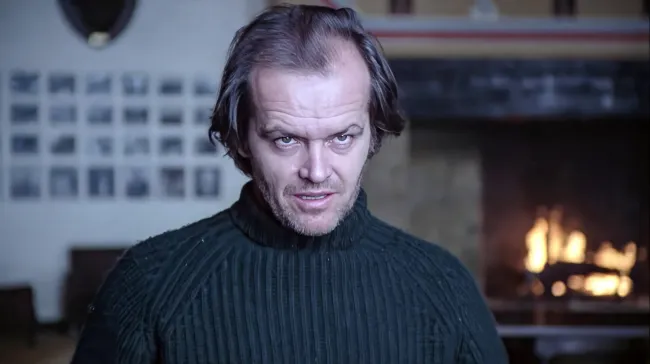
When screenwriter David Birke (“Elle,” “Benedetta“) went to see Stanley Kubrick‘s “The Shining” on opening day in the summer of 1980, he was mystified by the way Kubrick chose to end the film. After Jack Nicholson‘s homicidal hotel caretaker Jack Torrance was left to freeze to death after being tricked by his son Danny (Danny Lloyd) into getting lost in the Overlook Hotel’s hedge maze, there was an odd epilogue between Danny, his mother Wendy (Shelley Duvall), and Overlook manager Mr. Ullman (Barry Nelson), who had hired Jack in the film’s opening scene.
“That ending really left a bad taste,” Birke said during a recent interview with IndieWire. In the scene, Ullman visits Wendy and Danny in the hospital and tells them that no evidence of the supernatural has been found back at the hotel. “It was just so stiff and lame and weird to have an ‘Everything’s okay now’ hospital scene with that kind of forced cheeriness, when you might have thought the movie was over.”


Although there were hints of something more sinister, or even satirical, in Ullman’s bland corporate ass-covering, the lackluster execution made it impossible to discern what Kubrick’s actual intentions were. “It’s just a flat, nothing scene,” Birke said. “I suspect it was there because, with a child in jeopardy, it seemed like a scene that was necessary. Then it quickly occurred to Kubrick that it actually wasn’t.”
Indeed, Birke was one of the lucky few to see the scene, which has taken on mythic status among Kubrick disciples thanks to the fact that it disappeared from circulation after opening weekend. Kubrick, who had always had misgivings about the scene but kept it in after his daughter Vivian advocated for it, decided to remove the epilogue after the first few days of exhibition. He sent minions into theaters to physically cut the ending out of all the release prints, ordering the footage destroyed so that it could never be seen again.
Kubrick had struggled with the ending of “The Shining” throughout the writing and production of the film, knowing only that he didn’t want to keep the conclusion of Stephen King’s novel, in which the haunted hotel and Jack were destroyed by an exploding boiler. At one point Kubrick even considered a finale in which the Overlook’s psychic cook Hallorann (Scatman Crothers) became possessed by the hotel and killed the entire Torrance family, who would return in an epilogue as ghosts to greet a new clan of caretakers.
While Birke enjoyed much of “The Shining” even with what he saw as a bizarre finale, he says there’s no question Kubrick made the right choice getting rid of it. “I have to say that I’ve probably seen ‘The Shining’ 11 times since then, and all 11 times the whole movie has played so much better than that first time,” Birke said. The ultimately excised ending was undoubtedly one of the reasons, though not the only one, that “The Shining” received mostly negative reviews when it was first released — but more about that in a minute.

The opening weekend surgery wasn’t the last time Kubrick would make alterations to the “The Shining.” After the movie opened in the U.S., Kubrick took the scissors out again for its international run and cut the movie down by around 24 minutes. He had felt rushed editing the American version, which Warner Bros. wanted ready for the summer, and would ultimately designate the shorter European cut to be his preferred release.
For decades the 143-minute American cut went mostly unseen in the rest of the world, and the 119-minute international version was similarly hard to come by in the States. While the original ending seems to be lost outside of some still images, both of Kubrick’s approved theatrical release edits of the movie are now available in pristine transfers as part of Criterion‘s 30-disc “The Complete Kubrick” boxed set. The opportunity to study both cuts side by side is invaluable for Kubrick enthusiasts — and instructive for film students interested in examining what drastically different effects the same footage can yield.
In many ways the international edition feels like a response to the mixed reviews “The Shining” inspired upon its American release — not just from critics, but from Kubrick’s peers as well. The consensus was that the 143-minute “Shining” was a languorous bore; the Chicago Reader’s Dave Kehr was not alone in his feeling that “the incredibly slack narrative line forestalls suspense.” Reliable Kubrick-hater Pauline Kael called the movie dumb and passionless, drained of life by the director’s obsession with technology, and directors like Brian De Palma and David Cronenberg took Kubrick to task for condescending to the horror genre.
This latter criticism really stuck, and has been repeated in various iterations for decades by commentators from Bret Easton Ellis (who was so obsessed with “The Shining” as a high school student that he made a trip to see it the inciting incident in his novel “The Shards” and its TV adaptation) to King himself, who never tired of explaining how Stanley Kubrick failed to understand the basic mechanics of horror filmmaking. This criticism, of course, assumes that Kubrick was interested in such mechanics in the first place — which he clearly wasn’t.
“The Shining” came out at a pivotal moment for the horror genre, bridging the eras between “classy” studio vehicles for adults like “The Exorcist” and “The Omen” and the teen slasher boom inaugurated by John Carpenter’s “Halloween” in 1978 and sent into the stratosphere by the summer of 1980’s other big horror release, “Friday the 13th.” With its evenly lit, clinical and symmetrical images and its deliberate pace, “The Shining” did indeed fall short by comparison with the jittery shock treatment tactics of “Friday the 13th” and its ilk — Kael took the movie to task for its lack of moody atmosphere, and she’s right. There’s not a dark shadow with a monster lurking in it to be found anywhere in the film.
Obviously, as most sensible viewers of the film now acknowledge, Kubrick was up to something different, and it’s insane that the critics at the time were unable or unwilling to give him the benefit of the doubt. Judging “The Shining” by the same standards as a generic horror movie is like comparing “2001: A Space Odyssey” to “Buck Rogers,” or “Full Metal Jacket” to “The Sands of Iwo Jima.” Like his contemporary Robert Altman, Kubrick was less interested in fidelity to genre than reinvention and reinvigoration — in obliterating the forms to build something new and, for those of us who appreciated what he was doing, something more or at least equally valuable.
Of course, every time Kubrick went about transforming the medium, history repeated itself; when he made “A Clockwork Orange,” people said, “It’s no 2001.” “Barry Lyndon” was no “A Clockwork Orange,” “The Shining” was no “Barry Lyndon,” and so on right up until the “disappointment” of “Eyes Wide Shut” — a movie now correctly exalted as one of the greatest of its decade, if not of all time. Kubrick was always just a little bit too ahead of his time for his own good, at least critically — most of his movies, with the exception of “Barry Lyndon,” did well at the box office.
Audiences got what the critics didn’t, and that’s because, in spite of his reputation as a highly intellectual, analytical filmmaker, Stanley Kubrick operated on a level of pure emotion more accessible to general audiences than to critics who needed to articulate how and why a movie worked (and on a deadline, no less). Right from the beginning, for viewers who let their guard down “The Shining” did work as a horror film, but not one with the herky-jerky jump scares of a “Friday the 13th” or “Prom Night.”
“The Shining” builds its tension subliminally and psychologically in a way that makes those overlit compositions Kehr and Kael complained about a key factor in the movie’s eerie unease — we’re scared, and it’s even scarier because all the lights are on and yet we’re not always sure what we’re scared of. Kubrick pulls off this nifty trick via an endless parade of weird discontinuities and inconsistencies that, in a lesser filmmaker’s hands could be assumed to be mistakes, but are surely intentional when executed by one of the cinema’s most infamous perfectionists.
When Ullman debriefs Jack at the beginning of the film, for example, he refers to the prior caretaker who murdered his family as Charles Grady; when Grady’s ghost introduces himself to Jack over an hour later, he says his name is Delbert. By the time this happens we’ve long forgotten what Ullman called Grady, but we unconsciously register that something is just a bit off.
This is Kubrick’s modus operandi throughout the film, setting up scenes where furniture moves from shot to shot, wall decorations change, and there are further schisms between Ullman’s exposition and the reality that transpires. (He refers to Grady’s daughters as different ages, but when we meet their ghosts they’re clearly twins.) Even Ullman’s office makes no sense in terms of the geography of the hotel — as many “Shining” obsessives and conspiracy theorists have pointed out, it has a window with a view that’s impossible given the architecture that has been established.
On his superb new audio commentary for the Criterion disc, filmmaker Lee Unkrich (“Toy Story 3”) claims that some of these disjunctions were the result of the typical vagaries of production; the twins, for example, were cast after Ullman’s scene had already been shot and Kubrick simply couldn’t resist their creepy look. But Kubrick could easily have reshot or looped Ullman’s scene to match the changes (this is the guy who entirely reshot Harvey Keitel and Jennifer Jason Leigh’s scenes with other actors in “Eyes Wide Shut”), and there are other subliminally planted impossibilities — like a TV set that plays without being plugged into any kind of socket — that are clearly intentional.
All of this adds up to a deeply unsettling film whose mysteries never seem to fully reveal themselves; in fact, there’s a whole cottage industry of books and films (like the popular “Room 237”) devoted to theories ranging from the absurd (that the movie contained Kubrick’s hidden apology for his role in faking the moon landing) to the intriguing (that it’s an allegory for multiple historical genocides) and beyond. Like “2001” and “Eyes Wide Shut,” it’s a film that intentionally leaves key questions unanswered and fails to complete the trails of narrative bread crumbs it leaves for the viewer — one reason the movie holds up to endless repeated viewings.

Another reason the movie holds up is that it gets at something fundamentally terrifying: the idea of a husband so annoyed by his wife and son that he wants to kill them. Jack Nicholson based parts of his performance on himself during his failed first marriage, and for all the heightened artifice of later scenes like the infamous “Here’s Johnny!” moment, the early passages in “The Shining” are chilling in Jack’s understated contempt — especially in the American version, where we learn early on in a conversation between Wendy and a pediatrician that Jack once broke Danny’s arm after a few too many drinks.
The international version loses the pediatrician character entirely, completely shifting the emphasis of the movie; in the American one Jack is a threat right from the beginning, whereas in the international version it takes a little longer to see just how much trouble Danny and Wendy are in. We don’t learn about Jack’s past abuse of Danny until almost an hour into the film, and the revelation is more shocking in a way, since we’re unprepared for it (in the American version it comes before we’ve settled in to form any expectations or assumptions about the characters). The scene with the pediatrician doesn’t exist, but it lingers in the DNA of the movie like a ghostly remnant of the earlier version.
In fact, both versions of “The Shining” are filled with these kinds of ghostly echoes, since Kubrick was rewriting throughout production and ended up jettisoning a lot of substantial ideas that still hover around the edges of the narrative. In Stephen King’s novel, Jack finds an old scrapbook filled with information about the Overlook’s past; Kubrick and co-screenwriter Diane Johnson had intended to use this prop (even, in one of the proposed endings, closing the movie with the reveal of Jack’s picture inside its pages), but they ended up deleting it from the final cut.
Yet the scrapbook remains in prominent view on Jack’s desk at key moments in the film, another subliminal element that nags at us because it’s unexplained and unresolved. The international cut, as one might expect, has even more of these lingering ghosts, since Kubrick cut out big chunks of exposition in the opening act (the scenes in which Ullman gives Jack and Wendy information about the hotel are trimmed considerably) and even lost introductions to major characters like Hallorann, who appears practically mid-sentence just jabbering away without us having any idea who he is.
Throughout the international cut Kubrick loses beginnings and ends of scenes and even drops entire characters (not just the pediatrician but Hallorann’s friend who helps him return to the Overlook at the climax). Other changes are more minor, like cutting a shot of Wendy pushing a cart around the hotel, and in one case Kubrick ironically makes the movie scarier by losing one of its most overtly horror-centric scenes, in which Wendy walks into a room full of skeletons. That scene was always the silliest in the American version, and its absence in the international edition was a wise choice.
Odder is the choice to make Danny’s role much smaller in the second half of the film — there’s a big chunk of time where we don’t see him at all, outside of an occasional shot of him shuddering and looking terrified. Overall, though, the international cut of “The Shining” is leaner and meaner, and more resembles a traditional horror movie in its narrative propulsion, if not its clarity. Whether or not this is better or worse is largely a matter of taste, and a question of which version you saw first.
For those of us who grew up on the American “Shining,” the international cut often feels like it’s a CliffsNotes edition, a film that hits all the narrative beats but loses a great deal of the original’s abstract power. Yet for Australian horror director Elric Kane (“The Dead Thing“), who was weaned on the international cut, the shorter version is both tighter and more mysterious in its narrative ellipses. “While the version I grew up on may have been trimmed as a response to negative US critics, it taps into nightmare logic over narrative logic in a way in which horror films have always thrived,” Kane told IndieWire. “There’s no time to think, you are just pulled along with Danny down the endless hallways towards the horror that awaits in room 237.”
By the time Kane saw the American cut at the age of 20, he had seen the international version somewhere around 50 times. “With Kubrick’s passing a cinematheque in Australia showed all his films in order, culminating with the premiere of ‘Eyes Wide Shut,’” Kane said. “But most excitingly they advertised the rare screening of the U.S. cut with 25 additional minutes. My mind was blown at the prospect of more of my favorite film.” Kane was surprised, therefore, by the strange feelings the longer cut elicited.
“It just felt off,” Kane said. “Where my experience with the film had always felt dreamy, like being stuck in an unfolding nightmare, now it felt more real, almost documentary-like in its explanation of Danny’s medical history, Jack’s alcoholism, and most noticeably the difficulty of the U.S. transit system as Hallorann struggles to get back to the hotel.” Ultimately Kane came to appreciate that the two versions were completely different tonal experiences.
“It’s the difference between Antonioni and Rossellini, Bava and Fulci, dream and reality,” Kane said. “But here it was the same filmmaker with two very different versions of the same film. I thought all these years later when I saw the longer cut on screen at the New Beverly Cinema on 35mm film I might feel differently, but alas it’s not the same film that imprinted on me at a young age. These two cuts don’t just represent different versions of the same film, they are two different film experiences.”
Criterion’s new edition of the movie — which represents just a small portion of the massive Kubrick box set, unquestionably the physical media event of 2026 — provides a long overdue opportunity to have those two different experiences as often as one would like, and to consider and argue over the relative merits and deficiencies of each cut. As a director who built his movies to stand the test of time and continue yielding new questions and debates, Kubrick would be proud.
“The Complete Kubrick” will be available from Criterion on October 20.





Leave a Reply