
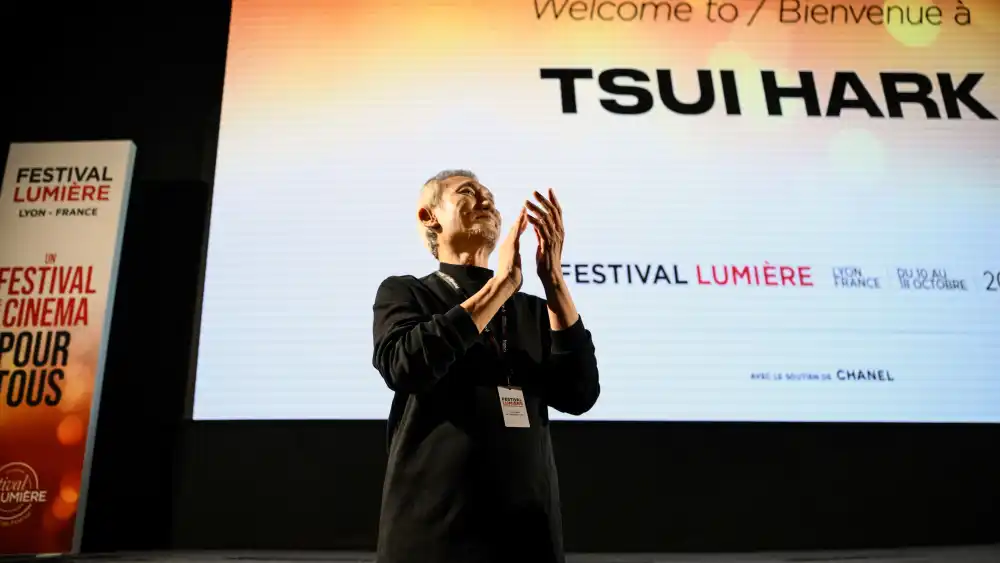
LYON, France — Hong Kong filmmaker Tsui Hark paid an emotional tribute to Nansun Shi, his former wife and longtime producing partner, at the Lumière Film Festival on Sunday, saying he deeply missed the pioneering producer, who died in July.
“I miss my partner, Nansun, who helped me on so many projects over so many years,” Tsui said at the start of his masterclass, after watching a montage of highlights from his career.
Clearly moved and searching for words, he went on: “I would say that my coming here is also a tribute to her. I hope that if she is around us spiritually, she’s happy about what we are doing here.”
Shi, who died on July 13 at the age of 75, was one of the most influential figures in Hong Kong cinema. She co-founded Film Workshop with Tsui in 1984, helping produce and bring to international audiences some of the industry’s defining films. Although the couple divorced, they continued their longstanding professional collaboration and were jointly honored with a Lifetime Achievement Award at the Hong Kong Film Awards in 2025.

Sylvia Chang and Kenny Bee in ‘Shanghai Blues’ (1984)
Credit: Shaw
A leading figure of the Hong Kong New Wave who helped reinvent the martial arts genre, Tsui is best known for films including “Shanghai Blues,” “Peking Opera Blues,” “Once Upon a Time in China,” “Green Snake” and the “Detective Dee” franchise. The multiple Hong Kong Film Award winner is in Lyon for a retrospective of his work and a masterclass exploring his career.
Looking ahead, the filmmaker shared details of a new project bringing together Eastern and Western cultures.
“I’m working on a comedy in London,” he said, explaining that the story would bring together people from different cultures to confront a serious problem. “I think we need to put people of different cultures together nowadays to face something serious, so that we have a funny angle looking at this kind of collaboration.”
Tsui, who said he has always believed in thinking five years ahead rather than simply living in the present, also reflected on the possibilities offered by the growing number of media platforms and how they might be used to create experiences that bring people closer together.
One idea he is exploring is to create a dreamlike version of a city such as Hong Kong or Beijing, imagined in the future. “The present is so real. Maybe we need something more inspiring to go on.”
Tsui also reflected on the increasingly blurred boundaries between reality and illusion in a world dominated by advertising, political propaganda, the internet and Artificial Intelligence.
He described modern society as being constantly influenced by messages designed to shape people’s beliefs and behavior, questioning how much individuals can resist what they are told.
“We are being very passive to our environment,” he said. “We have a problem with our identity.”
“I think it’s getting more ridiculous now that we have AI in our culture,” he added. “The funny part of AI is that you’re not sure whether what you see is real or not real.”
Yet that uncertainty also frightens him. “When you wake up, you don’t know what’s real,” he said, acknowledging that he had no idea what the next five years would bring.
The filmmaker also spoke about the philosophical dimension of his films, which he sees as a way of questioning the influences shaping people’s perceptions of the world.
Despite his concerns about contemporary society, Tsui remains convinced that humor has an essential role to play, even when tackling the most serious subjects.
“The world is so chaotic,” he said. “We have viruses, we have wars, we have economic problems. I don’t know how human beings can survive through all these problems.”
But cinema, he believes, can help people find a different perspective. “One of the important elements in filmmaking is that maybe we can entertain and inject humor into our belief that the world is still a wonderful place to live.”
Tsui is being celebrated at Lumière with screenings of four of his films: “Shanghai Blues” (1984), “Peking Opera Blues” (1986), “Once Upon a Time in China” (1991) and “Time and Tide” (2000).
The Lumière Film Festival runs in Lyon through Oct. 18.
Tsui Hark discusses his career at the Lumière Festival.
Credit: Sarah Mangeret




Leave a Reply