
Anime fights are often remembered for their biggest moments: the devastating finishing moves, the last-minute power-ups, and the clashes between characters that leave viewers on the edge of their seats. However, spectacular fights aren’t just about how powerful a character is or how many explosions fill the screen. The best action sequences combine fluid animation, creative choreography, and visual direction to make every movement feel exciting.
Some series make their fights stand out through their fluid movements and carefully choreographed exchanges, while others use unconventional abilities and striking visual direction to make their battles unique. These ten anime series showcase the artistry behind exceptional action, proving that a memorable fight is about more than raw power alone.
Realistic Boxing Choreography Packs a Punch in Hajime no Ippo

No one can talk about anime fights without covering the combative sports anime Hajime no Ippo. With the manga still ongoing since 1989 and the anime running from 2000 to 2002, along with its various films and specials, there’s a plethora of fights to choose from. The anime itself only covers up to around chapter 557 of the manga, when Ippo defends his title for the first time.
The fight choreography features realistic boxing that can be, and has been, imitated and referenced in games like Street Fighter, particularly through Dudley. Rather than relying on flashy superpowers or exaggerated visual effects, the series builds its action around footwork, defensive maneuvers, perfectly timed punches, and the split-second decisions that can determine the outcome of a match.
Every exchange feels like a battle of technique and endurance, making even a simple jab or counterpunch exciting to watch. Speedlines and dramatic impact frames emphasize the force behind each strike, while the fighters’ movements communicate the exhaustion and determination required to stay standing.
The result is a series where every match feels like a genuine test of skill, stamina, and strategy rather than a simple contest of strength. Even with its older animation, the combination of grounded choreography and impactful presentation makes its boxing bouts memorable.
Revy’s Gunplay Makes Every Shootout Unpredictable in Black Lagoon

Revy is a highlight of Black Lagoon, with her dual pistols and foul temper making her a force to be reckoned with. However, what makes the show even better beyond Revy herself is its fight scenes. Following a crew of mercenaries operating in the criminal underworld of Southeast Asia, the series features shootouts that rely on positioning, movement, and quick reflexes rather than supernatural abilities.
The choreography frequently incorporates environmental hazards, cover, and close-range exchanges, giving its gun battles a sense of momentum that transfers over to the with only fists. There’s constant movement, and it keeps even the most skeptical viewers believing in how dedicated the show is to the art of gunplay.
Saya’s Sword Fights Bring Brutality to the Vampire World of Blood: The Last Vampire

Blood+ was released in 2005 and was inspired by the film Blood: The Last Vampire. The series follows Saya Otonashi, a girl who discovers her role in a centuries-old conflict against monstrous creatures known as Chiropterans. Armed with a katana and the ability to defeat these otherwise formidable enemies, Saya brings a brutal edge to the series’ action scenes.
There aren’t as many action scenes in Blood+ as there are in some other anime, but that’s part of the suspense that builds over the course
of its 50 episodes. The tension between fights steadily rises until it finally erupts in a roaring crescendo. One of the strongest examples is Saya’s final duel with her twin sister, Diva, at the Metropolitan Opera House.
Both sisters coat their swords in their own blood before charging at each other, culminating in a simultaneous strike as they lock eyes. It’s a powerful moment that demonstrates just how personal their battle has become and how both sisters are finally ready to resolve their conflict once and for all.
Land of the Lustrous Uses CGI to Create Stunning Fight Scenes

Land of the Lustrous‘ action scenes are hard to describe without mentioning that the anime itself is made using CGI. For many anime watchers, that’s a red flag, but for Land of the Lustrous, it’s something that feels entirely necessary.
The main characters are Gems, each with a unique design that shines in its own way and gives them their own distinct luster, hence the anime’s name. This also applies to the combat, where their crystalline bodies make every fight visually distinct.
The way each combatant glistens as they stride across the battlefield makes every movement a spectacle. The series uses CGI to create fluid movements, dynamic camera angles, and a remarkable sense of speed. Characters shatter, pieces of their bodies break away, and every blow feels more visceral than many fights between human characters.
The camera sweeps around the battlefield, following the action from angles that emphasize the Gems’ speed and the unusual nature of their bodies. The result is a series of battles that are visually unlike anything else in anime, with a distinctive appearance that could have lost much of its impact through traditional 2D animation.
Futari wa Pretty Cure Makes Magical-Girl Combat a Physical Affair

Futari wa Pretty Cure is a magical-girl show that proves the girls donning the fuku skirts can be far more formidable opponents than they’re often given credit for. Few things are more satisfying than watching Cure Black and Cure White use hand-to-hand combat to topple monsters.
Rather than standing at a distance and firing magical projectiles, the two throw punches, deliver kicks, and work together to overwhelm their opponents. The emphasis on physical impact and teamwork makes the show a blast to watch, as these two middle school girls use the power of cooperation and straight-up pro-wrestling fighting styles to take on the forces of evil.
Cure Black fights with a more aggressive style, while Cure White complements her partner through her own movements and timing. Their battles feature acrobatic dodges, powerful combination attacks, and plenty of close-quarters exchanges that make the heroines feel like genuine martial artists.
Balsa’s Spear Fighting Brings Realism to Fantasy Combat in Moribito

Spear combat in anime is often an understated form of fighting. Compared to swords and everybody’s favorite, the katana, spears receive much less attention, which makes Balsa in Moribito: Guardian of the Spirit such a delight to watch on screen. As a seasoned bodyguard tasked with protecting Prince Chagum, Balsa frequently finds herself facing dangerous opponents who are more than capable of matching her strength.
It’s the grounded approach to combat in Moribito: Guardian of the Spirit that gives its battles as much weight as Balsa’s spear. Many of the enemies she faces are masters of their own weapons, forcing Balsa to outwit, outmaneuver, and outclass each and every one of them.
The animation gives her fights a natural rhythm, with combatants constantly adjusting their positions and reacting to each other’s movements. The result is a series of fights that feel dangerous and grounded, showcasing how thrilling well-executed spear combat can be.
The Sunday Morning Paper Becomes a Deadly Weapon in Read or Die

Read or Die or R.O.D is an anime that uses a very unusual weapon in its fights: paper, wielded by Yomiko Readman, the story’s main character and an agent working for the British Library’s Special Operations Division. What sounds like an easy power to counter becomes a deluge of creativity and possibility in Yomiko’s hands, making every fight scene far more dangerous than a simple paper cut.
Paper isn’t simply a projectile she throws at enemies; it becomes an extension of her body, allowing her to attack, defend, and maneuver through a fight in unexpected ways. She can harden sheets into blades, create shields to defend against attacks, and use enormous paper constructs to overwhelm her opponents.
The choreography constantly finds new applications for her powers, turning seemingly harmless sheets into weapons capable of matching much more conventional armaments. This creativity keeps the fights unpredictable, leaving viewers wondering what Yomiko will come up with next.
Hunter × Hunter Turns Strategic Thinking Into an Art Form

Hunter × Hunter stands out for its ability to make battles feel like elaborate games of strategy, where raw strength is often less important than a fighter’s ability to think several steps ahead. One of the most compelling aspects of the series is how its main characters are thrown together by happenstance and must learn how to survive in a world where mastering Nen takes more than raw strength alone.
Through the Nen system, characters develop unique abilities shaped by their personalities, creativity, and individual limitations. Gon relies on his straightforward but powerful techniques, while Killua combines incredible speed with precise, calculated strikes.
Every fight has its own set of rules, and every Nen ability has its strengths and weaknesses. During the climactic battle at the end of the Chimera Ant arc, Gon pushes his Nen to its absolute limit to kill Pitou, nearly dying in the process, making this confrontation one of the series’ best fights alongside Kurapika’s battle against Uvogin.
The Garden of Sinners Makes Every Knife Fight Feel Cinematic

The Garden of Sinners (Kara no Kyōkai) is a supernatural thriller that turns its fights into tense, cinematic encounters resembling the deadliest of dances. At the center is Shiki Ryougi, a young woman with a mysterious ability known as the Mystic Eyes of Death Perception, which allows her to perceive the death of living beings and objects.
Armed with a knife and an unnerving composure, Shiki fights with deadly precision, acrobatic movements, and fatal strikes that can bring her opponents to their end in an instant. Each fight features fluid animation, deliberate pacing, and sudden bursts of violence.
Shiki’s knife fighting feels intimate and unpredictable, with close-quarters exchanges that emphasize her skill and precision. The cinematic direction uses lighting, camera movement, and carefully timed impacts to heighten the tension, making each encounter feel swift and brutally decisive, with Shiki’s skill leaving little doubt about just how dangerous she is.
Samurai Champloo Combines Incredible Fight Choreography With an Unforgettable Soundtrack

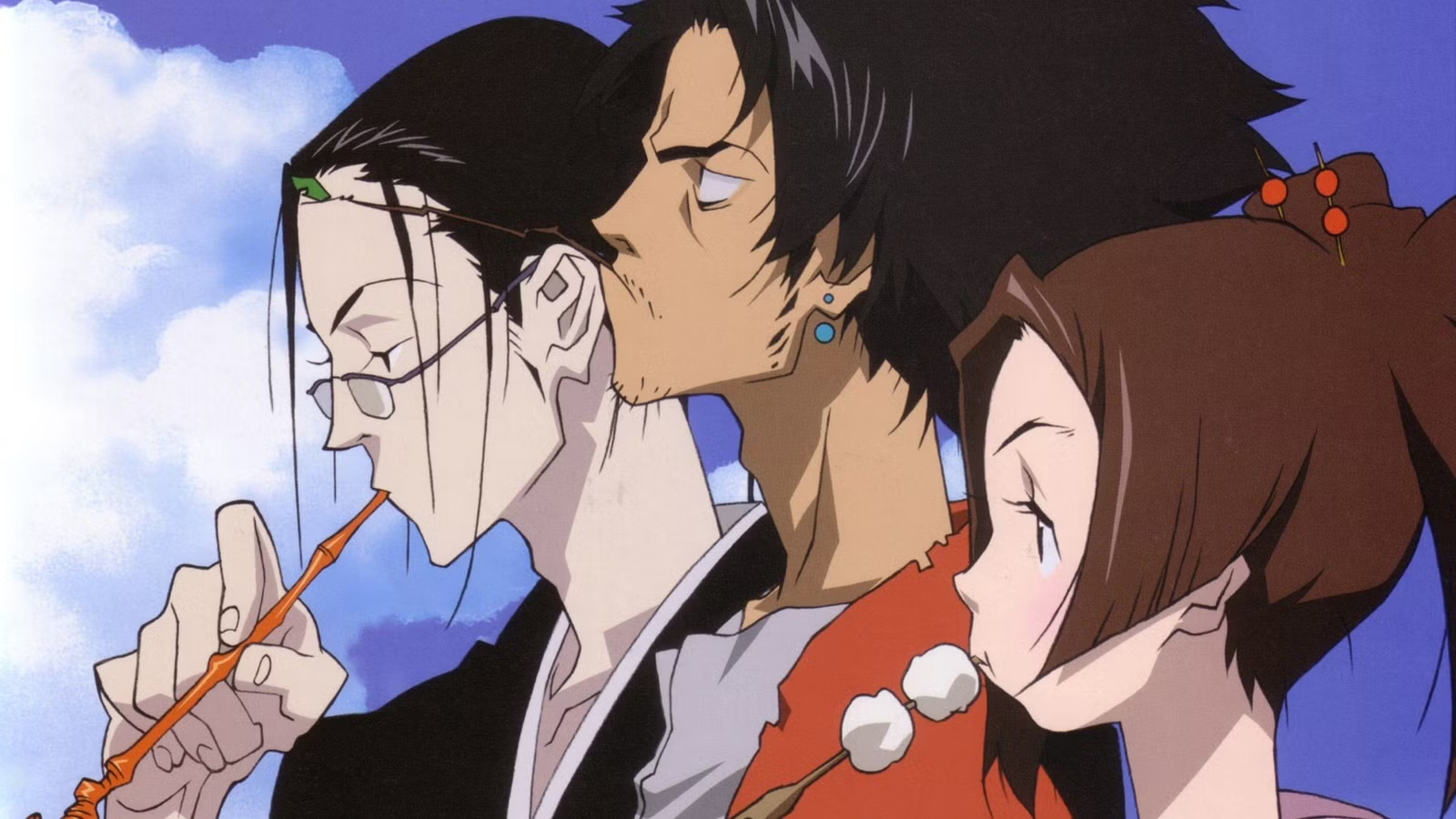
Samurai Champloo is a series that brings together samurai action and hip-hop culture to create something unlike any other anime. Every character, from Mugen, Jin, and Fuu to the side characters they encounter while journeying across an alternate version of Edo-period Japan, contributes to a distinctive style that gives the series a timeless look.
What’s especially interesting is how differently the two main fighters approach combat, with Mugen using an unpredictable, breakdance-inspired style while Jin relies on disciplined technique and precise swordsmanship. Each fight scene features inventive choreography that pairs every strike and movement with a carefully placed hip-hop soundtrack blended with the atmosphere of ancient Japan.
Every action seems timed to the beat, while each musical crescendo emphasizes the escalating intensity of the fight. The synchronization is so precise that watching the characters clash can feel almost hypnotic.







Leave a Reply