
These books have almost nothing to do with one another on paper. There are dystopias, ghosts, bad marriages, trapped lovers, organized crime, female friendship, and one extremely difficult woman living in Maine. Yet, I keep returning to books that ask what happens when marriage, family, sex, friendship, motherhood, and love get tangled up with forces much larger than any one person can control.
That sounds terribly serious, and sometimes these books are. But, they’re also funny, propulsive, sexy, strange, infuriating, and in the case of Gone Girl, responsible for a monologue I still think about way more often than is probably reasonable. These are books that understand that the private and political are rarely as separate as we’d like to believe. If you’re going to read any books before you die, make sure it’s these titles below.
‘The Handmaids Tale’ (1985)

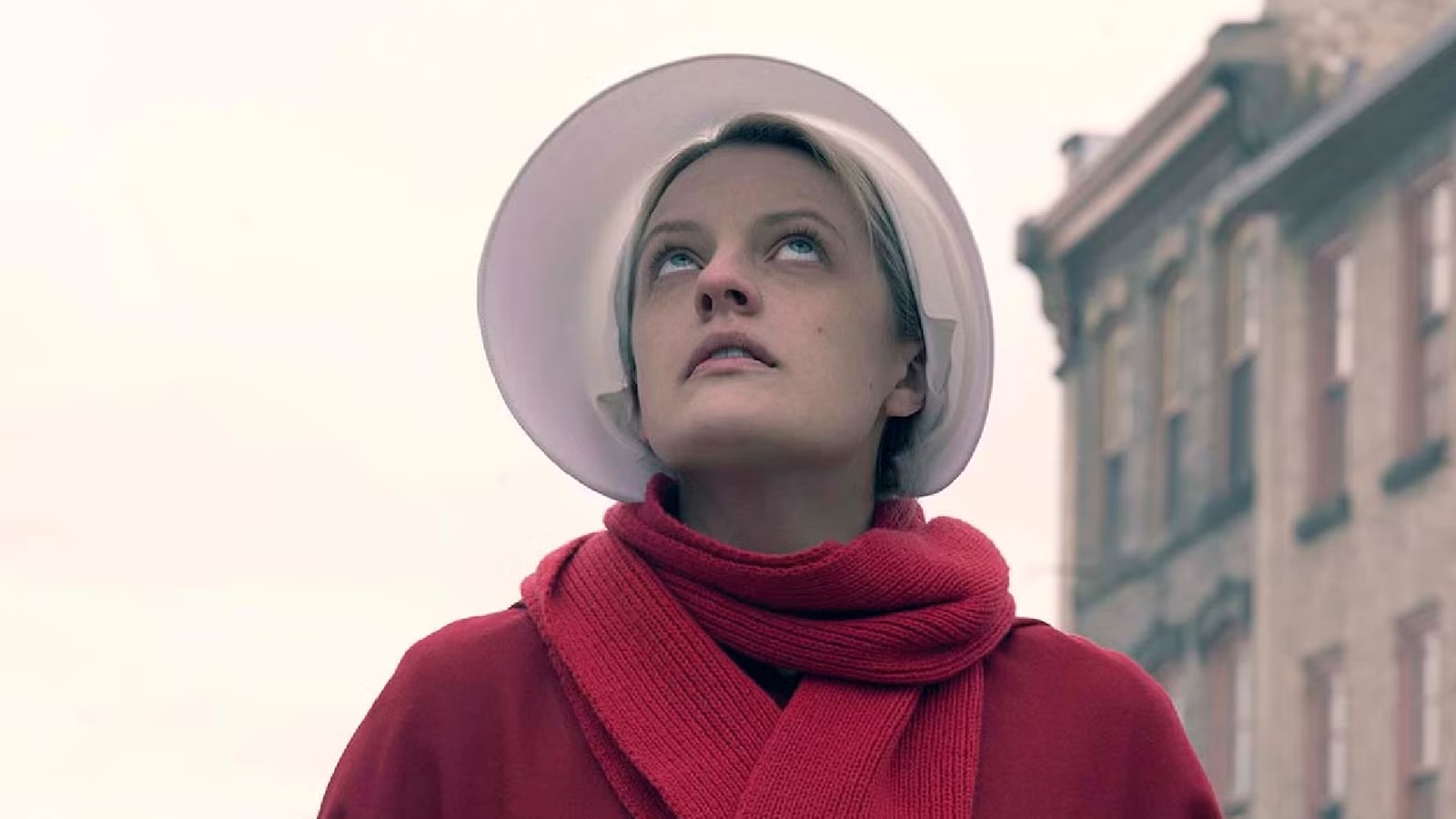
The scariest thing about Margaret Atwood‘s The Handmaid’s Tale is that Gilead does not appear out of nowhere. Environmental crisis, collapsing birthrates, political instability, and religious extremism create exactly the kind of opening an authoritarian regime needs, and suddenly women are valued almost entirely for what their bodies can produce. Offred has lost her job, her money, her husband, her daughter, and even her name; now she is a Handmaid assigned to a Commander and his wife, Serena Joy. The long-running Hulu adaptation is especially good at showing how many small concessions have to happen before somebody finally looks around and realizes the entire country has changed.
Atwood published the novel in 1985 amid renewed battles over women’s rights, and what still unnerves me is how little she actually has to invent to make Gilead horrifying. Offred remembers grocery stores, cigarettes, arguments with her husband, time with her daughter—all the boring, ordinary pieces of a life she had no reason to imagine could disappear. That’s the trick of the book: rights become restrictions, restrictions become routine, and eventually people start remembering freedom like it was something they dreamed of. Gilead may be a political system, but Atwood understands that power becomes real when it reaches your paycheck, your marriage, your bedroom, your children, and finally the name you are allowed to call yourself.
‘Beloved’ (1987)

Though the formerly enslaved Sethe manages to flee her plantation and make it to Ohio, Beloved makes very clear that escape and freedom are not the same thing. Eighteen years later, she lives with her daughter Denver at 124 Bluestone Road, a house haunted by the angry ghost of the baby daughter Sethe killed rather than allow her to be taken back into slavery. When a mysterious young woman calling herself Beloved arrives, the past stops being metaphorical and walks through the front door.
Toni Morrison makes haunting literal because slavery’s aftermath is literal. Sethe remembers Sweet Home through fragments, bodies remember what minds would rather bury, and the dead refuse to stay conveniently in history where everyone else would prefer them. What still devastates me is that Morrison never makes Sethe’s choice easy to condemn or forgive; instead, she makes us sit inside a world where a mother could believe death was the more loving option. Beloved is a ghost story, a family story, a love story, and one of the most brutal arguments I’ve ever read about what happens when a system corrupts even the most basic human instinct to protect your child.
‘Olive Kitteridge’ (2008)

Elizabeth Strout does something I find almost unfair in Olive Kitteridge: she makes an entire town feel enormous without much of anything traditionally enormous happening. Across thirteen connected stories in Crosby, Maine, Olive moves in and out of other people’s lives—sometimes as the center, sometimes barely appearing at all—while marriages strain, children disappoint their parents, people fall in love with the wrong person, contemplate suicide, age, grieve, and keep going. Olive herself is a retired schoolteacher who can be perceptive about everybody except, inconveniently, herself. The book won the 2009 Pulitzer Prize and later became an HBO miniseries starring Frances McDormand, which won the Emmy for Outstanding Limited Series.
Olive is rude, jealous, judgmental, needy, generous, funny, and disarmingly tender, often within a very small amount of space and time. Strout doesn’t ask us to decide whether Olive is likable, because likability is such an inadequate question for a whole human life. She lets years accumulate around Olive until the small choices, missed conversations, marriages, children, deaths, and reconciliations begin to feel as large as the plot. Somehow, a woman walking into somebody else’s story for three pages can tell you nearly everything about loneliness.
‘Kin’ (2026)

Annie and Vernice—Niecy—are “cradle friends,” two motherless Black girls growing up next door to each other in Honeysuckle, Louisiana. Niecy’s mother is dead, while Annie’s mother abandoned her. Annie’s abandonment versus Niecy’s loss means Annie can keep imagining that somewhere out there is an answer while Niecy can live her life pleasing the sainted mother she never knew. When they grow up, Niecy leaves for Spelman College and enters a world of Black affluence, education, and the heavy expectations she’s always craved from a mother. Annie eventually heads toward Memphis looking for the mother she can’t stop needing to find. Their lives separate in ways that have as much to do with class, gender, and the Jim Crow South as they do with the choices either woman makes.
That’s what Tayari Jones does so beautifully here: friendship can be the central love story of your life and still not be enough to save either person from everything else. Niecy and Annie know one another before lovers, education, money, respectability, or adulthood start assigning them different versions of who they are supposed to become. The tragedy isn’t simply that their lives diverge; it’s that the world causes those divergent consequences neither girl understood just from sharing a childhood. Kin is about family, but Jones keeps asking the more interesting question: who actually gets to count as family, and who knows you well enough to tell you who you were before everybody else got involved? Jones’ control of voice and language recently earned Kin the 2026 Kirkus Prize for Fiction, which comes with a $50,000 award.
‘Age of Vice’ (2023)

Age of Vice opens at 3 a.m. in New Delhi when a Mercedes jumps a curb and kills five people. But the shock continues when the police find Ajay behind the wheel. Ajay is a servant who has no business behind the wheel of a rich man’s car, but there he is. From there, Deepti Kapoor backs up and pulls us into the orbit of the Wadia family, whose money touches business, politics, crime, and seemingly anything else worth controlling. Ajay, the heir Sunny Wadia, and journalist Neda become tangled together through desire, loyalty, ambition, and the increasingly obvious fact that proximity to enormous wealth does not protect you from harm.
This book is a delightfully fun and chaotic read. It is huge, messy, violent, and incredibly readable, which is appropriate when excess is basically the subject. Kapoor understands wealth as not only having more money, but as the ability to make consequences land on somebody else. Sunny imagines himself different from his father while still benefiting from the exact machinery his father built, and Ajay’s devotion is heartbreaking when he is only useful to powerful people as long as he is disposable. This is a gangster novel, family saga, romance, and political novel all at once, but mostly it is about how power convinces everybody near it that maybe they will be the exception.
‘The Prophets’ (2021)

First and last, this is a book about love. While there is one main love story that beautifully drives the book, the novel is also about the different ways love manifests in the most horrific of spaces. Two enslaved men, Isaiah and Samuel, love each other. On a plantation in the Deep South, the barn where they work is one of the only places where they get to belong to one another instead of to somebody else. An older enslaved man starts preaching the owner’s Christianity, and quickly their relationship is recast as sinful, dangerous, and responsible for disturbing the plantation’s order. Robert Jones, Jr. builds outward from that love story into generations of enslaved people, slaveholders, ancestors, mothers, memory, religion, and the machinery required to justify human bondage.
What makes The Prophets so devastating is that Isaiah and Samuel’s love was not originally a problem. Other people have to be taught to see it as one. Jones shows how oppression survives by recruiting people into enforcing hierarchies that do not actually free them, and religion becomes especially dangerous once the master’s God starts speaking through the mouths of the enslaved. Against all of that, Isaiah and Samuel loving each other becomes something much bigger than romance: a private claim to humanity inside a system built around denying that either man belongs to himself.
‘The Book of Night Women’ (2009)

In the late eighteenth century, Lilith is born into slavery on a Jamaican sugar plantation. The women around her all believe there is something unusual—possibly dangerous—about her. Those women are the Night Women, a group secretly planning a revolt, and as Lilith grows older they believe she could be essential to what they are trying to do. The problem is that Lilith has her own desires, loyalties, rage, and ideas about what freedom means, none of which fit neatly into anybody else’s plan for her. Marlon James gives us rebellion from inside the complicated relationships among people who all desperately want freedom but don’t always agree on what they are willing to sacrifice for it.
The language makes the book feel alive; James doesn’t flatten the Jamaican speech into something easier or more comfortable. And he refuses to make these enslaved Black women uncomplicated symbols of resistance—these women desire, betray, protect, manipulate, love, compete, and make catastrophic choices because enslaved people are people, not lessons in history books. The violence of slavery is everywhere, but the Night Women are never reduced to the violence done to them. That’s what stays with me the most: the book gives these women enough humanity to be difficult.
‘Gone Girl’ (2012)

By now everybody knows Gone Girl is about a marriage gone spectacularly wrong, but that almost undersells how much fun Gillian Flynn has making us complicit in the disaster. Amy Dunne disappears on her fifth wedding anniversary, Nick behaves exactly like a husband who would prefer the police stop asking him questions, and Amy’s diary gives us the increasingly frightening story of the woman she had become inside their marriage. Then the book tells us what is actually happening, and suddenly the embarrassing part isn’t that Amy fooled Nick. She fooled us because she understood exactly which version of womanhood we were already prepared to believe.
Which is why I still think about the “Cool Girl” argument years after reading it. Flynn takes all the performances couples make for each other—the easygoing girlfriend, the desirable husband, the picture-perfect marriage—and asks what happens when two people begin resenting each other for believing the performance in the first place. Amy is horrifying, but she is horrifying partly because some of her diagnosis of heterosexual romance is very uncomfortably on point. Gone Girl is a thriller, yes, but underneath the missing-person mystery is one of the nastiest examinations of marriage as performance I’ve ever read (something David Fincher’s 2014 adaptation understood perfectly as well).

Gone Girl
- Release Date
-
October 3, 2014
- Runtime
-
149 minutes
- Writers
-
Gillian Flynn





Leave a Reply