
The Kasato Maru ferried 325 Okinawans to Brazil in 1908, making it the first immigrant ship from Japan to do so. That history is highlighted by the opening of the documentary “Okinawa Saudade,” (“saudade” being a Portuguese word for bittersweet longing, typically around a memory or place). The film looks at the results a century later, now that an estimated 200,000 Brazilians of Okinawan descent are living in Brazil today, and director and cinematographer Yoju Matsubayashi finds a specific and emotionally straightforward route into complicated history. The director has covered the subject to some extent before in 2020’s “Okinawa / Santos,” a film which collected testimony on the forced deportation and even internment of Japanese immigrants in Brazil in the 1940s.””Okinawa Saudade”” narrows that focus to the families of two third-generation Okinawan-Brazilians, specifically ones with an interest in — and a longing towards — the island their families came from, something partially explored through the arts.


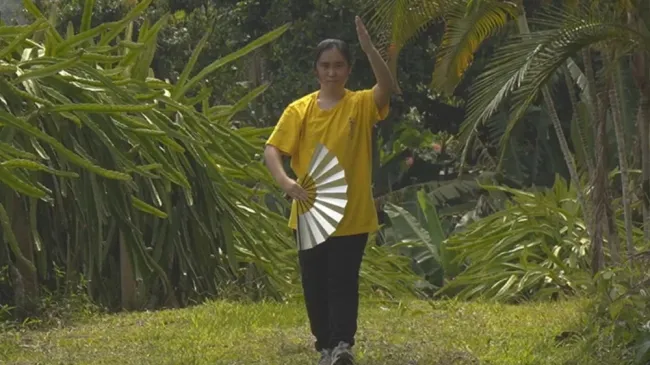
A visual motif of waves viewed from above punctuates different segments of the film, typically as its subject reflect on the previous movements of their families. In the first instance of the shot, a dissolve to a young girl practicing a traditional Japanese dance on her family’s farm in Brazil immediately communicates that feeling of “saudade,” a soft and gently expressed shadow hanging over much of the film. That feeling of “saudade” is seen in the incidental details the director chooses to include, like how one subject’s grandfather grew dragonfruit with Okinawan seeds, as well as his capturing of more outwardly emotional moments, like a tearful reaction to photos not seen in a long time.
The teenage girl Yumi practices Ryukyu Buyo, while a man named Everton practices Eisa, an Okinawan folk dance involving drums. By unspooling their enthusiasm for the history of such Okinawan heritage arts and the history of their families, Matsubayashi also orbits a history of displacement. This emerges in an accumulation of lots of small personal stories, like how one characters recounts their family’s war-motivated exile from Santos. Yumi and Everton also learn more of these details for themselves, the film following them on their travels to Okinawa through exchange programs and traineeships. (In some delightful cases, the learning cuts both ways, as Everton reunites with estranged family, and Yumi’s Okinawan relative marvels at the dialect being preserved halfway around the world.)
Capturing their subjects’ respective journeys with occasional and mostly spontaneous interviews, Matsubayashi prioritizes personal histories over the big picture,as the assembly of the footage and the occasional interjection of archival material makes the relationship of this diaspora a bit clearer. Some of these families left Okinawa to avoid the military draft as well as starvation. Others were divided because of land seizures by the US military in the wake of the war (“I’ve learned that this is a sad place,” Yumi reflects, a quote placed over footage of lingering American military bases on the island). Some viewers might be dissatisfied with how Matsubayashi never quite engages with World War II and the full history of Okinawan annexation directly, but the context feels like plenty for the stories which he is telling, choosing instead to focus on the feelings which all children of immigrant backgrounds have felt: an uncertainty about their connection with the homeland of their parents and grandparents, and a yearning to understand it. The glimpses are enough, as “Okinawa Saudade”gradually paints a picture of how the historical struggles of the island have translated to the diaspora.
Everton outright says why he engages in Eisa drumming, saying that “we are Brazilians, but we don’t look like Brazilians, so we are always looking for belonging,” and his engagement with these traditional artforms becomes a part of this. Both learn the different nuances of their respective practices at home compared to in Okinawa, though both are graced with teachers who refuse to be super didactic about what is “authentic” (“We are always adjusting,” Yumi’s teacher says, “there is no such thing as perfection”). It’s also simply moving seeing, through Matsubayashi’s rather unvarnished camerawork, how the connections and feelings embodied in performing arts can have such far reach across time and place, highlighting the community found by the Brazilian Okinawans who preserved a little piece of the island for themselves.
Grade: B+
“Okinawa Saudade” premiered at the 2026 Tokyo International Film Festival. It is currently seeking U.S. distribution.











Leave a Reply