
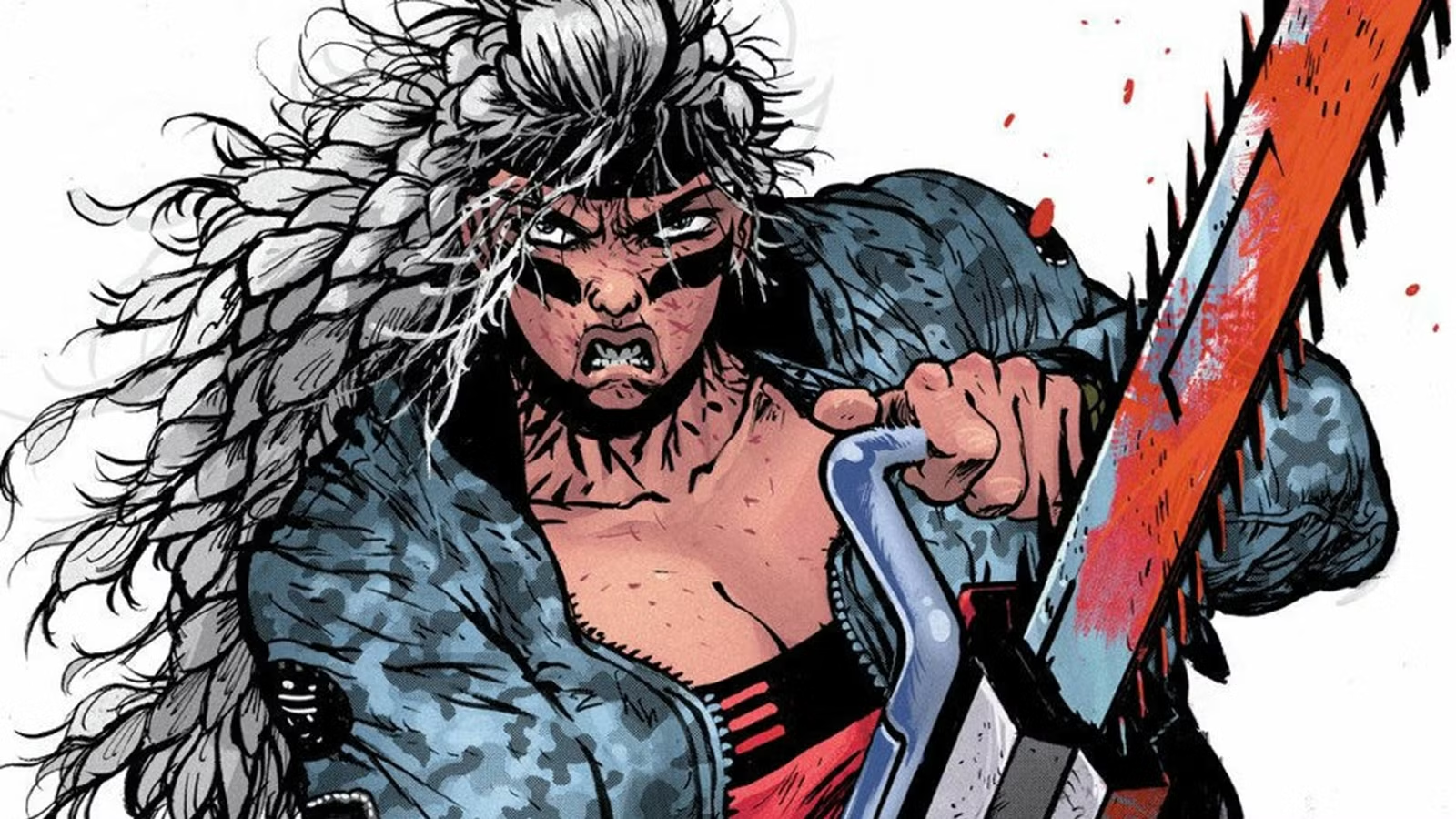
Daniel Warren Johnson has been on quite the roll lately. It seems like every year, the superstar writer/artist is picking up a new Eisner Award, winning for Do a Power Bomb!, and then Transformers and most recently, for his iconic Absolute Batman Annual #1 story that went viral on the internet.
After his Absolute Batman story made such a huge splash, he is returning to creator-owned comic books with a new Image Comics series launching this week called Chainkata, which is based on a character that Johnson first sketched out nearly a decade ago. In a CBR exclusive interview with the superstar, we talked about the origins of Chainkata, and how the series differentiates from his past work, while still holding true to the basic principles he has maintained throughout his comic book work.

Image Comics was nice enough to give us some preview images of the first issue of Chainkata that we will mix into the interview.
|
NEW Amazing Spider-Man Annual #1 Marvel, 1964 · CGC 5.0 Comic value $1,353 Detective Comics #378 DC, 1968 · CGC 9.8 Comic value $1,205 |
CBR: So, here’s an interesting story. In 1977, Dave Cockrum was working at Marvel as a staffer. He was drawing John Carter of Mars. He had just done a story in that comic with Dejah Thoris in it. Dave Cockrum famously always liked to draw beautiful ladies. That’s what he did IN the comics, and even when he wasn’t drawing for the comics, he would still draw pretty ladies on the side. He would just do these pinups for fun.
And so he drew a pinup of this beautiful lady, and two Marvel staffers, his coworkers, Paty Greer (later his wife, Paty Cockrum) and Andy Yanchus, both staff colorists, look at this drawing and go, “This is great. We’re going to do something interesting with it. We’re going to color it weird. We’re going to give her blue skin. We’re going to give her a whole look.” And they hang the finished piece up on the cubicle.

Chris Claremont walks by, sees it, and says, “Who is this? I want her for one of my books.” And Cockrum says, “It’s just a pretty lady I was drawing.” And obviously Claremont took it, made it Mystique, and then that became a pretty major character. And it just speaks to me, the power of what one simple sketch can mean for people. Chainkata, of course, all started with a single sketch of the star of the series, Luma, by you years ago. Can you speak a little bit about how that one drawing stood with you for so long?
Daniel Warren Johnson: Yeah, that’s a great question. Well, it’s something I kind of stumbled into. I had been wanting to get back to science fiction in some way, shape, or form since basically breaking into comics, where I didn’t have enough time to work on my webcomic, Space Mullet, anymore, which obviously was sci-fi. And the reason I picked sci-fi for my genre of webcomic back in the day is because I knew I sucked at machinery and tech, etc., all the sharp-angled things that I had no idea how to draw. Very uncomfortable with a ruler, shall we say? So I picked it to push myself, and push me it did. Space Mullet was trial by fire in every way, but of course, one thing leads to another. Working on The Ghost Fleet, Extremity, I just had to leave Space Mullet behind because I didn’t have time, and it was not paying the bills.
So it was always this itch to return to sci-fi after going through the gauntlet of published comics and having that experience in my tool belt, and the ability then to draw sci-fi and feel more comfortable in the world, which Space Mullet gave me. So I was always, I do this all the time still now, always looking for a way into new stories, new inspirations. And with the knowledge that, eventually, I did want to return to sci-fi, I would just draw characters, not really thinking about where they might go, but hopefully that had some sort of exciting element to them.
So I never really read any books or played the game, but I always loved the Warhammer vibe. Love things like Princess Mononoke, with strong female leads that have a deep magical and spiritual energy to them. So I always thought it’d be cool to have those kinds of influences with a female-led sci-fi cast, but that’s all I really had in my head. And so I’m just sketching, and I was like, “Well, this could be cool. Can I make a cool science fiction lady that can carry a story on her back?”
And so it was just me riffing, really, and not really knowing where the story was going to go or where to take it, but trying to find the visuals first because all I had time for was a sketch, like your story illustrates. I was just doing it on the side, and that sketch was almost like an accident. So you’ll notice that sketch, or I don’t know when the last time you saw it was, but there’s no chainsaw at all. Chainsaws were not a part of that story when I started. It wasn’t until much later that chainsaws were even considered for addition. I was just trying to come up with a character that made me excited, made me want to draw, and again, carry a story on her back.
Is it then a situation where you had this character and were thinking, what would it be cool to have this character do, and then eventually end up with chainsaws, or what?
It was more like, well, as you know, drawing comics, you have to draw the character every day, again and again and again, and you have to believe. The character has to make you believe and make you feel like, “Yeah, oh yeah, I could enjoy drawing this character over and over.” So if that’s not there in the initial part of it, it’s a bit of a chore, to say the least.
With something like Do a Powerbomb!, I hadn’t really come up with the character designs until maybe three months before drawing the book because I was just in the script phase, and that was just the way that project started. But Extremity was the opposite. I started with a sketch of Thea, and then that’s kind of where that story led. And Chainkata was more like Extremity in that it was more of a visual exploration, slowly, in the background while working on Wonder Woman, Beta Ray Bill, Do a Powerbomb!
So it was really just something that I was experimenting with and finding very organically. I wish that I could say I had a bullet-point plan of how to apply the character to the story, but things just revealed themselves to me in very, very thin onion layers.
Did you then come to, I guess, grow to have a special affinity for this unnamed character? Did this character come to have some meaning to you from having just sketched her out for so many years?
Yes, I think so. I mean, I can flip back through multiple, at least 15 sketchbooks, and have Luma be there.
Wow!
And it was almost like, it’s funny that you mentioned it that way, but almost like she became a companion in my artistic journey.

Interesting.
And also, just because I’m sketching a character, it’s almost like they never die. There’s no guarantee that this character’s story is going to get told, right? Because until you sit down and really apply yourself to the script and the outline, things just aren’t going to get born. And that’s one thing I don’t want to do as a creative person. If I feel strongly enough about something, I do want to try and put that work in.
But until I did have time, which happened during COVID, I finally had time. It just kind of existed in the ether of my mind. Then the birthing process was very difficult and strenuous, but that’s where things like the chainsaw come out.
Gotcha.
Where you’re trying to find a new way, and after drawing this character for so long with just a space gun and space armor, it just looks like another Destiny knockoff or another Warhammer lady, or etc., etc. Finding a new way into science fiction, and that whole kind of over-the-top sci-fi fantasy, heavy metal vibes, it’s all been done before. I want mine to look different and soulful enough that people can approach it in a new way, on their own terms, and treat it like a new story and not just like a rehash. And the visual language of that is really important, in my opinion, especially in science fiction.
That’s got to be fascinating. It’s almost like after X amount of years, you had to put it away because if you felt that you didn’t have a story for it, you’d almost be wasting this character then, I guess, right?
I did, and I did have to put it away. Actually, in 2020, I started outlining it, scripting it out, and it went nowhere. That was the first start. That was the beginning months of the pandemic, and then by the end of the summer of 2020, or fall, I’m hazy on that one, before 2021 began, I had shelved it, and it did feel like a death.
I bet, I bet. Because you had her for so many years, right? I mean, come on, that’s SO long!
I did. At least the script was dead. That outline was dead. I mean, I was banging my head against a concrete wall for months, just not coming up with anything good. But it’s so funny that you bring up the sketches. I still sketched her during that period.
Oh, really? Even after you dropped it? That’s interesting.
Even after I dropped it. And there were a few things that happened that brought me back to it. One was seeing the first Dune movie in late ’21, with Denis’ take on that universe, and I was blown away. It’s one of my favorite movies of all time now, and I remember thinking, maybe this is possible. Maybe there is a way for me to tell a new story in a new way, or at least tell it in a way that is mine.
And it kind of got me back on the horse with it, and I pulled the script off the shelf and started, or the outline, I should say, and started working on it. And there was another thing that I did. I played a video game, actually. This is pretty indie, but it was called Valfaris.

Okay.
It’s like a side-scroller. But it’s like the most heavy metal shit you’ve ever seen. If you just Google it, you’ll get exactly what I mean. But obviously, it’s a video game, right? So the character that you’re playing is just thrown into some crazy scenario because the developers want you to get to playing right away.
And it just reminded me how immediate comics can be and how immediate my story can be. I don’t need to have a Bible that people have to read before they start the science fiction tale. We can just go right in. And again, the visuals, the music. One of the musicians from Celtic Frost did all the music for that game, and it made me really happy and really excited to draw. And that also got me back on the horse and back to the sketchbooks.
There was one very gestural sketch of Luma that I did just on a whim that really made me believe again. It returned me back to the possibility of drawing this character and doing this story. So it was all that, again, very organic, and every time I really tried to force it, the story would pull back. And it was hard because I didn’t want to wait. I didn’t want to have to trust that eventually it would work.
In a lot of ways, I thought this would be the one that never got made. So honestly, to be here talking to you about it, even just mentioning these sketches, having the release be so close, it feels like a miracle.
It’s almost like, as you say, the opposite of death. It’s like you’re giving birth, you’re giving life to this, and it’s actually got to be so rewarding and emotional.
It is rewarding. It is rewarding, and you know what’s so funny? It’s also sad because, okay, now…

I got you. Now it’s no more.
Yeah, well, I don’t draw Murder Falcon in my sketchbook anymore, ever. That story, that character is in my past. It’s in my rearview mirror, and I don’t look back that often. Same thing with any character I’ve worked on, Beta Ray Bill, Wonder Woman. I still do draw Optimus Prime fairly often.
Well, come on, that goes back too long, too many decades.
Yeah. Yes. Foundational element.
Muscle memory.
Exactly. Well, yes, dude. I spent so much time when I got that gig figuring out how to draw him right that I’m like, I can’t just put this to waste.
But yeah, all those things had an effect, and it is emotional, but it is like a death. Now that it’s actually on the page, there’s a bit of a letting go. But ultimately, it is a good thing because I don’t want to be the creator that just draws things in their sketchbook when it never comes to life. It needs to have a birth, a living time, and then a death when it’s over.
What’s fascinating, I guess, on that note, with an ongoing title, that means I’m sure your sketchbooks are filled with other nuggets that can never be, because as long as you’re doing Chainkata, you can’t possibly have time to do those other ideas, right? It’s got to be a weird balance.
That’s funny. That’s one thing that does happen when I work on creator-owned projects. My imagination overall is much less active because it’s taking up so much of my mental and soul energy to get this thing made. And I wear these stories on my sleeve. I don’t get to put the story and the art away like I do when I work on Transformers. At the end of the day, I carry it with me all the time.
There’s a freedom in knowing that Hasbro has the final say. And that’s it. In a lot of ways, it’s a good thing. It’s a healthy thing. It allows me to have fun and be creative while also getting to really step away at the end of the day.
Whereas this discipline about working on Chainkata, I can feel it pulling from me in every which way, which again means that I don’t have that time to soak into other stories, ideas, character designs for my own making. So I guess this just means that I’ll have to draw Wolverine or something after Chainkata and get frustrated with “the man” again.
Joshua Williamson had a funny line when I was talking to him about the freedom of knowing, “I’m not going to ruin Batman.”
Exactly. Somebody else is going to come along and get some nerds mad.
It’s not like, okay, that’s it. This story ended in Batman. Sorry, he had a long run, but this story arc ended it.
Yeah, there’s that freedom there, and ultimately, you’re sharing that burden with a publisher who is having the final say, which is the way it is. And with those limitations come freedom. When you can do whatever you want on a story and your own characters, things get real dicey. The stakes get real high, and you look in the mirror far more.

That’s got to be crazy, too. The freedom of an Image #1, is great. Of course, it’s great, but because of that, you end up probably putting so much of yourself into these number ones, because you know this is the introduction of everything, and it’s…
Like an issue zero.
Yeah, and the page count, everything is under your control. So that’s got to be a lot. That’s got to be such a heady premise for when you launch a new book like this.
And I think that’s one of the reasons that it took so long, just figuring out where. I mean, I’ve been working on it for so long that I basically know the entire timeline of the story.
Wow.
And a lot of starting this process was figuring out, where do I enter? And as I’m writing issue one, and as I’m drawing issue one, man, I sure hope I made the right choice.
That is fascinating. You see that a lot in fiction, like famously, Ender’s Game, that all was a prologue to another book, and then Card was like, oh, never mind, this story is the story.
Yeah, heck yeah, exactly. And so in a lot of ways, there’s a lot of self-doubt in that regard, too, where it’s like, oh boy, oh boy.
And also the fact that even creators and family members and friends, people that I trust in my life, they’re like, “Hey, what are you working on?” And I’m like, “Oh, I’m working on this comic about ladies with chainsaws, heavy metal vibes. It’s really cool.”
And even people who know what I’m capable of, people in the industry, editors, artists, writers, peers, they’re looking at me like, “Huh?” Because it’s not real to them, right? It’s not like, “Hey, I’m working on Wonder Woman. I’m working on this, or I might be working on this character.”
There’s nothing solid about it. Everybody’s like, “Sure, great,” and there’s nothing solid for them to grasp onto. So then, all of a sudden, I’m like, is there anything to grasp onto? Am I just in outer space here?
And the only person that truly believed in it, my wife, my mom and dad, my close friends, of course, they do believe in me and believe in my ideas. But nobody really believed in Chainkata except for me. It took me to breathe it into existence and convince people that it was worthwhile, and the only way to do that is to make it and blow people away with an issue one.
Well, what’s fascinating, I imagine, right now we’re seeing you’re in the middle of this situation where you’re selling out of black-and-white reprints of Do a Powerbomb!
That’s true.
So revisiting that material has got to at least pump you up for whatever you’re doing now. Seeing the reactions to your reprint material of Do a Powerbomb!, it’s got to at least get you really hyped for whatever’s going on from the reaction.
Yes, I mean, it does, but also nothing’s really changed over here. My kids are still not calming down at the end of the day. I’m still dealing with the electrician who needs me in the long run. Life is continuing on.
Right.
And my job is very… I just draw in my house all day, or I write in my house all day. You know when it really hits me, that pumped-up feeling you’re talking about, is when somebody starts talking to me about how cool my books are in a different language.
I imagine.
There is no feeling in the world as cool as having an Italian person be super excited and start with saying, “I’m Daniel Warren Johnson. I love Murder Falcon,” and then they just start speaking to you in Italian.
That’s amazing.
It’s awesome. So that makes it feel real. The numbers, who’s buying what, the comic shops, it’s all business, and it’s all good. But it’s something that I don’t think about much.
If anything, I was a little worried about releasing Do a Powerbomb! in this kind of black-and-white hybrid-color vibe. But honestly, just again trying to find a new way to show something and to tell a story. That was part of it, and I just had to lean in and hope that people would follow me. And so far, it looks like people have. We’ll see. We’ll see.
Well, that’s interesting to talk about the coloring. What led to your coloring approach on Chainkata?
Well, it all started with trying to, again, I’ve said it a lot, but find a new way to show science fiction, especially this kind of popular, heavy-metal style of science fiction.

Right.
And make it feel exciting and kind of daring. And for the longest time, science fiction, to show space in comics, has always been like, ink something black, ink a background black, and then use a toothbrush with white on it, and it looks great. And I did that all through Space Mullet, and I just knew going into Chainkata that I needed to find a new way.
So I was kind of inspired by Kirby’s collage stuff that he did, right?
The immensity of everything, right?
Yeah. Oh yeah, and the contrast is so immediate and very satisfying. And then also trying to incorporate some element of chaos and randomness to the art, where I do have a lot of chaos in my lines, but everything is still quite intentional. And I love the contrast of finding a way to contrast that intentional with the chaos.
And so finding this new way to show galaxies, space, and scenes of importance really was part of the creative process of finding how to make the book. And once I did figure that out, and once I did feel like I had nailed it, the contrast was so strong when the art was in black and white with some of these specific color examples that I knew it was the visual identity and the language of the book.
And I went into Chainkata telling Mike Spicer, “I want you on the book. We’re going to figure it out.” And then once I saw the way that I had done it, I told Mike, “I still want you to color it, but I also need to figure out a way to have my cake and eat it too.”
And so that was because I really do love every time I give Mike something to color. He always brings a new energy and life to it, and he’s an incredible collaborator. And so I said, “Let’s have you color the collected edition so people can still see your addition to this world, and then the single issues will be black and white with a little bit of this hybrid color, so that people can kind of see the original way that I had the book in my mind.”
Then we can have it both ways, and I don’t really care about people trade-waiting or double-dipping. I don’t care about any of that. It’s never bothered me if someone trade-waits, so I’m not trying to get a trade-waiter’s money. But I do think this way of presentation within single issues gives people a reason to come to the comic book shop that goes a little bit beyond, like, the comic has a letters column. It’s just a different experience that I hope will honestly bring more people into the comic stores and have something to talk about on Wednesdays.
That’s great. Speaking, I guess, of the collections, that’s got to be such a fascinating thing. For instance, when our generation was getting into comics, there’s this long history that exists obviously before you get into it all. And so for us, you could read, say, Archie Goodwin and Walt Simonson’s Manhunter and just have it be new to you.
So it’s got to be crazy now that you have started to stack up this backlog, that now you have these fans who have all these new experiences of your old work at the same time they’re getting Chainkata.
It’s the coolest thing ever. That’s really fun. Going to shows and signings and having fans tell me the books that they started with is very rewarding. And I love talking about my old work. It’s just different with everyone. Some people started with The Moon Is Following Us. Some people started with Beta Ray Bill. There are a few people that were reading my webcomic way, way back, started with Space Mullet. And yeah, it’s the coolest thing.
And it’s my life’s dream to have a Daniel Warren Johnson table set up at my childhood Barnes & Noble in Framingham, Massachusetts. I don’t know. I feel it. All I can say is that I feel it. It feels awesome. Feels really cool.

What’s so funny is that with The Moon Is Following Us, and now Chainkata, it’s got to be interesting to see your real-life experiences impact the direction of the books. For instance, The Moon Is Following Us was so visceral about having kids.
But now Chainkata, obviously, it’s not as obvious as that, but it has that same element of that sort of growth and the changes, as you say, in your life as time goes by. The births, the changes, that whole life cycle. You see this sort of thing with many writers. You can look at Jim Starlin going back, and as The Death of Captain Marvel and Dreadstar happen, it’s all about changes in his life.
Is this something where those sorts of life changes are on the top of your mind when you’re creating stuff like this, or is it just an aftereffect of that’s how you’re living your life, and it’s going to affect your work no matter what?
I think it’s probably the first one. I just only know how to write what I know. I don’t see myself writing a Civil War historical fiction comic at any point. This is probably a detriment, what I’m about to say, but I only know one speed. It’s 110, heart strapped to the sleeve, devil may care, and I don’t look back too often.
So I guess I’m terrified. I’ll just say it. I’m terrified of just repeating myself, and I’m sure I’ve already done it. But I just know what it takes for me to be able to finish a comic book with all the work and all the emotions and all the ups and downs and the numbers and the business and the drawing. It’s only worth it if I make what I am feeling, and what I’m feeling, honestly, is just what you read on the page. That goes for Transformers, Wonder Woman, and my creator-owned stuff. It’s really, probably shouldn’t be this honest, but you’re reading me.
Right.
It’s as simple as that. So maybe it’s just me trying to figure out different ways to say the same thing over and over again, and maybe I will graduate to some other version of storytelling, but as of right now, until people stop buying the comics, this is just the way that I’m going to make it.
And I wish that I was better at being more chameleon-like. Unfortunately, I am bad at it. Also, unsurprisingly, I am terrible at poker {laughs}
Well, I mean, not for nothing, look at some of the strongest comic book voices ever. You mentioned Kirby. Kirby, not for nothing, he would repeat a lot of the same themes over and over in his work, and because what you’re getting in a Jack Kirby comic is that you’re getting Jack Kirby, and that’s what we love about it.
Obviously. And also, I only have so many stories in the tank. I’m not going to live forever. At some point, this is all going to be over, and I hope that there’s something left that people want to read of my stuff. And yeah, all I can do is just swing for the fences every single time with everything I have, and that’s just kind of the name of the game for me.
Well, as you said, as you noted before, though, and I think it’s similar to that concept, which is why a lot of these themes in science fiction are going to be familiar. They’re going to be similar from book to book. So much of it is just your personality is what makes it stand out.
That’s true. That’s true. I guess I wonder. I have a fear that people will get tired of my personality.
Well, then that, though, is why it’s got to be interesting when you have to go back to do whatever the setup for these reprints of Do a Powerbomb!, and you see that, hey, people are responding to your personality in REPRINT FORM, for God’s sake.
In black and white.
In black and white, right.
Yeah. So that does feel good. And I wish I could take credit for the idea, but it was actually just Image being like, “Do you want to do black-and-white single issues of Do a Powerbomb!?”
At the same time, I guess when you see a success like Do a Powerbomb!, does it cause a situation where you feel it’s hard to live up to it, or does it reinvigorate you? Is it both, depending on the day?
Now that I am far away from it, and the black-and-white reprints, as you said, sold well, that is very invigorating. The season I actually finished Do a Powerbomb! was one of the toughest of my creative life. I think I had just stuck the landing so well. I felt so good about the story and the way that I did it, and it didn’t blow the roof off anybody with numbers, but it did solid enough that I was providing for my family. I was just so happy with it. And I had so much fun making it from page one to the last page.
I guess I finished it, and I was like, “I think I peaked. I think this is it.”
And that was scary. And I just didn’t know what was going to be next. I just felt, how the heck am I going to top myself? With going 110% all the time, there could be moments and seasons where you’re like, “Have I just given everything that I have to give?”
And that was definitely one of those times when I was like, “Maybe, maybe this is it. Maybe this is all the stories that I have.” And that was a bit of a creative lull for me, too. And it was actually good that Transformers came at that time because I really did need a “break.”
As we established, as you say, you put so much on yourself on these creator-owned projects.
Yeah, yeah. And when you put all that in there, there can be a little bit of a void when it’s gone, and a little bit of, “Oh, I have to do this over again now.”

Like, “Okay, that’s perfect. Now do it again.”
Exactly, exactly. Yeah, dance, monkey, dance.
Which, you’d think by now I would know how the creative process works, and that it’s not just ring around the rosy. It takes time, and that’s okay, and it’s okay for it to take time. But when you’re in the midst of staring down a new project after such a successful one, after draining so much of that life energy, it is very overwhelming.
So I’m trying to not let that happen with Chainkata. It’s something that I’ve learned with Do a Powerbomb!, and I’m hoping I’ll be able to bounce back faster when Chainkata is over. That being said, I will probably fail.
Does the more open-ended aspect of Chainkata help there, where you’re not as pressed to have the perfect ending because it’s not as limited of a story?
No, because I think Chainkata ultimately is a different kind of story. Because it is an ongoing, because the scope is so big, the world is so big, the ending is going to be different anyway, and the tone of that ending is going to be different.
With Do a Powerbomb!, it was so short that the ending had to be perfect. After you close, after you read that last page, you’re done. And with Chainkata, you are going to be done at the end of the story. And I do have the ending exactly in my mind. But the way that we get there is obviously a little more roundabout, and with that roundaboutness, with the larger cast, with the helicopter view of a lot of things that happen in the story, the emotional elements are kind of a little bit further away from the viewer in my mind.
And I think that’s kind of a nice change because usually I’m right up in people’s faces with the feelings, so to speak. And so I do think, I’m hoping that this differentiates Chainkata as well from my previous work.
Chainkata #1 is out this week.




Leave a Reply