
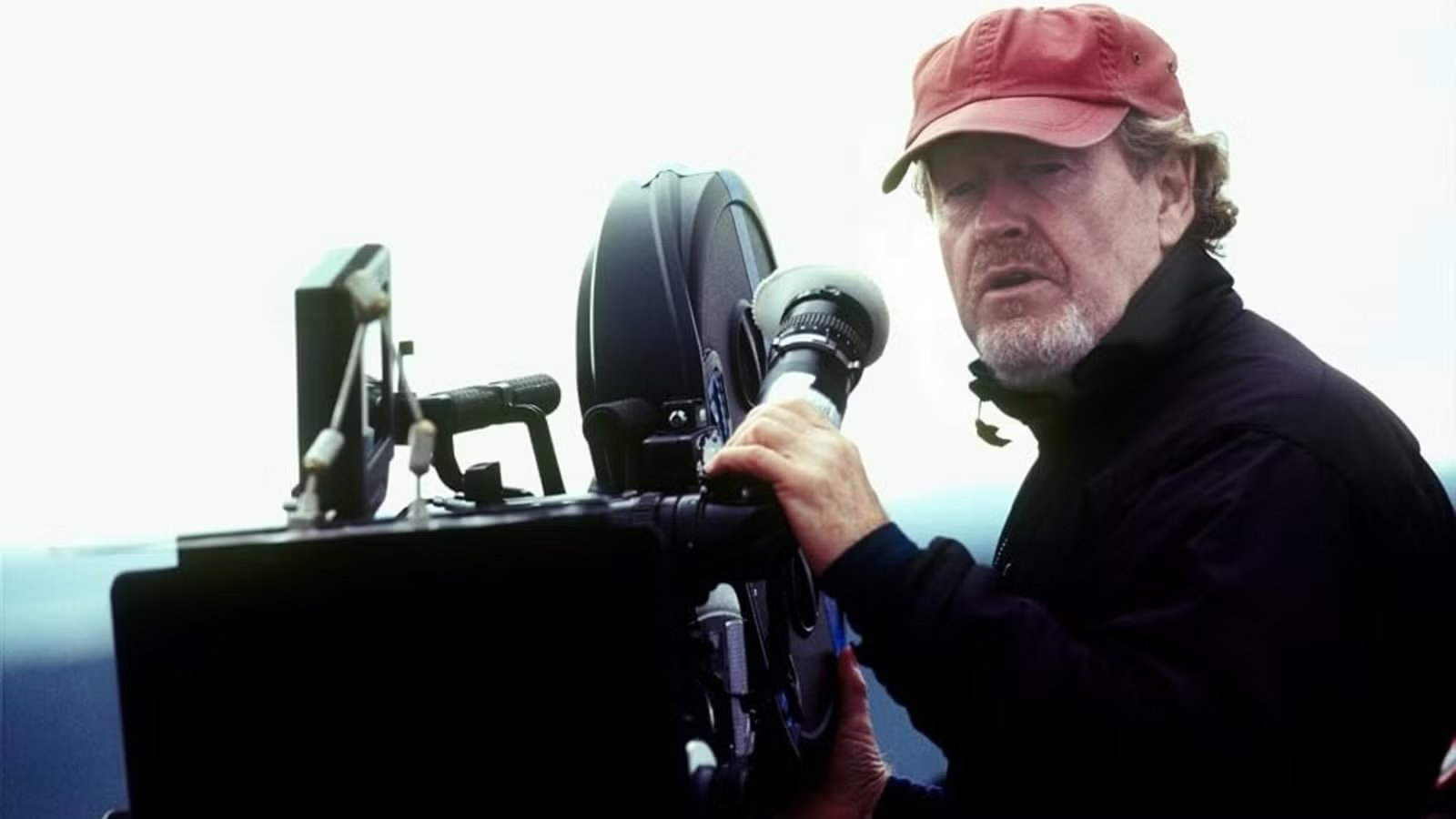
Ridley Scott was on a critically acclaimed run in the early 2000s, releasing Gladiator (2000), Black Hawk Down (2001), and Matchstick Men (2003) in quick succession. The Alien director’s streak ended with Kingdom of Heaven (2005). The historical action epic is set in the 12th century. It follows Balian of Ibelin (Orlando Bloom) as he travels to Jerusalem and becomes the city’s defender during the Crusades. After Gladiator won Best Picture at the Academy Awards, another bloody entry into the genre seemed a perfect fit.
I couldn’t wait to see Kingdom of Heaven, so I headed to the theater on opening weekend. The action was spectacular, and the final siege sequence was a masterclass in scope and execution. Still, I was disappointed by the film’s weak character elements, and I wasn’t alone. Kingdom of Heaven holds a 39% rating from critics on Rotten Tomatoes, and the consensus captures the issue perfectly, noting, “Although it’s an objective and handsomely presented take on the Crusades, Kingdom of Heaven lacks depth.” Thankfully, Scott released a director’s cut on DVD that restored nearly 45 minutes of footage, and the changes are staggering, turning a critical misfire into a 72% audience rating on Rotten Tomatoes.
‘Kingdom of Heaven’s Theatrical Release Prioritized Style Over Substance
The Kingdom of Heaven trailers teased massive battle sequences, with Scott appearing to top the ambitious action of Gladiator. The ensemble cast spoke volumes, with Bloom joined by Liam Neeson, Eva Green, Edward Norton, David Thewlis, and Michael Sheen. Even a pre-Game of Thrones Nikolaj Coster-Waldau is recognizable to keen-eyed viewers. The theatrical cut runs 144 minutes and follows a lengthy journey with many characters. 20th Century Fox reportedly insisted the film be edited down from Scott’s intended 189-minute version.
Fun Fact: A third edit of Kingdom of Heaven runs 194 minutes. It’s called the roadshow format presentation, featuring the director’s cut with an added Overture, Intermission, and Entr’acte.
The edits pushed the movie to prioritize action, leaving many scenes that added character development and story context on the cutting room floor. Character motivations were lost, causing characters like Sibylla (Green) to make improbable choices. It was an action-packed spectacle full of stellar performances, but it was hard to care about most characters. The narrative felt disjointed and at times incoherent.
The movie offers geopolitical and religious tensions, but Kingdom of Heaven failed to connect on a meaningful level. Rather than drawing audiences into the emotional stakes, the rushed edit leaned into flashy spectacle, hoping to hide the story’s flaws. Kingdom of Heaven recouped its $130 million budget, finishing its theatrical run with a worldwide box office of $214 million. Still, Scott’s director’s cut restored the elements that make it an underrated gem.
The ‘Kingdom of Heaven’ Director’s Cut Makes Sweeping Changes

I hesitated to revisit the movie on DVD, especially since the director’s cut runs over three hours, but positive word of mouth drew me in. What began as a disappointing theatrical release became an undeniable masterpiece of action, dialogue, and character work. Changes to dialogue can be nearly imperceptible, like the acolyte on the pilgrims’ road saying, “To kill an infidel, the Pope has said, is not murder. It is the path to heaven.” The theatrical cut features the line but shortens it to, “To kill an infidel is not murder. It is the path to heaven.”
Some additions merely extend action scenes with heightened graphic violence. It seems odd for the theatrical cut to lose blood and gore in an R-rated film, but the brutal combat feels better constructed in the director’s cut. From fighting alongside Godfrey (Neeson) early in the movie to the final siege, every scene has noticeably more violent imagery. The added action improves the overall viewing experience, but it’s not inherently what makes the director’s cut better.
The extra 45 minutes slow the pacing, but it becomes more engaging and tense by letting motivations and emotional stakes shine. Rather than rushing to action beats, the director’s cut lingers on political intrigue and escalating tensions naturally. The disjointed, incoherent narrative that hindered the theatrical cut now flourishes with impeccable story details, some of which were baffling removals.
The Priest

The opening scene of the director’s cut is longer, featuring additional scenes with Godfrey and the priest (Sheen). Balian kills the priest before setting off for Jerusalem, with new scenes fleshing out his motivations. The priest is revealed to be Balian’s half-brother, adding context missing from the theatrical release. The priest is also seen stealing a crucifix necklace from a woman’s corpse, revealed to be Balian’s deceased wife. While audiences knew Balian’s wife had died, the necklace theft further fueled his motivation to kill the priest.
Balian’s Background

The theatrical cut shows Balian rising to power in Jerusalem, leading the people in their stand against the incursion. However, his rise as an exceptional military strategist sometimes seemed like happenstance. The director’s cut clarifies that Balian has prior training as a military engineer. This detail makes his impressive defense of Jerusalem more logical, including how he neutralizes the siege towers late in the movie. His leadership and interpersonal skills gain extra weight with simple background information.
More Time With Secondary Characters

While it may seem detrimental to the pacing, the director’s cut lets the film’s religious and political themes breathe by giving secondary characters more room. Godfrey gets extra time before his early demise, but characters like the Hospitaler (Thewlis) truly help the story. By giving extra time to characters like the Hospitaler, King Baldwin IV, and Guy de Lusignan, Kingdom of Heaven explores deeper philosophical ideas, examining faith versus fanaticism through intricate relationships.
Sibylla’s Son

Without question, the biggest change in Scott’s director’s cut is Sibylla’s son, who does not appear in the theatrical cut. In the film, she aligns with Guy de Lusignan after her love affair with Balian, but that choice feels poorly motivated. The added story about her son gives her decision the context it needs. Sibylla’s brother, King Baldwin IV, suffers from leprosy and constant pain, wearing a metal mask throughout the movie. When King Baldwin IV dies, her young son becomes King Baldwin V. Sibylla’s allegiance to Guy de Lusignan comes from his promise to protect her son from those who want to invade Jerusalem.
She learns that her son also has leprosy. Rather than doom him to the same painful life she saw her brother endure, Sibylla makes the heartbreaking choice to poison her son, killing him to spare him the same suffering. This plunges her into deep depression, shifting her motivations. Her son’s death makes Sibylla the film’s most tragic character, a fact never hinted at in the theatrical cut.
The Director’s Cut Makes ‘Kingdom of Heaven’ a Classic

After watching the director’s cut, I was blown away that the studio thought the theatrical version deserved release. When I saw it on opening weekend, I considered Kingdom of Heaven one of Scott’s weakest films. He’s had misfires in the past, with the merits of films like G.I. Jane being debatable. However, as with Blade Runner, Scott released an edit that reflected his true vision. I’ve since touted Kingdom of Heaven as an underrated masterpiece worthy of rivaling the director’s acclaimed epics, like Gladiator and The Last Duel (2021).
I’m fully convinced that if Scott’s three-hour cut were the version that initially went to theaters, it would have been another lauded release for the director, sure to stir up plenty of awards attention. As it stands now, make sure you watch the version that isn’t the 144-minute theatrical cut. Now, if only there were just a better edit of Exodus: Gods and Kings (2014) floating around somewhere.

- Release Date
-
May 6, 2005
- Runtime
-
144 Minutes




Leave a Reply