
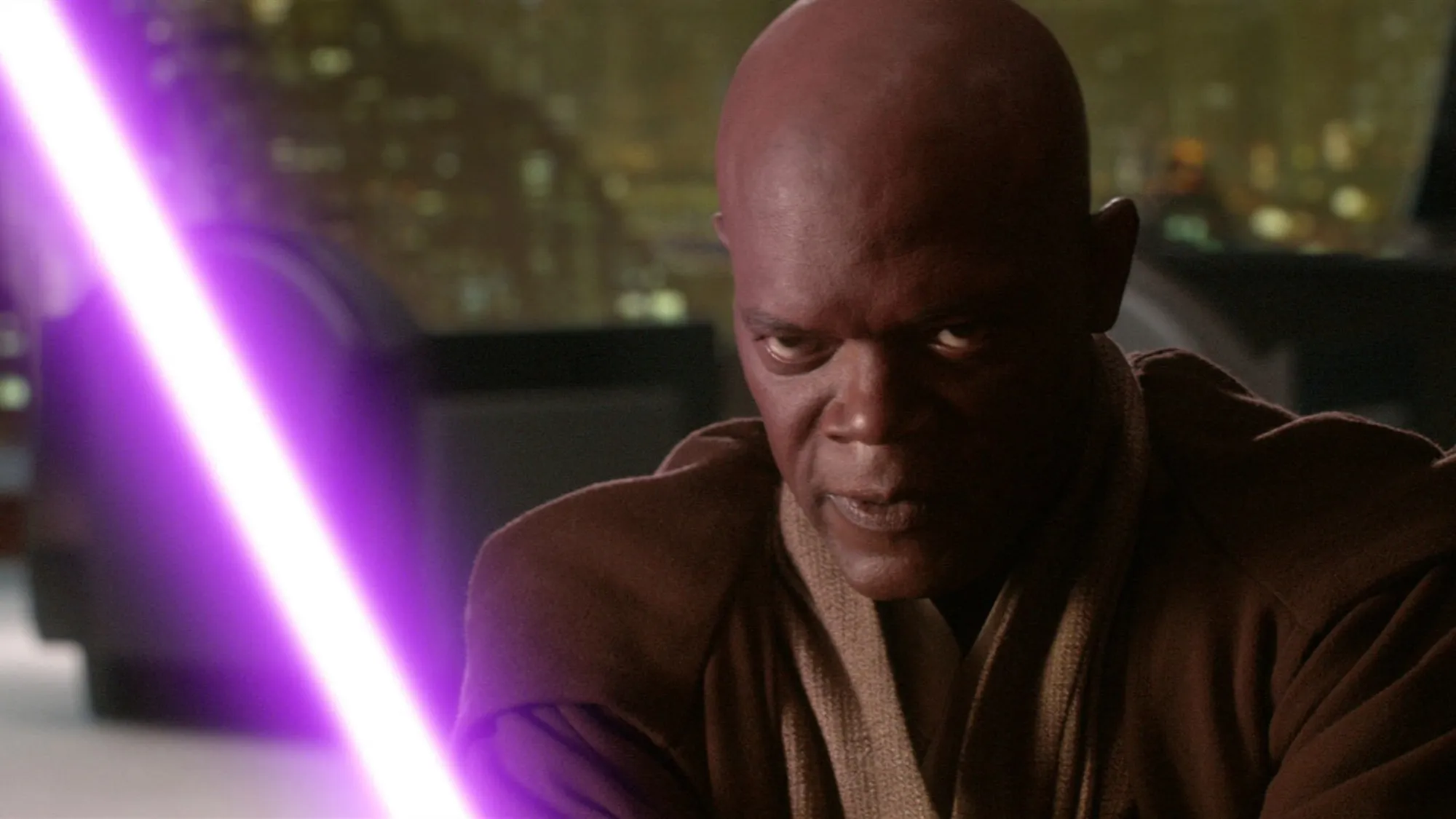
Samuel L. Jackson first appeared as the Jedi Master Mace Windu in Star Wars: Episode I – The Phantom Menace, which opened on May 19, 1999. Six years before that, there was already a Mace Windu in licensed Star Wars material, and he was not a Jedi. He was not human either. He turned up in 1993 via Galaxy Guide 7: Mos Eisley, a 96-page reference manual written by Martin Wixted and published by West End Games for people running their own Star Wars adventures at a table. His biography runs a few lines. He had been a bartender aboard a salvage cruiser, got stranded on Tatooine, and took work shifting used droids for a shop owner named Aguilae, which is exactly the kind of throwaway detail those books existed to supply.
The name was not an homage, because in 1993 there was nothing yet to pay homage to. Mace Windu was a character in a treatment George Lucas wrote in January 1973 and then abandoned, roughly 13 handwritten pages that survive as the earliest recognizable draft of anything Star Wars. For twenty years the name sat there as a discarded piece of trivia that anybody holding a license could pick up and use, and West End Games did just that, apparently without anyone raising a hand to stop them. Three years after that, a freelance writer gave the Squib a full name in a short story published in a tie-in magazine. That writer later joined Lucasfilm and became a founding member of the small group that decides what officially counts as Star Wars.
The First Mace Windu Sold Secondhand Droids Out Of A Mos Eisley Junk Shop

West End Games held the Star Wars roleplaying license from 1987, and across that run it produced dozens of books whose entire job was to make the galaxy feel occupied. Galaxy Guide 7: Mos Eisley was one of them. It takes the spaceport Luke Skywalker calls a “wretched hive” and fills it in street by street, so that anyone running a game there has a cantina bartender, a docking bay foreman and a droid dealer ready to hand. The droid dealer is the Squib. He works at a shop called Jawa Traders, he is small and covered in fur, and he haggles compulsively, which is less a personality trait than a species default. Squibs have turned up across decades of tie-in fiction as scrappy opportunists. His name is Mace Windy.
Nothing about that was provocative at the time. The name existed only in an unpublished treatment from two decades earlier, attached to no character anybody had seen, and a licensee reaching into that pile for something to call a background alien was ordinary practice. The books were written fast, they were written for a few thousand people who played the game, and the odds that any given walk-on would ever matter were effectively zero. Lucasfilm signed off. The Squib went into print in 1993 and sat there, one entry among hundreds, for three years before anyone did anything else with him.
George Lucas Wrote The Name In 1973 And Then Threw It Away

The treatment is called “The Journal of the Whills,” and Lucas wrote it in January 1973, four years before Star Wars reached a cinema. It runs to about 13 handwritten pages and it is barely recognizable as the film that followed, but the opening line is famous among people who go looking for this sort of thing: “This is the story of Mace Windy, a revered Jedi-bendu of Ophuchi, as related to us by C.J. Thorpe, padawaan learner to the famed Jedi.” You read that right, the spelling is Windy rather than Windu, the rank is Jedi-bendu rather than Jedi Master, and the character is a hero being described by his own apprentice.
Almost none of it survived. The name disappeared through the drafts that became the 1977 film and stayed gone through both sequels. Lucas started writing The Phantom Menace on November 1, 1994, working from an outline he had made in 1976, and somewhere in that process the abandoned name came back and landed on a member of the Jedi Council. By then the Squib had been in print for over a year. Two characters now carried a version of the same name, one of them a senior Jedi played by one of the most recognizable actors alive, and the other a fur-covered secondhand droid salesman on Tatooine.
The Writer Who Named The Squib Now Helps Decide What Counts As Star Wars

In November 1996, two and a half years before The Phantom Menace opened, the eleventh issue of the Star Wars Adventure Journal ran a short story called “Spare Parts.” The author was a freelancer named Pablo Hidalgo, and the story is a small piece of Mos Eisley crime fiction built around an accounting droid carrying information a local criminal wants for leverage over Jabba the Hutt. It is also where the Squib acquires a full name. Mace Windu turns out to be short for Macemillian-winduarté. That detail exists for the same reason most things in those magazines existed, which is that a writer was enjoying himself.
Hidalgo joined Lucasfilm in January 2000, eight months after The Phantom Menace reached cinemas. In 2014 he became a founding member of the Lucasfilm Story Group alongside Leland Chee and Kiri Hart, the small internal body responsible for keeping Star Wars continuity straight and ruling on what is and is not official. The writer who in 1996 decided a fur-covered droid dealer should be called Macemillian-winduarté spent the following decades helping govern the rules that such a decision would now have to pass. The whole sequence resurfaced in August 2026, when a fan account laid the dates out side by side.
The collision did eventually get tidied up, in the most Star Wars way available. Later material established that the Jedi Mace Windu helped defend the Squib homeworld of Skor II during the Clone Wars, and that a grateful King Ebareebaveebeedee put up a statue and handed him the title Big Time Hero of Beyond-Squib Eliteness, recorded in The New Essential Chronology in 2005.
A Squib calling himself Mace Windu stops being a continuity problem and becomes patriotism. Then Lucasfilm moved the entire Expanded Universe under the Legends banner on April 25, 2014, so none of it is official any more and the droid dealer is once again just a name somebody borrowed. I think that is the right ending for him. He was a scavenger the whole time.







Leave a Reply