
With spooky season rapidly approaching, Halloween lovers far and wide are ready to get cozied up next to their carved pumpkins and throw on their favorite horror movies. From Halloween to Friday the 13th, there are some truly iconic movies to choose from. But what if there are some less-appreciated gems hidden in plain sight that deserve another look?
Sequels often have a lot to live up to and, in many cases, fail to do so. This goes double for the horror genre, where the general small budget justifies a movie being made regardless of whether the quality was there to begin with. Still, a few sequels are either wrongfully panned or outright overlooked, so now is the perfect time to take a look at a few that will surely help those creepy feelings crawl back to the forefront this October.
Smile 2 Forces Viewers To Turn That Frown Upside Down

Smile 2 was a great return to the Smile franchise, but it didn’t quite do the numbers as the first movie and seems to have fallen by the wayside since its release. That shouldn’t discourage anybody who is a fan of modern horror from watching this movie, though. With the Halloween season right around the corner, this movie is well worth adding to the rotation.
Naomi Scott puts in a star-making role as popular pop star Skye Riley, who is tortured long before The Entity takes over. She’s forced to navigate drug abuse, past trauma, and then, of course, the ever-lingering Entity that terrorizes its victims by appearing in the form of some truly horrifying smiles. Smile 2 ups the ante compared to the first Smile by placing its terrifying curse on a worldwide superstar, and following Riley as she attempts to get rid of The Entity for good is about as entertaining as this type of movie can get. The film also offers visuals in the final few minutes that are a must-see for any horror fan and deserves to be sought out at least once.
Hatchet II Brings Victor Crowley Back For More Cheesy Slasher Mayhem

The original Hatchet trilogy is an interesting, gleefully gruesome case. While it took roughly a decade to complete, writer and director Adam Green was able to complete his vision, with each film taking place immediately after the other. Touting a 43% Tomatometer score, Hatchet II is considered the worst of the trilogy by critics — but that doesn’t mean it’s devoid of the slasher gore one would come to expect from Victor Crowley.
Hatchet II delves into the origins of Crowley and why he still haunts his Louisiana swamp, while directly tying main protagonist Marybeth Dunston’s father to Victor’s initial demise. The sequel’s pace was a lot slower than the original Hatchet, which left many fans of the original film’s chaotic throwback to 1980s slashers a little disappointed. Still, there is plenty to love here for anybody looking to scratch their 80s itch — especially with the most popular Jason Voorhees actor, Kane Hodder himself, starring as the resurrected swamp-stalker.
Ouija: Origin of Evil Makes A Movie About Ouija Boards Worth It

Ouija: Origin of Evil may technically be a prequel to the first Ouija, but it deserves a mention here for being one of the few second installments in a series that improves upon the first in almost every single way. Directed by acclaimed horror storyteller Mike Flanagan, Ouija: Origin of Evil explains exactly how the ghostly presence in the household seen in the original Ouija comes to be, with the young Doris Zander inviting it in with none other than a Ouija board.
While Ouija: Origin of Evil doesn’t necessarily bring anything new to the “possessed child” trope or horror genre in general, it’s Flanagan’s masterful way of executing the tension that sets the film head and shoulders above its predecessor’s fairly unremarkable scares. Flanagan is a master at reimagining horror tropes in extremely inventive ways, and Ouija: Origin of Evil is a great example of what he’d later become far more well known for.
The Exorcist III Is An Underrated Gem Left In the Shadow Of Its Terrible Predecessor

There is a primary reason The Exorcist III goes as overlooked as it does in the modern film landscape — and that comes in the form of the movies it’s sandwiched between. The Exorcist II is a notoriously bad film that only worked to sully the good name of the original — and 2004’s Exorcist: The Beginning was a doomed production from the start. The Exorcist franchise gave viewers very little to have faith in — which is a shame considering The Exorcist III is a very good story adapted directly from the Exorcist novel’s sequel, Legion.
The Exorcist III even managed to find an interesting way to bring the character of Father Damien Karras — the priest who sacrificed himself to save Regan MacNeil in the original Exorcist film — back into the fold without treading on The Exorcist‘s unforgettable ending. As it would turn out, the demon entity from the first Exorcist, Pazuzu, trapped the soul of the executed Gemini Killer — played to perfection by horror icon Brad Dourif — in the body of Karras, torturing the poor man even after death. While the studio-mandated, overly violent exorcism from the film’s finale misses the point of Legion‘s original story, horror fans can still do a lot worse than The Exorcist III — including just about any other movie in the series save for the original.
Land of the Dead Is An Underrated Romero Classic

All of George A. Romero’s Dead series deal with class division, but it has never been more prominently featured than in Land of the Dead. Its premise is an all-timer — the mega-rich live in luxury inside a fortified skyscraper, Fiddler’s Green, while the rest of the population slum it out outside the colossal building, working as grunts for the bigwigs. Land of the Dead‘s on-the-nose social commentary turned a few viewers off — when compared to the legendary Dawn of the Dead, it’s a lot less subtle — but there is still plenty of Romero’s gory zombie action for fans of the director to enjoy.
Another issue fans had with Land of the Dead was the weapon-toting Big Daddy — a zombie who teaches the nearby horde to use weapons and move in on Fiddler’s Green. Many longtime zombie movie fans found it too hokey for zombies to regain these skills, but it was Romero’s own film, Day of the Dead, that laid the foundation for this development. If one can turn their brain off for an hour and a half for some zombie action, Land of the Dead sits perfectly comfortably as an entry in Romero’s filmography.
Fear Street Part Two: 1978 Anchors the Spooky Story Of Shadyside

For those not quite ready to let go of Summer, Fear Street Part Two: 1978 brings viewers to Camp Nightwing for a Summer of scares. 1978 continues the story of what plagues the town of Shadyside, which is plagued by a curse that brings historical serial killers back to haunt its residents. While each installment of the Fear Street trilogy was only released a week apart, each film has its own specific identity with a piece of the puzzle about how to lift the curse plaguing the town.
Sadie Sink puts in yet another strong performance that helped solidify the Spider-Man: Brand New Day star as a leading lady for anything spooky and gloomy. Her character, Ziggy, is forced to navigate the infamous Shadyside killers on top of some well-written teenage angst in a story that eventually helps the primary 1994-era characters figure out how to deal with the town’s killer problem once and for all. Being sandwiched between Parts One and Three makes it the lesser-discussed of the three, but for those seeking horror with a summer atmosphere, it shouldn’t be missed.
Blair Witch Is A Lot Better Than It Gets Credit For Being

1999’s The Blair Witch Project was groundbreaking for the found footage genre, with its iconic viral marketing campaign and all the word-of-mouth surrounding its production. It’d be very difficult to replicate that atmosphere and, according to most critics, 2016’s follow-up, Blair Witch, failed to do so. However, many diehard Blair Witch Project fans have begun coming around to the film over the decade since its release, and have grown to appreciate the film for giving a little more to the audience.
Blair Witch also raises plenty of new questions when exploring the lore — but in ways more interesting than it’s given credit for. The concept of time dilation introduced in the first film is in full swing here, with many theories suggesting that an answer for it all may even be hidden within the film’s context. Blair Witch should be praised for attempting to expand on the lore that left so many viewers wanting more in 1999; even expansion isn’t necessarily what everyone wanted.
Red Dragon Returns Hannibal Lecter To the Menacing Mastermind He Is

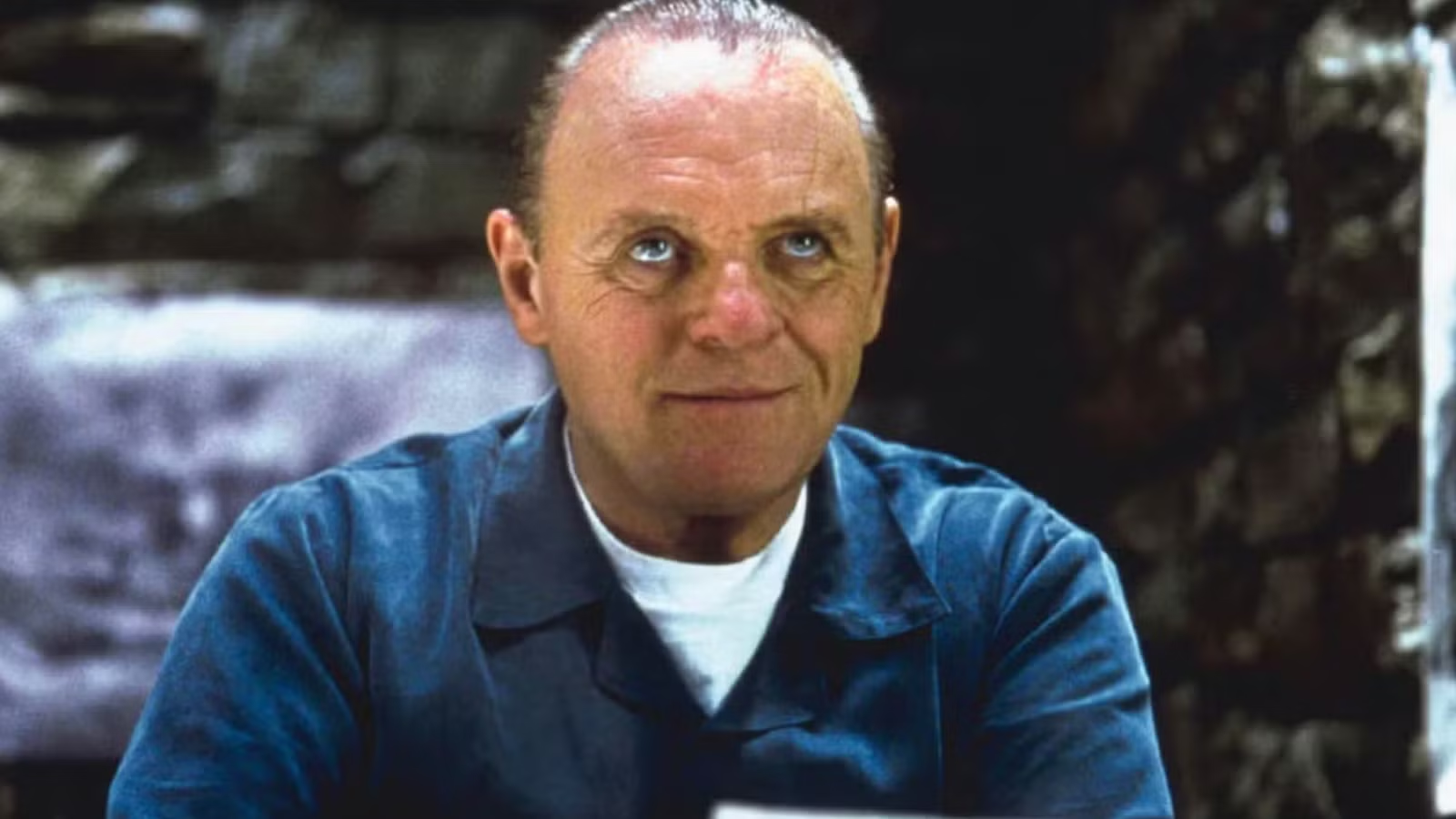
Red Dragon is a criminally underrated entry in the saga of Hannibal Lecter, with the original novel’s story finally getting Anthony Hopkins playing the legendary cannibal mastermind. While 1986’s Manhunter — which adapted the same story starring Brian Cox in the role of Lecter — was a great film in its own right, Hopkins elevated the character into pop culture history and deserved to have his turn at it.
Some viewers couldn’t look past a noticeably older Hopkins playing a younger version of Hannibal, but it’s difficult to argue that Hopkins didn’t deliver an incredible final performance as the character he made famous. Edward Norton and Ralph Fiennes also delivered great work, with Fiennes especially delivering a haunting performance as the Tooth Fairy, Francis Dolarhyde. As important as the original The Silence of the Lambs is, revisiting Hannibal’s original capture, and all the chaos that followed, is still fascinating to see to this day.
Wes Craven’s New Nightmare Is the Scariest Freddy Krueger Has Ever Been

Freddy Krueger is an icon in the horror genre, so it’s difficult to call any of the films he’s haunting dreams in a “hidden gem,” but Wes Craven’s New Nightmare has historically not gotten as much love as other entries such as the original A Nightmare on Elm Street or its third installment, A Nightmare on Elm Street 3: Dream Warriors. It’s no secret why that would be, as it came after a long run of subpar Nightmare movies that left a bad taste with viewers.
Another reason Wes Craven’s New Nightmare may be disregarded is the inherent meta nature of the story being told. New Nightmare‘s story took place in real life — meaning real-life Nightmare alumni like Heather Langenkamp, Wes Craven, and even Freddy’s actor himself, Robert Englund, all appeared as fictionalized versions of themselves. New Nightmare acted as the prototype for the meta-style storytelling Craven would later implement in the Scream franchise, and should be remembered for that if nothing else. For any horror buff looking to check out an iconic character in an influential movie that isn’t talked about nearly enough, Wes Craven’s New Nightmare is the go-to.
Halloween III: Season of the Witch Is One Of the Most Underappreciated Sequels Ever

Halloween III: Season of the Witch had the unenviable job of following up the first two appearances of Michael Myers — a character that has come to define the Halloween franchise. Every horror fan knows the story about how the studio wanted Halloween to become an anthology story, with this film introducing that concept to extreme contempt among moviegoers.
The decades-long hate made this the black sheep of the Halloween series, which led to it being the forgotten film among a list of memorable slasher outings. With that said, if one were to watch this movie without the expectations set upon it in the 1980s, they may find that it actually delivers a frightful story that at least lives up to the title Halloween, if not the films that preceded it. Some would even go so far as to suggest that Halloween III is the better movie overall when compared to Halloween II, but it’s undoubtedly difficult to shake the lack of Michael Myers regardless.


Leave a Reply