
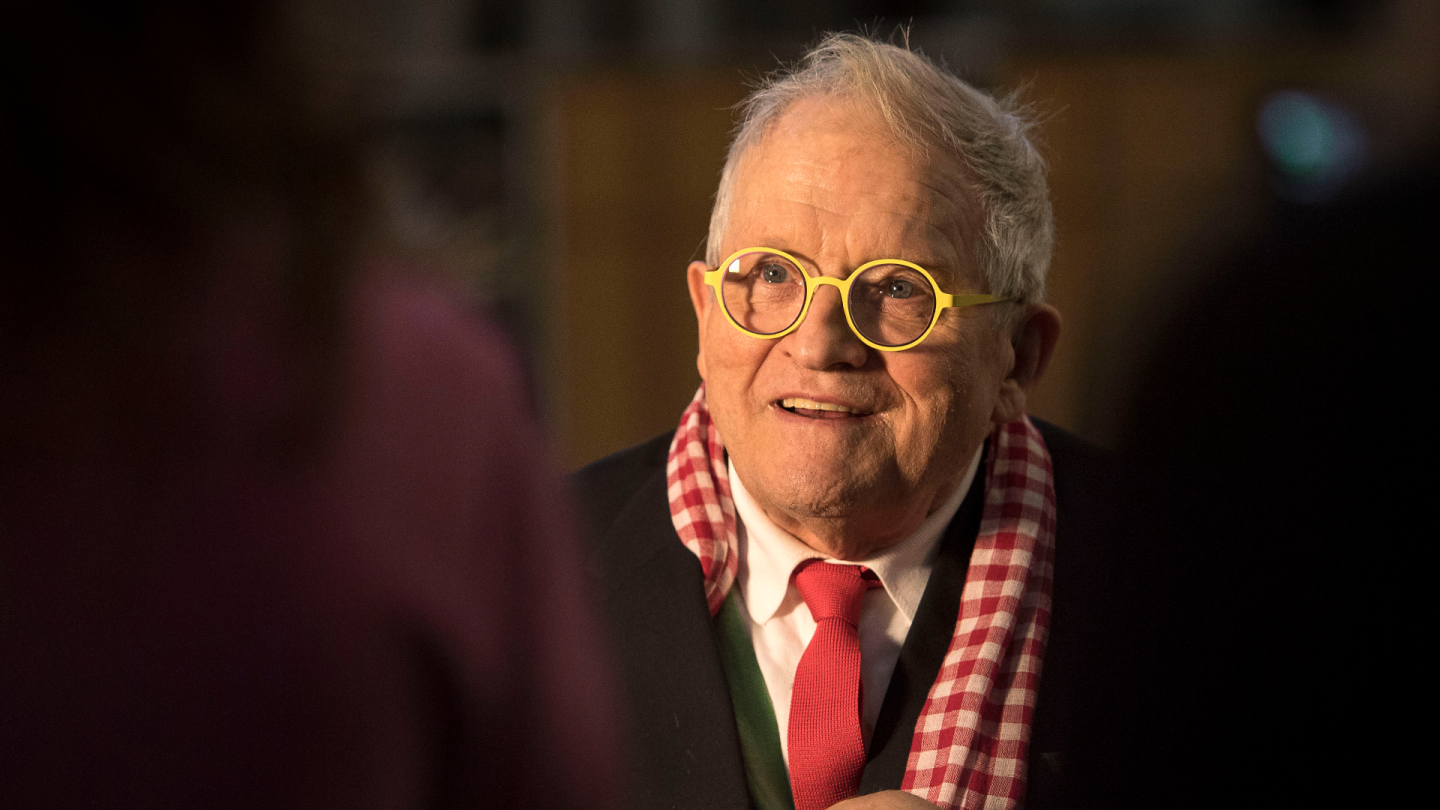
David Hockney, the revolutionary British painter, has died. He was 88.
The artist’s publicist confirmed his death in a statement to BBC News on Friday. It read: “The celebrated British artist David Hockney, one of the most important figures in contemporary art in both the 20th and 21st centuries, passed away peacefully at home on 11 June 2026, one month short of his 89th birthday.”
A cause of death was not immediately made available. He is survived by his partner, Jean-Pierre Gonçalves de Lima.
Hockney was indeed one of the most influential figures in the art world, working across paint, photographs, and lithographs. He made a name for himself through the ’60s and ’70s, and his trademark swimming pool portraits would turn him into a superstar in Los Angeles, where Hockney would purchase a home in 1964. He was undaunted by modern media and in recent years, even took his talent to the iPad.
In 2018, one of his 1972 swimming pool paintings, Portrait of an Artist (Pool with Two Figures) — a rich piece with popping greens and blues, sunlight glistening on the water — sold for nearly £70 million ($94m) at a New York City auction, a record for a living artist.
Born in 1937, the Yorkshireman was raised in Bradford and educated at Wellington Primary School before honing his artistic gift at London’s Royal College of Art. There, Hockney was featured in the exhibition New Contemporaries, marking the arrival of British pop art, and his early display of expressionism would draw comparisons to Francis Bacon.
Hockney had teaching stints at Maidstone College of Art, the University of Iowa and the University of Colorado in the mid-1960s. From 1966 to 1967, he taught at the University of California, Los Angeles and the University of California, Berkeley.
In moving to Los Angeles, he was inspired to make a series of swimming pools portraits using vibrant, acrylic paint — works that would go on to make him a household name — and throughout this period he would spread his time between L.A., London and Paris, as well as Yorkshire in the 1990s, to visit his mother. These trips back home grew more regular as he aged, and would be the inspiration for various pieces including 2006’s Between Kilham and Langtoft and 2011’s The Arrival of Spring in Woldgate.
Through a colorful, celebrated career, Hockney experimented with varying art forms: printmaking, photo-collages, sketching on iPhones and iPads — including one iPad sketch that formed the basis of a design for a stained-glass window at Westminster Abbey, in celebration of the late Queen Elizabeth II.
He even gave much of his time to stage design, his first foray in this area being Ubu Roi at London’s Royal Court Theatre in 1966. Hockney designed opera sets for the prestigious Glyndebourne Festival Opera and even costumes for performances at the Met in New York. This work continued through the ’80s and well into the ’90s. In 2017, he was awarded the San Francisco Opera Medal.
Hockney was featured in over 400 solo exhibitions during his lifetime, the most iconic including at the National Portrait Gallery in 2006 and the Royal Academy’s A Bigger Picture in 2012, which drew over 600,000 visitors in just three months. This exhibition then moved to the Guggenheim in Bilbao, Spain, before it went on to the Ludwig Museum in Cologne. From four months in 2017, an exhibition simply titled David Hockney was presented London’s Tate Britain gallery — it became the most-visited in the building’s history.
A critically acclaimed artist, Hockney was the recipient of hundreds of awards. He even turned down a knighthood, but would later accept one of the most prestigious British honors, the Order of Merit, out of respect for the then-Queen.
Hockney was staunchly pro-smoking and in 2005, fought to stop the ban on smoking in pubs and restaurants in the U.K. Two years later, at a party held in celebration of his 70th birthday at the Tate, the smoke alarms were turned off for approximately 10 minutes to allow the beloved painter a cigarette.
In 2015, he sold his house and studio in Bridlington, Yorkshire, and for a period of time lived in Normandy, France. Hockney returned to London in 2023, and reportedly maintained a daily swimming routine. He had suffered hearing loss through his life, and used hearing aids from as early as the ’70s.




Leave a Reply