
One of the greatest sub-genres of speculative and science fiction is undoubtedly dystopia. Imagining societies characterized by oppressive control and totalitarian governments or dehumanization and environmental disasters. Some works of dystopian fiction have terrifyingly predicted the future, while others serve as a dark mirror that reflects present-day social, political, and technological norms as an urgent warning for necessary change.
Dystopia often explores exaggerated worst-case scenarios of society’s contemporary anxieties, such as authoritarianism, surveillance, and technological overreach. Works of this genre act as powerful critiques and are often used to draw attention to environmental, economic, religious, psychological, ethical, scientific, and social issues. While several 20th-century dystopias remain literary classics, the last 26 years have seen an increase in dystopian fiction with the rise in popularity of young adult fiction, which in turn brought awareness of larger societal and global issues to today’s progressive youth.
The Hunger Games Defined a New Generation of Readers

Suzanne Collins’ The Hunger Games is a global phenomenon that revitalized the dystopian genre. Set in the post-apocalyptic North American country of Panem, which consists of the wealthy Capitol and 12 districts in varying stages of poverty. As punishment for a rebellion, the Capitol hosts an annual televised competition where each of the districts must send two children to participate until the last surviving child is deemed the winner of The Hunger Games. The original trilogy follows teenage protagonist Katniss Everdeen, who sparks a massive political rebellion.
With profound social commentary, gripping pacing, and strong character development, The Hunger Games has left an indelible mark on contemporary dystopian fiction. Critiquing extreme socioeconomic disparity, media desensitization, and propaganda in an authoritarian regime, the franchise has cemented itself as a masterpiece of YA fiction. The series also includes two prequels — The Ballad of Songbirds and Snakes, exploring the 10th annual Hunger Games with the villain origin story of President Snow, and Sunrise on the Reaping, considered one of the best sci-fi books of the last 10 years in its depiction of Haymitch Abernathy’s backstory during the first Quarter Quell.
A Clockwork Orange’s Violence Nauseated Its Own Author

Anthony Burgess’ transgressive 1962 novel, A Clockwork Orange, is set in a terrifying, near-future world with a hyper-violent youth subculture. It follows Alex, a charismatic teenager and gang leader who commits violent acts purely out of thrill-seeking sociopathic tendencies, sadism, and sheer boredom. Betrayed, he is subjected to brutal, state-sanctioned psychological conditioning that forces him to be “good.” The book features a barrage of physical assaults, robberies, home invasions, and sexual violence, with Alex implied to have committed several predatory acts.
Raising deep questions about free will, it is considered one of the most influential dystopian books and a pillar of the genre. The novel is unique in forcing readers to grapple with complex moral questions. It explores a debate between free will and state control as the totalitarian government’s attempt to reform Alex through psychological conditioning raises profound ethical dilemmas about morality, human agency, and whether the end justifies the means. With its groundbreaking fictional slang and widely celebrated Stanley Kubrick cinematic adaptation, A Clockwork Orange proves to be as culturally significant as when it was first published.
Fahrenheit 451 Has Never Been More Prevalent

Fahrenheit 451 by Ray Bradbury is set in a future American society where books are illegal and “firemen” burn any books they find. The novel follows Guy Montag, a fireman who, while initially enjoying his job, becomes disillusioned with his role in censoring literature. Undergoing a profound awakening after encountering curious neighbors and witnessing the power of literature, he commits himself to the preservation of cultural writings. With a message that is more important than ever, this 1953 cautionary tale accurately predicted modern societal shifts regarding fast-paced mass media, mindless entertainment, and the destructive power of censorship.
A powerful and enduring tribute to the value of intellectual freedom and the dangers of censorship, Fahrenheit 451 is one of the most prophetic and beautifully written masterpieces in the genre. Its story has never been more prevalent with modern book banning practices — which, ironically, often includes Ray Bradbury’s magnum opus. Despite the disappointing 2018 adaptation starring Michael B. Jordan, Fahrenheit 451 is a seminal dystopian novel that remains an essential read.
Never Let Me Go Is a Heartbreaking Coming-Of-Age Story

Never Let Me Go is Kazuo Ishiguro’s 2005 dystopian novel set in a parallel version of 1990s England. It follows Kathy, a 31-year-old carer who is reminiscing about her time at an elite boarding school, Hailsham, with her friends Ruth and Tommy, who were all human clones bred in Hailsham solely to donate organs to their originals until they die. Exploring themes of friendship, memory, and what it means to be human, the novel is widely regarded as a masterpiece.
With a perfect film adaptation starring Andrew Garfield, Never Let Me Go breaks the mold of traditional dystopian fiction — instead of rebelling against a totalitarian state, Ishiguro delivers a deeply moving and melancholic look at mortality, complicity, cloning ethics, and the philosophical boundaries of humanity in a subversive setting. It is part mystery, part romance, and part biting critique of how easily society can dehumanize vulnerable and marginalized groups as disposable when it benefits the mainstream.
Parable of the Sower Predicted Climate Change Crisis

Highly regarded as one of the most eerily predictive works of speculative fiction, Octavia E. Butler’s Parable of the Sower explores America in the 2020s as it’s ravaged by climate change, wealth inequality, and societal collapse. It follows 15-year-old Lauren Olamina, who can feel the pain and pleasure of others from her powers of hyper-empathy. When she is displaced from her home, she develops a survivalist philosophy called “Earthseed,” which teaches that “God is Change” and that humanity’s destiny is to spread to other planets.
A landmark in dystopian literature, Parable of the Sower is widely praised for its chillingly accurate depiction of environmental and societal collapse. Published in 1993, the novel’s portrayal of a world devastated by economic crises and climate disasters has since become terrifyingly prescient. Unlike the majority of dystopian fiction, Butler’s novel doesn’t focus solely on destruction and society’s collapse but instead centers on how cooperation is key in a broken world by highlighting Lauren’s intentional, loyal community of survivors and the creation of a new, empowering belief system.
The Giver Reveals the Darkness Hidden in a Utopian Society

Published in 1993, Lois Lowry’s The Giver was the first in a quartet of young adult classics. Set in a seemingly utopian society that has eradicated pain, war, and emotion by adopting “Sameness”, the novel follows 12-year-old Jonas, who is selected to learn the dark, painful secrets of his community’s past from the former Receiver of Memory, who stores all the history from the time before Sameness. As Joseph struggles with concepts of new emotions, he uncovers dark truths about his community.
Widely celebrated as a foundational young adult dystopian novel, The Giver explores deep philosophical questions about memory, history, the burden of wisdom, and the necessity of experiencing the full spectrum of human emotions. In creating a highly controlled “utopian” society, the novel highlights the profound cost of conforming to a life of total security and sameness. Exploring heavy topics regarding euthanasia, eugenics, and reproductive rights, the book has sparked debate for years, but has consistently led readers to agree with its importance as a coming-of-age story. Spawning countless sequels and a disappointing 2014 film that deserves a remake, The Giver is a classic work of dystopian YA fiction for the ages.
The Road Is a Lyrical Epic of Horror and Humanity

Cormac McCarthy’s The Road is a Pulitzer Prize-winning dystopian novel published in 2006. This bleak post-apocalyptic story details the grueling journey of an unnamed father and son as they walk across an ash-covered landscape some years after an undefined extinction event caused societal collapse and destroyed almost all life on Earth. Surviving on scavenged food and pushing a shopping cart of belongings, the father and son battle starvation, freezing temperatures, and cannibalistic gangs as they cling to their own morality.
Showcasing raw human endurance and the unbreakable bond between a father and son in a dead wasteland, The Road is widely celebrated as a masterpiece of post-apocalyptic and dystopian literature. Praised for its stark minimalism, haunting emotional depth, and sparse prose, McCarthy’s novel is a profound meditation on parenthood, the fragility of civilization, and the flickering hope of humanity in the face of total devastation. With an equally bleak book-to-movie adaptation, The Road is a haunting, harrowing, and heartbreaking work of dystopian fiction.
Brave New World Is One of the Most Prescient Sci-Fi Novels

Aldous Huxley’s 1932 dystopian novel, Brave New World, envisions a futuristic society where citizens are genetically engineered, conditioned from birth, and pacified by a constant pursuit of mindless pleasure from a government-issued drug. In a society built on forced conformity and the suppression of genuine human emotion, the novel’s protagonist, the “Alpha” psychologist Bernard, challenges the system with John, who was raised on the Savage Reservation. The novel explores the cost of happiness, the suppression of individuality, and questions whether peace and stability are worth sacrificing art, religion, love, passion, and free will.
Aldous Huxley presents a unique and unsettling form of “soft totalitarianism” where — instead of brute force and fear — the World State maintains absolute control of economic and social order, which is achieved through psychological manipulation, the removal of individuality, and mass consumerism and narcotics. Considered one of the best American novels of the 20th century, the novel is incredibly accurate at predicting future scientific and technological advancements, as shown in its hard sci-fi TV adaptation. Controversial and often banned, Brave New World is a thought-provoking novel with an enduring legacy.
The Handmaid’s Tale Is a Powerful Cultural Phenomenon

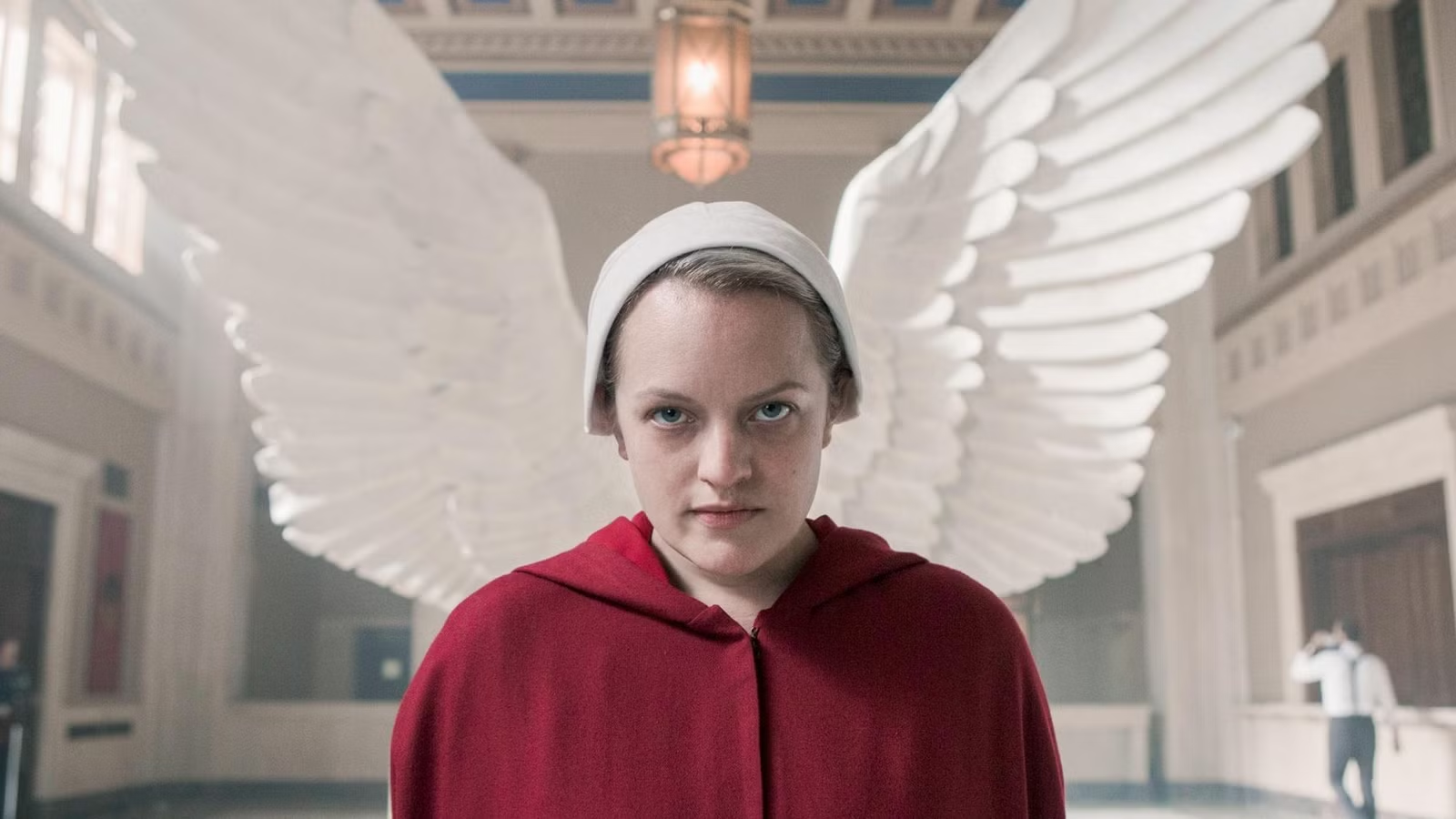
Published in 1985, Margaret Atwood’s The Handmaid’s Tale experienced a resurgence in popularity with the success of the Hulu series and its bleak mirroring of contemporary political events. Set in the Republic of Gilead — a totalitarian, theonomic regime that overthrew the US government amid a fertility crisis, it follows Offred, a Handmaid forced into sexual servitude to bear children for the ruling elite. This chilling story explores the subjugation of women and the fight for bodily autonomy as Offred struggles to survive and retain her memories of her life before with her husband and daughter.
Just as powerful as it was when it was first published, The Handmaid’s Tale is widely regarded as the pinnacle of dystopian literature. Atwood has been praised for her frighteningly plausible depiction of patriarchal control and environmental collapse, as well as Offred’s intimate internal monologue that explores the insidious slow burn of freedoms being eroded. This feminist novel focuses on the loss of female agency and individuality, the suppression of reproductive rights, and the various ways women can resist and regain their independence within the patriarchy. As beloved as it is banned, The Handmaid’s Tale is a persistent cultural touchstone for political resistance.
1984 Is One of the Most Banned Books in the World

The undisputed gold standard of the genre, George Orwell’s 1984, is a seminal dystopian masterpiece. Published in 1949, the novel is set in Oceania, a totalitarian superstate ruled by the Party and its omnipresent leader, Big Brother. The story follows minor party official Winston Smith, whose job it is to alter historical records to fit the Party’s ever-changing narrative, ultimately leading to him rebelling against the regime by keeping a diary, engaging in a forbidden love affair, and seeking out an underground resistance.
A foundational classic of dystopian literature, Orwell’s chilling exploration of total state control, mass surveillance, censorship, and the manipulation of truth has made it one of the most influential books ever written. The novel continues to serve as a vital cautionary tale that warns society about the dangers of absolute state power and the erasure of historical reality. With an enduring legacy, 1984 is the definitive blueprint for dystopian fiction that all other works must live up to.










Leave a Reply