
This article discusses sensitive topics, including suicide, abuse and torture.
As a genre, horror comes in many forms, but one of the most twisted of them all is the thrilling psychological horror that sits in the back of the mind long after the credits roll. Anime has always been a solid medium for exploring the depths of the human mind, and it does an incredible job capturing the deeply disturbing in ways that leave audiences feeling unnerved.
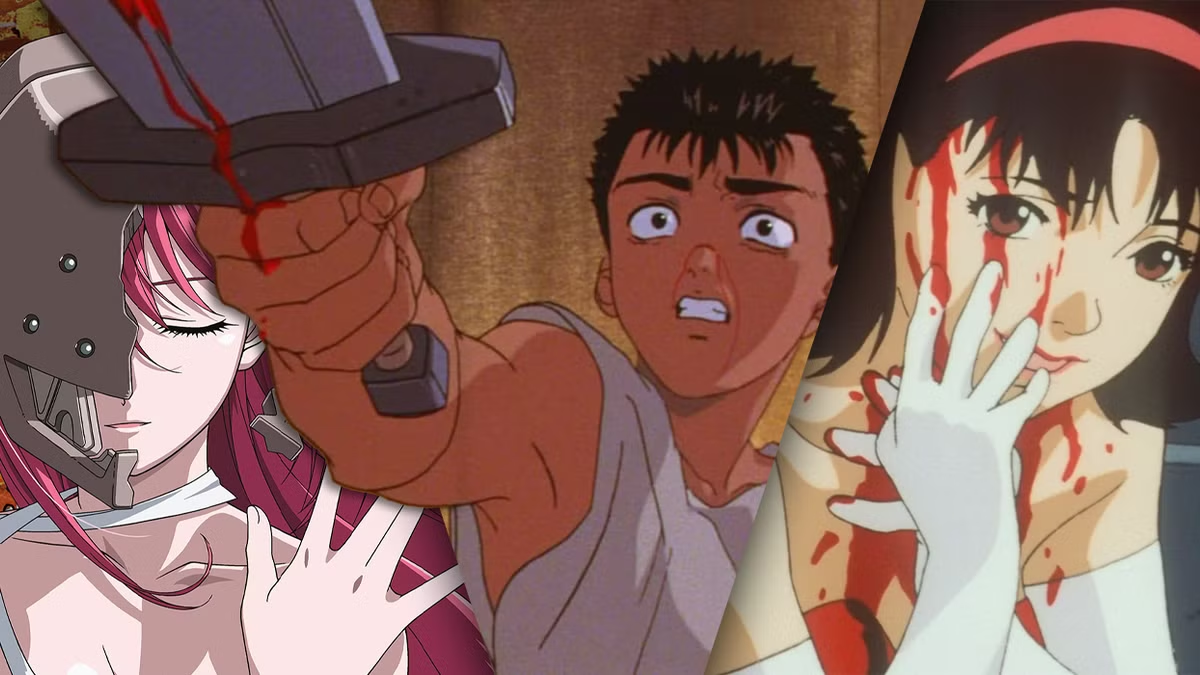
From serial killers using a supernatural notebook to take out victims to groups of orphans learning they’re being farmed like cattle for the slaughter, anime explores the psychologically disturbing in ways live-action media can’t capture in the same way. The fact that the medium does it so well can be seen in unforgettable series like Death Note, Berserk and The Promised Neverland, all of which challenge fans to open their mind, and let the darkness in.
Akira Is a Brutal Cyberpunk & Psychological Anime
Director Katsuhiro Otomo and studio Tokyo Movie Shinsha’s Akira is one of the most influential movies in the anime and cyberpunk subgenre. While the relentless action, bloodshed, and sci-fi trappings are the anime movie’s main draw, it has grim psychological undertones and themes. The story, set in a dystopian 2019, follows Shōtarō Kaneda, a young biker gang leader whose friend gains psychic abilities after inadvertently getting into an accident with an escaped “esper.”
Akira is well known for its ruthless pacing and gory portrayals of violence. The visuals that ensue are shocking and sometimes even difficult to comprehend. Still, it’s all anchored by the bleak consequences of systematic corruption in governing bodies, military oppression and the anxieties of nuclear war. What makes this all especially disturbing on a psychological level is the visceral way Akira conveys these themes through the disaffected youth society left behind.
Death Parade Spotlights the Highs & Lows of Human Nature

Delving into the many facets of human nature is an easy way for a psychological anime to hook and shock its audience. Studio Madhouse’s Death Parade tries its hand at this and much more in its afterlife-themed story. After death, humans must face reincarnation or the void, but they must first pay a visit to the Quindecim bar. There, the bartender, Decim, passes judgment on the pairs of people that come through by having them play life-threatening games that reveal the context behind their deaths.
Death Parade is a revolving door of psychological profiles of the bar’s deceased visitors, sometimes stunning viewers with the warped details of their personalities and what led to their deaths. But aside from vengeful killers and abusive relationships, bittersweet elements add sympathetic layers to other characters. Overall, Death Parade is a whirlwind of emotions that unsettles viewers as often as it does comment on coming to terms with mortality in a touching manner.
Ghost in the Shell Asks Unsettling Questions of Humanity

Anime or otherwise, the cyberpunk genre has a penchant for pinning dark psychological concepts onto its riveting stories and slick visuals. Director Mamoru Oshii and studio Production I.G’s Ghost in the Shell, much like Akira before it, pushed anime more into international spaces and made a case for audiences to take adult animation seriously. The movie transports audiences into an atmospheric and deeply cybernetic-focused Japan in 2029.
The plot revolves around a cyborg security agent, Motoko Kusanagi, who is hunting down an elusive hacker with her Public Security Section 9 assault team. Ghost in the Shell presents a gripping, moody story full of tension and mystery while also peeling back layers of psychological themes. It prompts its audience to ponder questions of self-awareness, gender identity and the demoralizing experience of living in an increasingly technological society. These psychological elements combine to form an unnerving examination of humanity’s and technology’s complex relationship.
Pluto Spins Dark, Detective-Themed Sci-Fi Thriller

Fans of Naoki Urasawa’s work and anime, in general, were treated to one of the best sci-fi anime of the last decade in the form of Pluto. Studio M2 adapted the manga by Urasawa and co-author Takashi Nagasaki for Netflix, which told a gritty reimagining of a classic Astro Boy story arc. It follows Gesicht, a German Europol robot detective trying to unravel the mystery behind a series of killings targeting the world’s seven prolific robot heroes.
It’s hard to imagine an Astro Boy arc reinterpreted as a grisly detective thriller, but Pluto does so with aplomb thanks to its engrossing mystery. The slow-burning murder case progresses to unveil increasingly harrowing details and motives behind the killings. As the story reveals them piece by piece to the audience and the characters themselves, Pluto exposes the themes of deep-seated hatred and post-war trauma that haunt this sci-fi world.
Made in Abyss Puts Children Through Hell
(1).jpg?q=49&fit=crop&w=500&dpr=2)
The horrors in Made in Abyss‘ slow-burning plot all center around the unknown properties of a massive crater in the town of Orth. Riko, an orphan from the Belchero Orphanage, is dead set on becoming a Cave Raider who descends into the Abyss to find her missing mother. Riko meets a cyborg boy from the Abyss, Reg, and the two decide to go together to find Riko’s mother. However, the Abyss isn’t a peaceful cave-diving experience — if anything, it’s the stuff of actual nightmares.
Made in Abyss feels particularly grotesque at its worst moments because the main characters are young children. This anime isn’t straight-up horror, but it will make its viewers unsettled. The lethal aspects of the Abyss itself are one thing, but perhaps the most disturbing part of Made in Abyss is human scientists using the Abyss to experiment on kids. While there are some hopeful moments in Made in Abyss, the mental and physical pain that the characters go through is hard to watch.
Wonder Egg Priority Personifies Mental Illness and Realistic Fears

While some fans believe that the ending of Wonder Egg Priority could’ve been far better, that doesn’t take away from the more gruesome and hard-hitting moments of the series. As this anime deals with heavy topics such as depression, suicide, and self-harm, it shouldn’t come as a surprise that it’s not always easy to watch. Wonder Egg Priority often offers a morbid exploration of mental health topics instead of a more hopeful one.
After teenager Ai Ohto loses her closest friend, Koito Nagase, to suicide, Ai becomes entirely reclusive. One night, Ai finds a machine that spits out a “Wonder Egg,” which sucks Ai into a dream-like world where she must protect the girl who is hatched from the egg from otherworldly monsters.
Eventually, Ai finds out that if she continues to save these girls (all of whom have taken their own lives or suffered deeply), she might be able to save Koito. While Wonder Egg Priority sounds ready to deliver an uplifting message, it uses its monsters to personify the horrific events that happened to all the girls.
Tokyo Ghoul’s Main Character Can’t Catch a Break

Tokyo Ghoul is an anime that is painfully tragic with its depictions of horror. Kaneki Ken is just a sweet, teenage boy who is excited about going out on a date with a beautiful woman named Rize Kamishiro. The date doesn’t end with fluttering feelings – instead, it ends with Rize revealing herself as a ghoul and attempting to eat Kaneki. When all is said and done, Kaneki becomes an artificial ghoul, and life, as he knows it, completely flips upside down.
There are certainly some tender moments in Tokyo Ghoul, thanks to its incredible cast of characters, but the very world itself is bleak. Kaneki personally always seems to get the short end of the stick, even being tortured so badly at the point that his hair turns white from stress. Kaneki is the most tragic character in Tokyo Ghoul, but few other characters are safe from impending doom and horrific experiences. There’s plenty of action throughout Tokyo Ghoul, but it uses disturbing psychological points to carry the narrative.
Elfen Lied Is Full of Brutality

It can be argued that Elfen Lied uses its graphic displays of violence and shameless nudity for shock value more than anything, but there’s no denying that many anime watchers have scenes of this anime burned into their brains. The first episode alone showcases incredible guts and gore as the mysterious Lucy breaks free from her confinement and slaughters every living person in the facility. Lucy is no ordinary human — she’s a human-like species, called a Diclonius, capable of telekinetic attacks.
After the shocking beginning, Lucy regresses into a different personality that sees her turn into Nyu, who acts like a child. Aside from the glorified bloodshed, Elfen Lied tells a haunting tale of the darker sides of humanity. The episodes are grim, making them all the more memorable. Elfen Lied also has one of the most beautiful yet eerie anime openings of all time, fitting the theme perfectly.
The Promised Neverland Brutally Robs Its Children Of Their Innocence

Though its second anime season did not even come close to matching the perfection that is Season 1 of The Promised Neverland, the disturbing premise of the overall story is enough to chill viewers to the bone. Set in an orphanage where children believe a loving family will come and give them a beautiful life, three of those children discover the promises their seemingly loving overseer, Mom, makes are nothing but lies.
Plotting to escape a dark end, Mom twists these children’s minds in the most disturbing ways, making them not just believe in the lie, but using their doubt to turn them against each other. The Promised Neverland is, hands down, one of the most psychologically disturbing anime of all time because it preys on the innocence of not just children, but orphaned children, who just want a loving family.
Berserk’s Ultimate Betrayal Is As Difficult for Viewers As It Is For Guts
Berserk is one of the greatest anime of all time, but it’s also one of the darkest. Known for its violence and gore, Berserk tells the tale of a man, Guts, who is desperately clinging to his remaining humanity. The betrayal of a close companion, Griffith, sends Guts down an even darker spiral. Berserk highlights the similarities and differences between man and monster. What is the line? And what happens when that line is crossed?
Berserk doesn’t hold anything back and has proven to be a difficult anime to watch, though very much worth it. It doesn’t get much darker than this fantasy anime, as the cruelties portrayed are horrifying at worst and gasp-worthy at best. Guts’ path as the protagonist is one for the anime and manga history books. His internal struggle is understandable, even when it’s painful — he experiences trauma after trauma, which pushes him closer to darkness. Anyone seeking an excellent story with deep psychological impacts will enjoy Berserk.







Leave a Reply