
The 1980s formed the foundations for modern sci-fi, with filmmakers pushing their craft beyond the tropes of shiny spaceships and simplistic futurism. Advances in animatronics, practical effects, miniature modeling, and other related disciplines generated new ways to bring impossible worlds to life. In many ways, the 2020s have been completely shaped by ’80s science fiction.
Even when exclusively considering ’80s sci-fi movies that can be called masterpieces, the list spans a wide range of subgenres, from cyberpunk and time travel to existential horror. Their visual effects remain as influential as their central questions about humanity, technology, power, and survival. Hardly genre experiments, these films reshaped science fiction on a fundamental level.

The emotional possibilities of Steven Spielberg’s E.T. The Extra-Terrestrial are immediately apparent, abandoning the threatening monster and alien invasion tropes in favor of a profoundly tender coming-of-age narrative. Inadvertently stranded on Earth, E.T. forms a powerful bond with Elliott, a lonely suburban child desperate for friendship. First-contact movies until that point rarely imagined stories as intimate as E.T., with the aforementioned bond evolving into a complex connection.
Spielberg relegated the adults to obscure background threats during the first half, allowing the film’s celebrated sense of childlike wonder to take center stage. E.T. demonstrated that mainstream science fiction could also thrive as efficiently on empathy rather than destruction, inciting a now-popular take on the genre. From Elliott’s bicycle crossing the moon with E.T. in the basket to memorable quotes like “E.T. phone home,” the movie transformed simplicity into cinematic immortality.
Blade Runner Elevated Dystopia Into Existential Art

Ridley Scott’s Blade Runner initially struggled to achieve recognition, underperforming at the box office and dividing critics. And yet, cyberpunk originator William Gibson nearly discarded his draft of Neuromancer after watching the movie, expressing concerns about unconsciously plagiarizing the “fine visual texture.” The greatest artistic creations often face backlash, sometimes because critics are unable to resolve the consequences of a work far ahead of its time.
But Blade Runner‘s status improved over the years, eventually achieving the same literary level that Neuromancer also took time to reach. The atmospheric worldbuilding provides the template for its philosophical ambiguity, as production design seamlessly blends into the metaphysics. Interrogating the very nature of the human condition, Ridley Scott’s masterpiece skillfully complicates the iconic statement posed by René Descartes: “I think, therefore I am.”
Back to the Future Perfected the Time Travel Adventure

Back to the Future may not be the first “fun” time travel movie, but it showed the world just how delightfully entertaining the concept could be. The main premise is distorted through a personal lens: Marty unwittingly prevents the canon event that brought his parents together in the past, so now he must restore their relationship in time for his return to the future. Basic, yet riddled with tension, brimming with humor, infused with tons of heart, and absolutely ingenious in its execution.
Any other pairing wouldn’t have been as successful as the chemistry between Michael J. Fox and Christopher Lloyd, whose Marty McFly and Doc Brown complete the formula. Restless charisma balances manic weirdness, grounding the temporal eccentricities in an unexpected friendship. Back to the Future never once loses sight of its goal: to infect audiences with a hope for the possibilities that tomorrow could bring.
The Empire Strikes Back Took Star Wars Toward Darkness

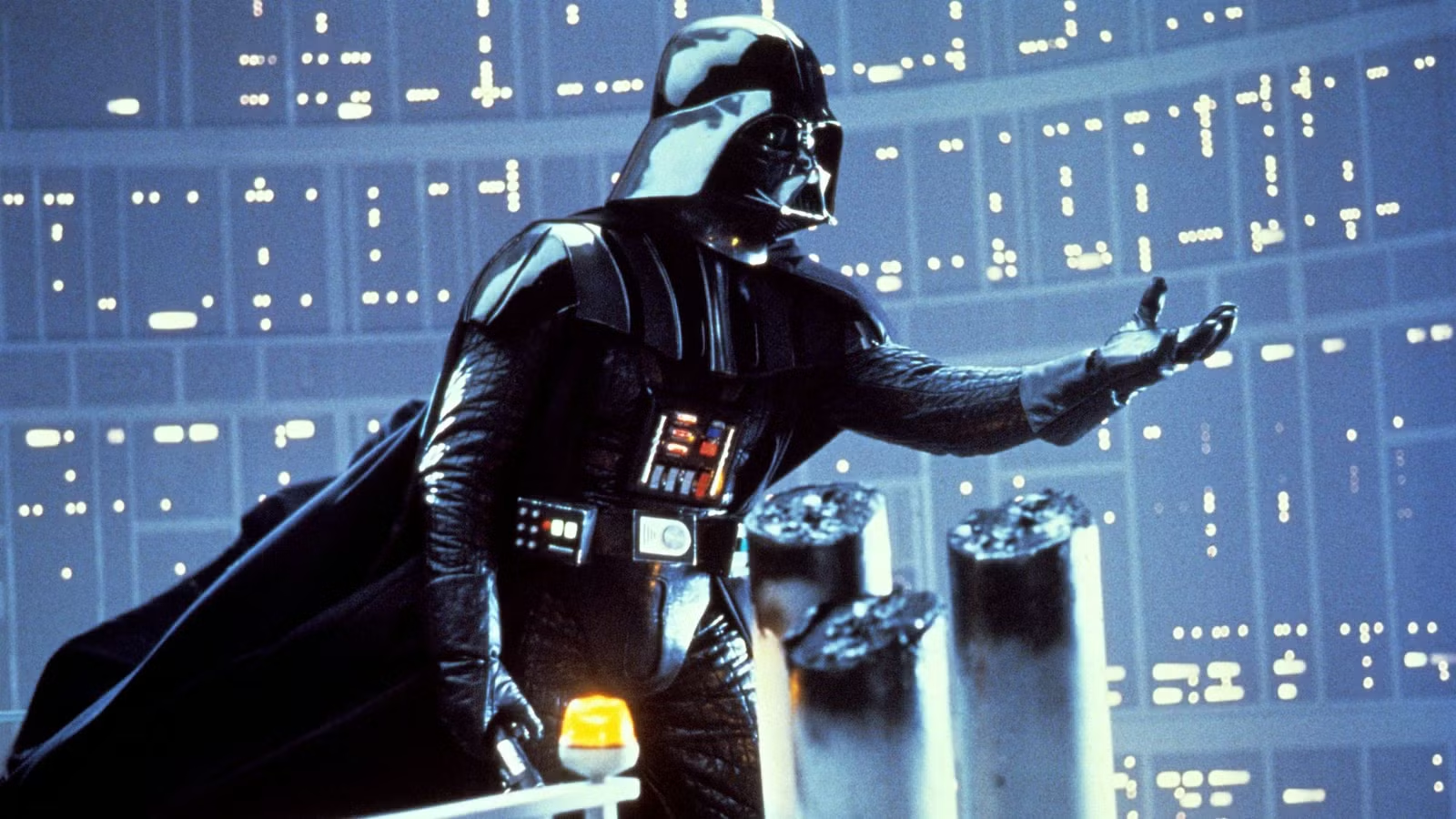
Star Wars‘ 1977 release ushered in a new era of hybrid science fiction, innovative filmmaking, and cinematic spectacle; the bar already seemed out of reach for a sequel. But there was a precedent, set just a few years before by The Godfather Part II, and George Lucas soon followed in Francis Ford Coppola’s footsteps. What The Empire Strikes Back did for pop culture cannot be measured in profits, trophies, or even critical reviews.
It took its predecessor, warped it into something darker and stranger, ultimately revealing the impassable gulf between Luke Skywalker and Darth Vader. The Empire Strikes Back remains the emotional center of the entire saga, and that includes literally every installment in the vast franchise. By allowing its heroes to lose horribly without destroying their hope, a Star Wars sequel would always outshine the original.
Aliens Proved a Great Sequel Could Change Genres
If Alien was released a year later, Ridley Scott would have two sci-fi masterpieces from the 1980s. James Cameron may now be known for the Avatar franchise, but his reputation was forged in the blistering furnace of Aliens. Refusing to weaponize claustrophobia like its predecessor, Cameron engineered and subverted a grand hero’s journey through hardboiled military sci-fi, culminating in one of the greatest movie climaxes ever made. Few stories have done as much for feminist art.
Aliens became another ’80s sequel to prove the scope of a franchise beyond the original film — so much so that it might be humorously blamed for the overfranchisation problem today. At six feet tall, Sigourney Weaver’s Ellen Ripley cuts an imposing figure among the toughest of Marines, even robust enough to survive their destruction, but it’s always her nurturing compassion that keeps both her and Aliens in a league of their own. What once gave young Millennials nightmares are now nostalgic reminders of how thoroughly it shaped a whole generation.
Akira Expanded the Grand Possibilities of Cyberpunk

Like Blade Runner and Neuromancer did for the early ’80s, Akira elevated the realm of cyberpunk into the next decade and beyond. The sinister vision of Neo-Tokyo holds the memories of an apocalypse past, one that caused so much damage that the future — and, by extension, the story — was fundamentally shaped by it. This is how the film begins: the tranquil landscape of 1988 Tokyo is annihilated by a blinding flash of light, expanding to cover the whole screen, a metaphor for the absolute power wielded by the eponymous character.
Kaneda and Tetsuo’s relationship barely anchors the story, which takes viewers on a hallucinatory roller-coaster filled with omens and dread. Akira‘s production demanded an unusually high number of animation cells, and the extensive attention to movement, lighting, shapes, and mechanical detail manifests spectacularly onscreen. Landmark technical achievements aside, the movie’s legacy amplified the scope of multiple artistic potentials, from Japanese animation to sci-fi itself.
The Thing Has Always Been a Triumph of Cinema

Arguably the greatest ’80s sci-fi movie, The Thing suffered greatly under contemporary opinion, whose complaints of hyperbolic viscerality and ominous doom ironically ignored the entire point of the film. From the popular reviews of the day, some of the common adjectives used were “cold and sterile,” “wretched excess,” “bereft, despairing, and nihilistic.” All of those things are now regarded as significant advantages in favor of the movie, one encapsulating the paranoia of the late Cold War through the unexpected optics of gore.
Trust is perhaps the central emotion binding The Thing together, or rather, the instinctive fears that emerge when trust erodes. The titular monster is exceptionally efficient at inflicting psychological damage, and this feeling burns as harshly as the sight and smell of steaming intestines and grotesque biological fusions scuttling across the room like demon spiders. John Carpenter’s horrifying masterpiece of storytelling was sculpted by Rob Bottin’s genius hands, a triumph of artistic compatibility that occurs rarely — but when it does, it can be era-defining.





Leave a Reply