
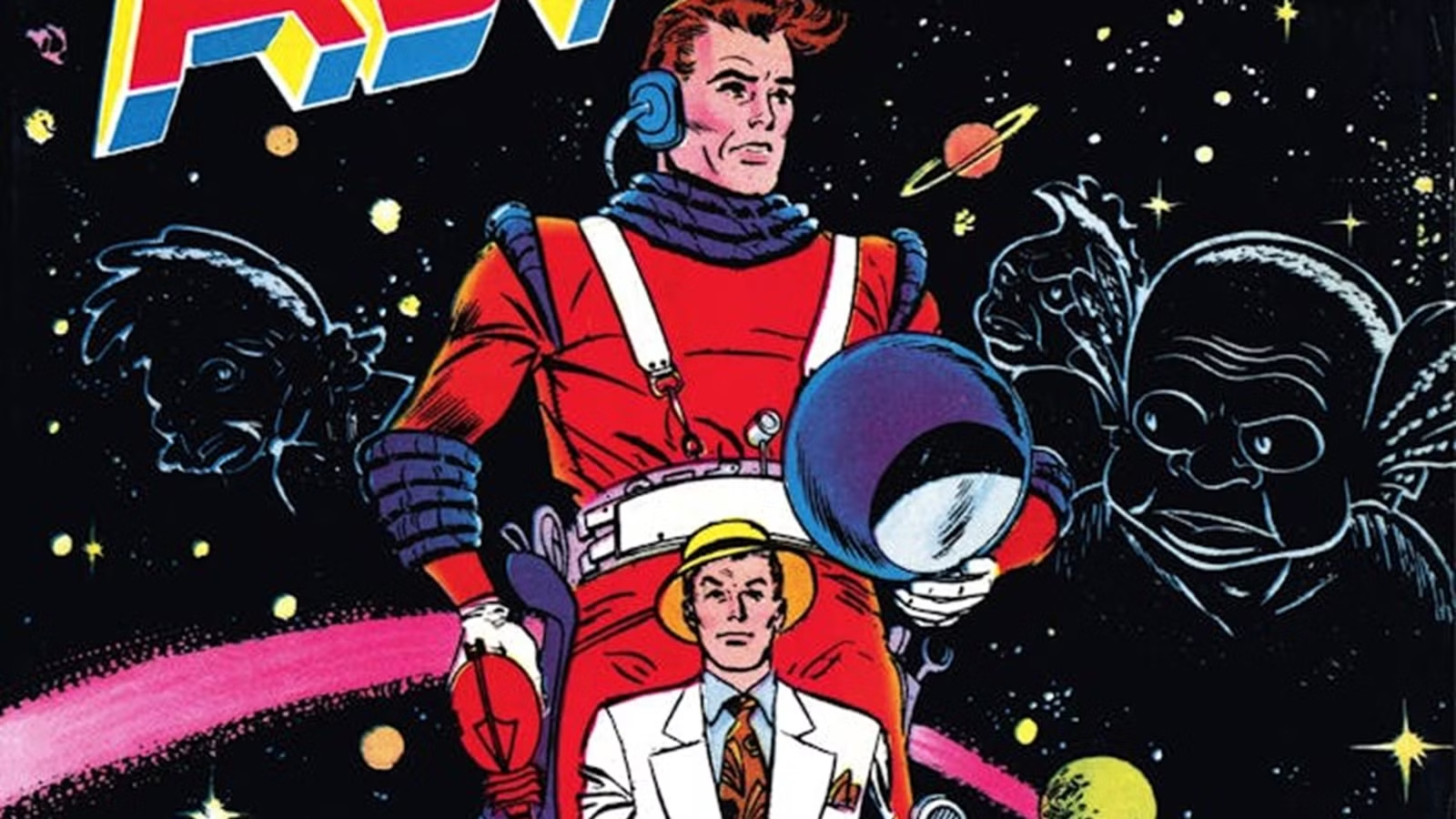
In every Look Back, we examine a comic book issue from 10/25/50 years ago (plus a wild card every month with a fifth week in it). This time around, I’m a bit late as I head to May 1951 for a major superhero debut.
There are a couple of things that have to be remembered about comic book history that related to today’s Look Back. One, everyone stole from everyone else. As I’ve noted a number of times over the years, in the world of comic books, imitation was definitely the purest form of flattery, and boy, did comic book companies like to flatter each other. Whenever a comic book company had a hit with a concept, other comic book companies would rush out their own versions of that concept.
This was true, too, for comic book companies looking to TV and film to see what was popular. When Mickey Rooney became one of the biggest stars in the world with his teen everyman movie character, Andy Hardy, MLJ Comics famously introduced Archie Andrews, who became so famous that they renamed the company Archie Comics. Even there, though, MLJ had already introduced a DIFFERENT Andy Hardy-inspired character before Archie Andrews ever debuted! Every other company did their own version of Andy Hardy (although, of course, notably, Archie is the only one still standing).
Two, “ages” aren’t definitive things. It’s the same with “generations.” Generation X is typically quantified as people born between 11965–1980, and, well, come on, how in the world are we saying that a 61 year old is of the same “generation” as a 46 year old? It’s all just kind of grasping at straws. There is obviously something to be said for ages as a concept, just like there is something to be said for eras as a concept, but the SPECIFICS are where things fall apart, and that, unsurprisingly, is how we come to the first DC superhero after the Golden Age of Comics, who was basically a knock off of a popular pulp character…but is he also the first SILVER AGE DC superhero? As we look at May 1951’s Strange Adventures #9, let me note that the answer is, “I dunno.”
Who Was Captain Future?

As I noted in an old Magazine Legends Revealed, Mort Weisinger was many things, some of them not so great, but one thing he definitely was was a man who knew what his readers were into, and he would plan accordingly. This served him to great effect in the years to come when he worked in comic books at DC Comics, but it also helped him back when he was an editor for Standard Magazines (publishers of Thrilling Wonder Stories, Startling Stories, etc.)
Weisinger figured that their audience of science fiction readers were mostly teenage boys, so he theorized that a science fiction adventure hero would be quite successful with such an audience, so he told one of the company’s regular writers, the great Edmond Hamilton, to write about a futuristic space adventurer named Mr. Future. Hamilton, naturally, improved on the character, and we got the Captain Future that would ultimately be published.
Weisinger then announced the character at the first World Science Fiction Convention in New York City in 1939. Weisinger had been planning the new magazine for months before the convention, and Captain Future debuted in his own series.

Captain Future ran for 17 issues over four years. That series was so well-regarded that it was later reprinted in the popular Startling Stories pulp magazine, leading to a short return of new Captain Future stories as part of Startling Stories for a few years in the early 1950s. Captain Future was your typical pulp science action hero. He was a brilliant scientist, but he could also kick ass. He traveled the galaxy stopping bad guys with his “Futuremen,” a robot named Grag, an android named Otho and a brain-in-a-box named Simon Wright.
Julius Schwartz was heavily involved in the world of pulp science fiction, having been an agent for science fiction writers before he became a comic book editor. So when DC decided to get into science fiction at the start of the 1950s with Strange Adventures and Mystery in Space (whose debut I spotlighted recently), of course Schwartz was involved, and of course Schwartz knew the best characters to do knockoffs of, leading to the introduction of Captain Comet!
Is Captain Comet the First DC Silver Age Superhero?
Created by Julie Schwartz, John Broome and Carmine Infantino in Strange Adventures #9, Captain Comet was Adam Blake, a seemingly ordinary human boy, who had something x-traordinary about him after his pregnant mother was exposed to the effects of a comet…

As he grew, his powers grew, too, and it was clear that he was a mutant with terrific mental powers…

He talks to a professor mentor, who explains that Adam is a mutant, basically 100,000 years ahead in the evolutionary scheme of things. The scientist is then robbed by a trio of idiot crooks, who are trying to steal the gold output of one of the scientist’s machines. Adam uses his powers to stop them, but after he does so, his mentor tells him he’ll need a secret identity before he fights any more crime…

Then, a freaking alien TOP shows up, wreaking havoc on the planet (a freakin’ TOP, John Broome? Why were you so weird?), and Adam debuts his Captain Comet identity in a cliffhanger ending…

Okay, so this is 1951. The Golden Age of comics is obviously over, but it seems too early for the Silver Age of comics, as well. If I HAD to pick one age for this comic book to appear in, I GUESS I would say the Silver Age, but really, this seems to exist BETWEEN those two eras. I’ve seen some people call it the “Atomic Age,” due to the science fiction comics of this era. I’m okay with that, but this just goes to show you that “ages” are really not too speciific. All I know is that this is post-Golden Age, and thus is DC’s first post-Golden Age superhero! And one of the very first MUTANT superheroes, over a decade before X-Men #1!
If you folks have any suggestions for July (or any other later months) 2016, 2001, 1976 and 1951 comic books for me to spotlight, drop me a line at brianc@cbr.com! Here is the guide, though, for the cover dates of books so that you can make suggestions for books that actually came out in the correct month. Generally speaking, the traditional amount of time between the cover date and the release date of a comic book throughout most of comic history has been two months (it was three months at times, but not during the times we’re discussing here). So the comic books will have a cover date that is two months ahead of the actual release date (so October for a book that came out in August). Obviously, it is easier to tell when a book from 10 years ago was released, since there was internet coverage of books back then.










Leave a Reply