
What is now understood as the Young Adult (YA) genre started to take shape between the 1940s and 1960s, officially popularized as more of a categorization label by library associations in the 1960s for readers between the ages of 12 and 18. It was the publication of groundbreaking books like The Outsiders by the late ’60s that began to cement this as a true literary genre, one perfect to get tweens and teens to see the beauty of reading.
YA books tend to include teenage protagonists and fast-paced plots, dealing with themes like romance, identity, self-exploration, and coming-of-age elements. Throughout history, there have been several great YA novels—but there are eight in particular that are absolutely essential reading for anyone interested in better understanding the history, evolution, and true nature of this genre. These aren’t necessarily YA’s best, but rather the most important, influential, and impactful book in the genre’s history.
8
‘Twilight’ (2005)

Some love it, some hate it, but no one can claim to be a true diehard fan of young adult literature if they’ve never at least attempted to read Twilight. It was an idea that came to Stephenie Meyer in a dream. So, with a degree in English literature, no experience as an author, and the influences of authors like Jane Austen and William Shakespeare, she set out to write what is now easily the most culturally significant book about vampires of the young adult genre.
It truly had an indelible impact on the YA category as a whole.
The mere reason that Twilight stirs up such ardent conversations whenever it is brought up would be reason enough to make it an essential read, but on top of that, it truly had an indelible impact on the YA category as a whole. An immense bestseller and the beginning of an equally successful book series, Twilight may not be the best-written romance novel the world has ever seen, but it sure is a must-read nonetheless. It spawned a vampire genre boom that’s arguably still going to this day, it proved the market power of YA literature aimed at a female demographic, and it led generations of young people to fall in love with reading.
7
‘The Fault in Our Stars’ (2012)

John Green is a deeply significant and impactful figure in the world of young adult literature, and his entire bibliography should be considered essential reading for all those who love the genre. There is little room for any arguments, however, against the fact that his most foundational novel is The Fault in Our Stars. Green was inspired by his experiences working in a children’s hospital, and dedicated the book to his friend Esther Earl, who died of thyroid cancer at the age of 16. The subject matter alone is enough to make this one of the most heartbreaking books of all time, but that’s precisely why it’s a must-read.
Before The Fault in Our Stars was published, the YA market seemed to be obsessed with works of speculative fiction in the same vein as Twilight. As soon as Green’s masterpiece hit bookstore shelves, however, young readers realized that there were also YA novels out there full of raw, realistic, painfully honest emotion and romance. More realistic fiction started to make its way into the saturated YA book market, and sick-lit (a subgenre where characters deal with terminal illnesses or mental health struggles) was catapulted into the stratosphere in terms of popularity and reader demand.
6
‘The Perks of Being a Wallflower’ (1999)

A whopping 13 years before he wrote and directed the film adaptation of the same name, Stephen Chbosky penned The Perks of Being a Wallflower, one of the best YA books of all time. The author spent over five years developing and writing the book, inspired by the memories of his own teenage years and interested in topics like sexuality, drug use, mental illness, and sexual abuse. The book deals with these topics in such a mature and open way that it has been banned across several schools in the United States.
But though it’s definitely for young adults who lean more toward the “adult” side than the “young” side, Perks of Being a Wallflower is a must-read nonetheless. It completely redefined how YA fiction dealt with these kinds of complex issues, proving that the genre could make powerful statements on the messier things that are on pretty much all teenage readers’ minds. On top of breaking taboos in all sorts of powerful ways, the novel tapped into elements of ’90s teen culture and counterculture in manners that have continued to age like fine wine.
5
‘The Giver’ (1993)

Well before the boom in popularity that the dystopian subgenre of YA saw throughout the 2010s came Lois Lowry‘s The Giver, set in a universe that at first appears to be utopian but is gradually revealed to actually be entirely dystopian. Throughout the years, critics and scholars have deeply studied the way it talks about things like religion, eugenics, racism, and other nuanced topics in ways that are undeniably complex but still perfectly suited for younger readers. Because of that, The Giver is often praised as one of the best novels for teenage readers ever written.
Labeled by Variety as “the godmother of dystopian YA fiction,” Lowry created in The Giver a masterpiece that completely revolutionized fiction for young readers forever. Before The Giver, the publishing industry assumed that only adult readers could understand and appreciate the layers and complexity of dystopian fiction. With the success of Lowry’s magnum opus, things changed. The depth with which the author approaches sociopolitical themes and dark philosophical questions had never been seen in YA literature before, challenging the paradigms that had been held on the genre for years.
4
‘The Outsiders’ (1967)

Seeing as so many people point to it as the origin point of true YA literature, saying that S. E. Hinton‘s coming-of-age novel The Outsiders is essential reading is the understatement of the century. Indeed, it’s one of the best coming-of-age books of all time, the source material for an awfully underrated movie directed by Francis Ford Coppola. It’s already a phenomenal-enough work of fiction on paper, but what makes it all the more admirable is that Hinton started writing the book when she was 15, wrote the bulk of it when she was 16, and saw it published when she was 18.
The Outsiders was significantly controversial upon publication, due to its use of strong language and depiction of taboo topics.
Much like history’s best YA books, The Outsiders was significantly controversial upon publication, due to its use of strong language and depiction of taboo topics like gang violence and underage drinking and smoking. Even to this day, it continues to be one of the most widely debated YA books ever written. After The Outsiders, literary depictions of youth and teenagers acquired a level of raw realism and grittiness that they had never seen before.
3
‘The Golden Compass’ (1995)

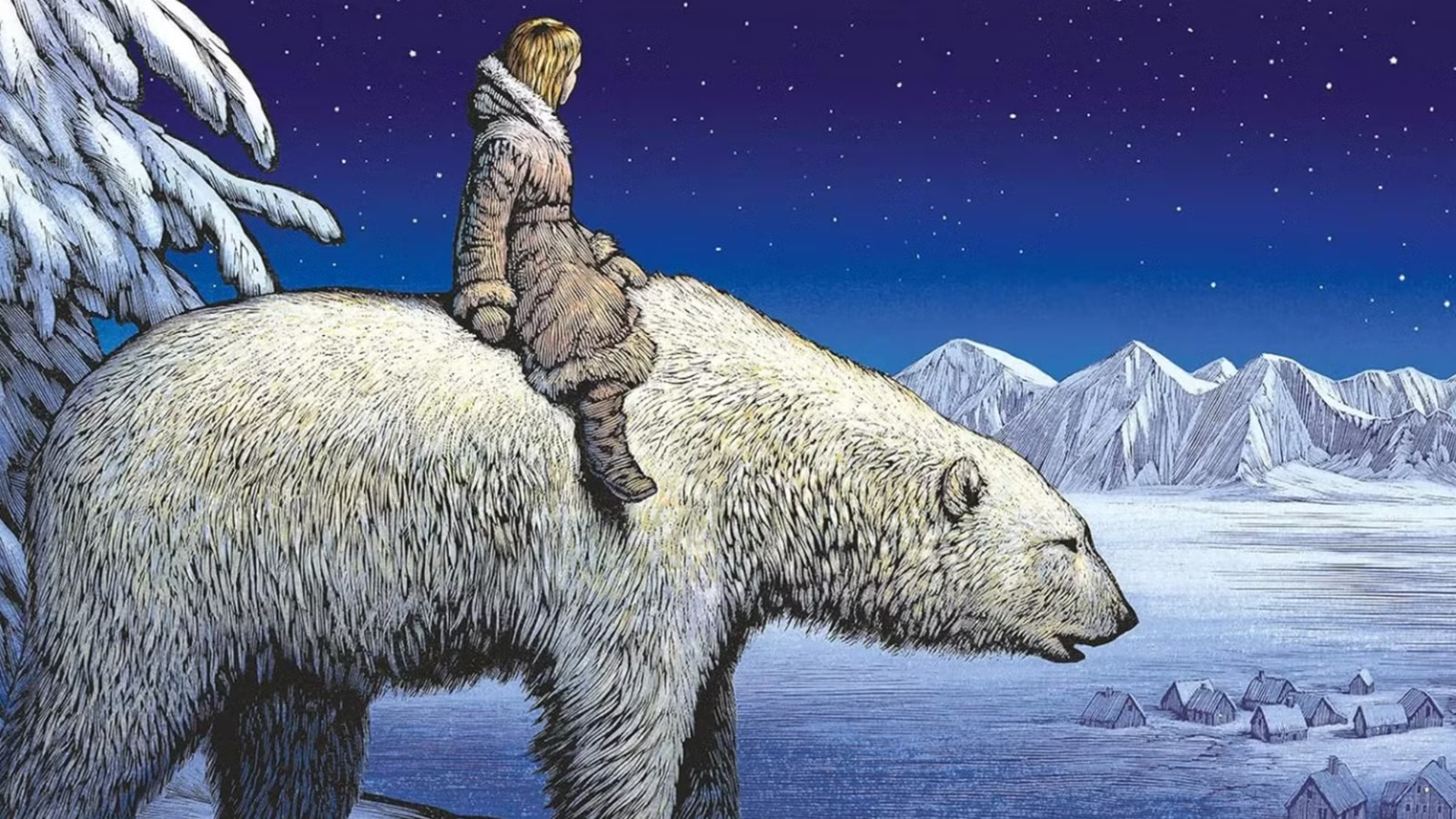
Even though Philip Pullman wrote the His Dark Materials trilogy without any specific target demographic in mind, the industry has since dealt with these phenomenal books almost exclusively as YA fantasy. That means that Northern Lights (titled The Golden Compass in the United States) is one of the greatest, most important, and most influential works of YA that not just fantasy, but all of literature has ever seen.
One of those fantasy books that are a masterclass in world-building, The Golden Compass proved that YA fantasy could explore incredibly deep philosophical, scientific, and theological ideas while still remaining entirely teen-friendly. Indeed, to this day, the book’s distinctly anti-organized-religion messaging mean that it’s still one of the most controversial novels YA has ever seen, which only makes it all the more of a must-read. In its taboo-breaking, The Golden Compass questioned the dogmas not just of the Catholic faith, but of its very genres.
2
‘The Hunger Games’ (2008)

Saying that The Hunger Games helped launch dystopian YA to levels of popularity authors had only ever dreamt of before, or that it helped turn YA into a powerhouse genre in the publishing industry, would both be tremendous understatements. Suzanne Collins‘ whole trilogy was unprecedentedly popular and had a level of influence on the genre that can still be seen and felt to this day, but the original book in particular changed YA literature as a whole forever.
Constantly imitated but never matched—neither in its quality nor in its pop-cultural impact—, The Hunger Games transformed YA into a true commercial juggernaut, even outside of the world of literature. And the best part? On top of being culturally significant, it’s a genuinely phenomenal piece of dystopian action literature, handling dark and complex topics with a level of depth and maturity that even older readers should be able to appreciate. It’s fast-paced, it’s action-packed, it’s romantic without ever being saccharine, and it’s easily one of the most essential works of YA writing in history.
1
‘Harry Potter and the Goblet of Fire’ (2000)

With Harry Potter and the Philosopher’s Stone, J. K. Rowling didn’t just revolutionize Middle Grade (MG) fantasy, but all of fantasy literature and the publishing industry as a whole. And as its two sequels continued selling a volume of novels that the world had rarely ever seen before, it seemed that there was nowhere the series could keep going other than up. Up, indeed, it went, with Harry Potter and the Goblet of Fire gradually taking the saga away from MG territory and steadily into introductory YA grounds.
This is far and away one of the most fun fantasy books of all time, a masterpiece that’s probably the single best way for a young reader between the ages of 10 and 14 to transition from MG literature to YA—which isn’t to say that Goblet of Fire is exclusively for kids, because it’s such a phenomenal and culturally impactful novel that anyone and everyone who loves fantasy should check it out at least once. Rowling completely rewrote the rules of the YA publishing market with this one, just as she had done with the MG market three years prior.








Leave a Reply