
Ah, the 1980s, when a not-yet-broken-by-the-comics-industry Alan Moore would still write as work for hire on superhero comics. In 1986, Moore wrote “Whatever Happened To The Man of Tomorrow?” and imagined a hypothetical ending for the Superman mythos.
The previous year, Moore contributed three Richard Corben-drawn pages to the exquisite corpse comic “Heroes for Hope: Starring the X-Men.” Moore depicts the then-reformed Magneto experiencing a bleak fantasy of a ruined world where his Brotherhood of Evil Mutants stands triumphant, albeit on a mountain of corpses.
Then there’s 1988’s “The Killing Joke,” the infamous origin (maybe) for the Joker. It’s one of the most famous and influential Batman stories ever. “Batman” and “Batman Returns” director Tim Burton has said, “[‘The Killing Joke’ is] the first comic I’ve ever loved.” But many hate it for a pivotal sequence where the Joker shoots, strips, and disables Barbara Gordon.
Moore has praised Brian Bolland’s artwork but has voiced regrets about writing the comic. “I think [‘The Killing Joke’] put far too much melodramatic weight upon a character that was never designed to carry it. It was too nasty, it was too physically violent,” Moore has said, feeling it spawned the “regrettable trend” of “grimness and psychosis” in superhero comics.
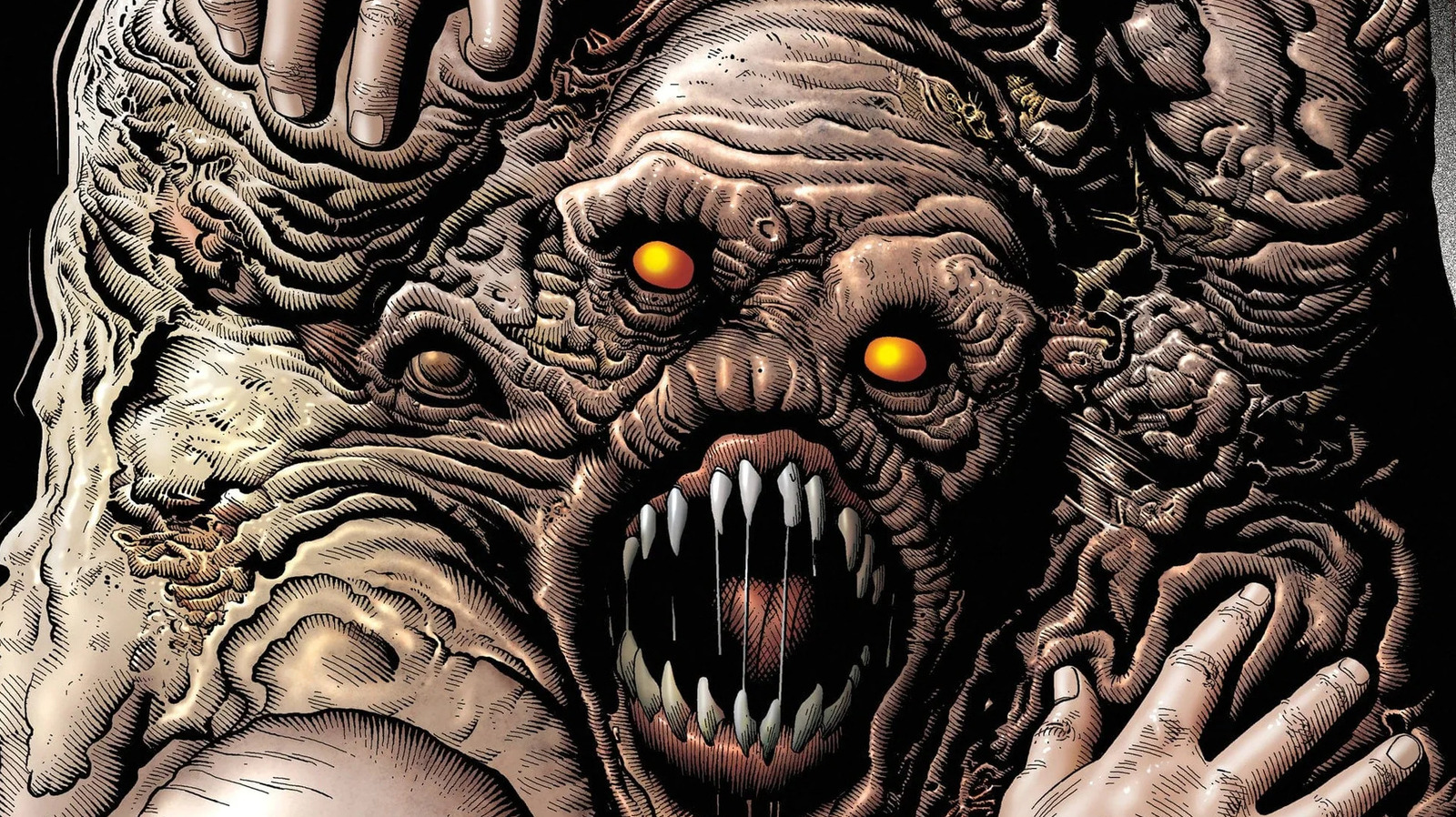
Previously, in 1987, Moore wrote a story about a different Batman villain: Clayface. “Mortal Clay,” drawn by artist George Freeman, was published in “Batman Annual” #11. The issue (advertised as “Villains In Love!”) includes two stories: “Love Bird,” a backup by Max Allan Collins and Norm Breyfogle, about the Penguin attempting to reform, and “Mortal Clay,” about Clayface’s obsessive romance with … a department store mannequin. It’s got the flowery prose and super-villainous psychological depth of “The Killing Joke” without the “nastiness” that makes that story a classic in most people’s eyes (but not Moore’s).
Preston Payne’s Clayface origins, explained
“Mortal Clay” is not about Matt Hagen, the character featured in the DC Universe’s “Clayface” movie (played by Tom Rhys Harries). In the “Batman” comics, there have been many Clayfaces. “Mortal Clay” is about the third one, Preston Payne, who’s distinguished by his wearing a glass helmet containment suit.
Clayface III debuted in “Detective Comics” #478-479 by Len Wein and Marshall Rogers. Preston Payne had the hormone disorder acromegaly. To cure his condition, he stole a sample of Matt Hagen’s blood, hoping Clayface’s shapeshifting would transfer over to him. Instead, he not only became a mud monster like Hagen but one with a touch that dissolves living flesh (hence his containment suit).
Payne is also delusional. He dotes on his girlfriend, Helena, even rushing back into his burning hideout to save her. Except “Helena” is actually a wax museum figurine, because Payne can only touch inanimate matter. During these issues, Batman is reeling from his girlfriend Silver St. Cloud leaving him, so a romantic villain makes for a compelling foil.
Clayface’s dark romantic spirit carries over into “Mortal Clay.” Searching Gotham City, Clayface rediscovers “Helena” (really, a department store mannequin). He embraces her like a lover and hides himself in the mall so at night, he and Helena can “live” as man and wife.
“Mortal Clay” is narrated entirely by Preston, with a clear dissonance between what his warped mind claims and what the more objective images of the comic show. Later in his narration, he claims men close their eyes when they kiss because they’re afraid they won’t see love in their partner’s eyes staring back. Maybe that’s one reason why men like Preston prefer a “woman” who is literally just a pretty object, incapable of speech or thought.
Mortal Clay gives Clayface a tragic romance
“Mortal Clay” explores the loneliness that Clayface’s poisonous touch brings. Payne embraces his delusions because that’s the only “love” possible for him. The way Clayface anthropomorphizes Helena, though, leads to jealousy and ruin. He thinks Helena is “cheating” on him when she’s used as a lingerie standee, or when a night guard steals a scarf off her display for his own wife — cue Clayface melting him. Once Batman shows up to investigate the murder, Payne concludes the Dark Knight is Helena’s gentleman caller. Batman, for his part, recognizes what’s happening and pleads: “Preston … let me help.”
“Mortal Clay” ends with Clayface sitting in Arkham Asylum with Helena. Payne drinks beer, watches TV, and resents his “wife” — a portrait of a marriage. In a closing line of beautiful dramatic irony, Payne smirks and narrates: “One day I shall be free [of Helena]. After all, she can’t live forever.”
“The Killing Joke” also ends with Batman extending his hand and offering to help a nemesis. The Joker rejects it, not spitefully but earnestly, because “The Killing Joke” demonstrates Alan Moore’s belief there has to be something human that drives the Joker. (“Dark Knight Returns” author Frank Miller, who feels the Joker is “evil incarnate,” claims he and Moore once had an hours-long disagreement about that.)
The best companion piece for “Mortal Clay,” though, is Moore and Rick Veitch’s “Swamp Thing” #56, or “My Blue Heaven.” Stranded on an alien world, Swamp Thing uses his powers to remake a simulacrum of his life on Earth, including a plant puppet of his wife Abby. But Swamp Thing knows he’s fooling himself, whereas Clayface deludes himself into genuinely believing Helena is a real person. As “Mortal Clay” shows, not even that ignorance has brought him bliss.










Leave a Reply