
Anime is a medium that’s given tremendous leeway in the stories and genres it explores, but there’s often an extra level of excitement surrounding mecha series. Mecha anime typically features giant robots that are used to fight wars, help humanity, or protect the world from evil aliens or other malevolent machines. Mecha series are an anime staple each decade, and yet this doesn’t necessarily mean that these titles all blur together.
Mecha anime can explore geopolitical struggles and operatic wars that play out in space, while others use these giant robots for slice-of-life silliness or to comment upon society’s relationship with technology. Some of anime’s most popular mecha series include Super Dimension Fortress Macross, Patlabor, Neon Genesis Evangelion, Code Geass, and the totemic Mobile Suit Gundam franchise. These mecha anime have all achieved evergreen success. However, there are some equally impressive mecha anime that have unfortunately slipped through the cracks and fallen into obscurity.
RahXephon Turns Mecha Mayhem Into A Profound Philosophical Awakening

The early 2000s were a challenging period for the mecha genre. There was a compulsion to capitalize on the success of the many formative mecha anime that closed out the ’90s, while still finding ways to do something different with the genre. 2002’s RahXephon got lost in the early 2000s shuffle, but it’s held up incredibly well more than two decades later. RahXephon begins with a somewhat traditional setup in which a sullen teenager, Ayato Kamina, accepts the steep responsibility of piloting a formidable mecha to defeat mysterious, dimension-jumping aliens.
RahXephon presents many ideas that should be familiar to seasoned mecha genre fans, but it becomes a considerably more complex vehicle that feels like the existential hybrid of Evangelion and Macross. RahXephon features its share of giant robots battling against unfathomable aliens. At its core, RahXephon explores far more challenging ideas, such as the intrinsic power of music and its ability to change the world. The harmony that’s created by music and the corresponding sound waves hold tremendous power over RahXephon‘s mecha and monsters alike. The anime even explores the premise that Ayato is an instrument of sorts who spends the whole series being tuned and learning how to create the perfect music.
Guess the anime from the emojis.
🎌
Guess the
Anime
⭐
Guess the anime from the emojis.
Easy (120s)Medium (90s)Hard (60s)
RahXephon‘s emphasis on music and sound is the secret weapon of this mecha anime. However, it’s still rich in cathartic character development that’s set in a unique world that’s steeped in rewarding secrets. Studio Bones also ensures RahXephon‘s visuals are immaculate. The combat choreography and the grander wars that break out become stunning spectacles. RahXephon taps into a similar brand of surreal, philosophical storytelling that ensures this mecha anime has something deeper to say and isn’t just flashy fights.
The King Of Braves GaoGaiGar Denies Cynicism In Favor Of Inspirational Archetypes

Sunrise is one of the biggest names in the anime industry when it comes to mecha storytelling. There’s always an extra level of excitement whenever Sunrise returns to the mecha genre, and yet The King of Braves GaoGaiGar has struggled to find universal acclaim. Released in 1997, The King of Braves GaoGaiGar explores a rather ambitious story about two eclectic heroes who share the same goal of protecting Earth from the deadly Zonders. At the same time, one of these individuals — Mamoru — learns that he shares a unique connection to the Zonders that continues to evolve.
The King of Graves, GaoGaiGar, is such a breath of fresh air because it staunchly rejects the gritty cynicism that filled the ’90s in favor of shonen heroes who proudly embody courage, altruism, and honor. The powerful humanity that’s championed by the anime’s pilots is juxtaposed against incredibly detailed mecha designs that grow more intricate over time. GaoGaiGar’s transformation sequences — one of the genre’s biggest tropes — truly go for broke and feature ridiculously hyperbolized final forms and fights. Anime that uses “the power of love” to resolve conflicts can be hit-or-miss, but there’s a sincerity to GaoGaiGar that helps this emotional material land.
The entire King of Braves GaoGaiGar anime is a worthy mecha experience that provides a satisfying counterpoint to much of the alternative programming that filled the ’90s. However, the anime’s concluding OVA, GaoGaiGar Final, is widely considered the mecha franchise’s crowning achievement and the perfect way to end the series. It solidifies King of Braves GaoGaiGar‘s status as an all-time mecha classic, even if it’s relatively obscure to modern audiences.
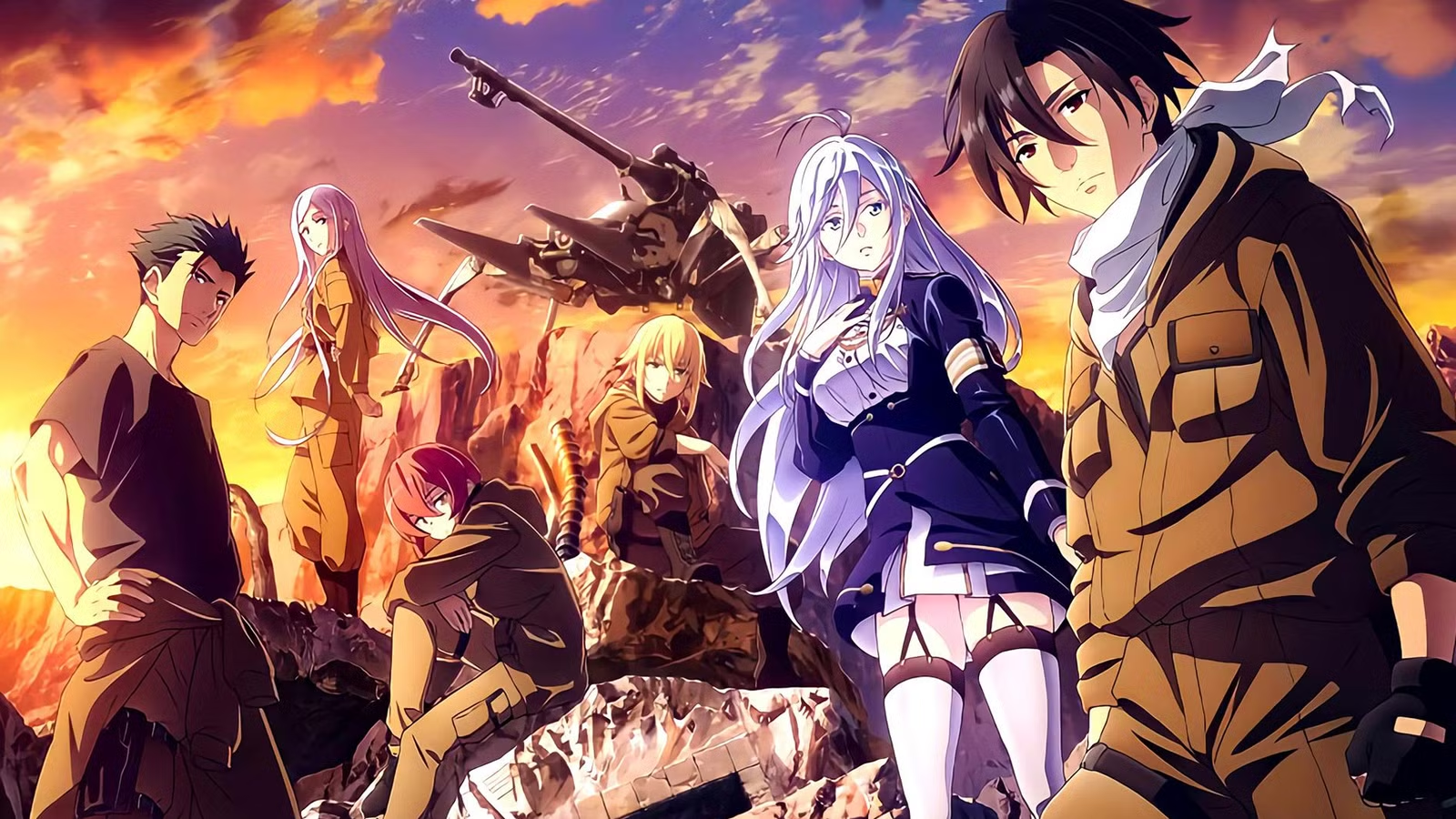
86: Eighty-Six Unpacks The Human Cost Of War Through A Chilling Lens
A common theme explored in many mecha anime is that advanced technology is used to expedite war and push conflicts into even more extreme forms. It’s sometimes easy to forget that there are actually human pilots in these giant robots, and 86: Eighty-Six is a contemplative mecha anime that specifically deconstructs the detached distance that mecha warfare can bring to battles.
The 2021 anime features an intense war in which the Republic of San Magnolia boasts that it’s perfected a “bloodless” war achieved through unmanned mechs that ostensibly operate as an evolution of drones. However, it comes to light that these mecha units actually have human pilots who are forced to fight for their lives as their rights and freedom are ripped away. It’s an extremely disturbing premise that prompts a greater degree of emotional and thought-provoking storytelling that litigate the cost of war and the apathy, manipulation, and oppression that it can trigger in society.
It’s the perfect angle for a militaristic mecha series that’s just as interested in the consequences of battle as it is in the battle itself. Eighty-Six has the rare ability to make its audience feel disgust and shame over its epic mecha battles as they consider the truth of the matter, rather than the protective lie that’s being sold.
Eureka Seven Mixes Intergalactic Mecha Combat With A Coming-Of-Age Love Story

Eureka Seven is a chaotic anime that taps into the 2000s’ energy of creative coming-of-age parables that use extreme scenarios to reflect human experiences. Renton Thurston’s ordinary life is irrevocably changed when a giant alien aircraft — an LFO — lands on Earth and requires maintenance. Renton connects with the ship’s pilot, Eureka, leading to a sweet, soothing slow-burn romance that’s also a sublime “fish out of water” story.
Greater conflicts pull Renton into combat and subject him to a crueler world than he’s used to, albeit one that’s necessary for him to mature into a proper hero. Eureka Seven‘s relationships all feel authentic and ring true with a wide range of flawed figures. The anime really asserts its individuality in how the LFO mechas operate. This technology “surfs” on airborne particles, resulting in slick, stylish action sequences that feel unlike most mecha battles.
Eureka Seven‘s bold soundtrack also celebrates these creative elements and helps unite the chaos into a superior package. Eureka Seven is an underrated mecha triumph of the 2000s. That being said, its sequel, Eureka Seven AO, loses much of the magic and fans of the original should be wary of its precarious continuation.
Martian Successor Nadesico Delivers Extreme Satire That’s Never Lacking In Substance

Martian Successor Nadesico embraces the many new mecha anime that dominated the early ’90s and is designed to be a pitch-perfect parody of the sci-fi genre’s heightened nature. Set in 2196, Martian Successor Nadesico follows the crew of an intrepid space battleship that’s been tasked with the extermination of extraterrestrial lizards. The anime is seen through the eyes of an ordinary boy, Akito Tenkawa, who simply wants to hone his passion for cooking and watching anime.
Akito is thrust into a position of authority when he proves to be a natural with the ship’s advanced mechs, despite his desire to stay in the kitchen. Martian Successor Nadesico uses these eclectic ingredients to craft a one-of-a-kind mecha experience that balances space-opera melodrama with broad gag comedy, slice-of-life mundanity, and the hormonal hijinks that often accompany the harem subgenre. Martian Successor Nadesico may seem generic to outsiders, which is part of why it’s become a bit of a lost mecha relic of the ’90s. However, Nadesico intentionally embraces these tropes to reinvent the genre and genuinely surprise its audience.
There’s a dramatic tonal shift in the anime’s second half that works so well because it completely undercuts the comedy that comes before it and delivers a grave reality check for Akito and the rest of Nadesico‘s players. Martian Successor Nadesico is deceptively ambitious and is thematically rich. It gives serious sci-fi fans an engaging, suspenseful story that never neglects its comedy.







Leave a Reply