
We may receive a commission on purchases made from links.
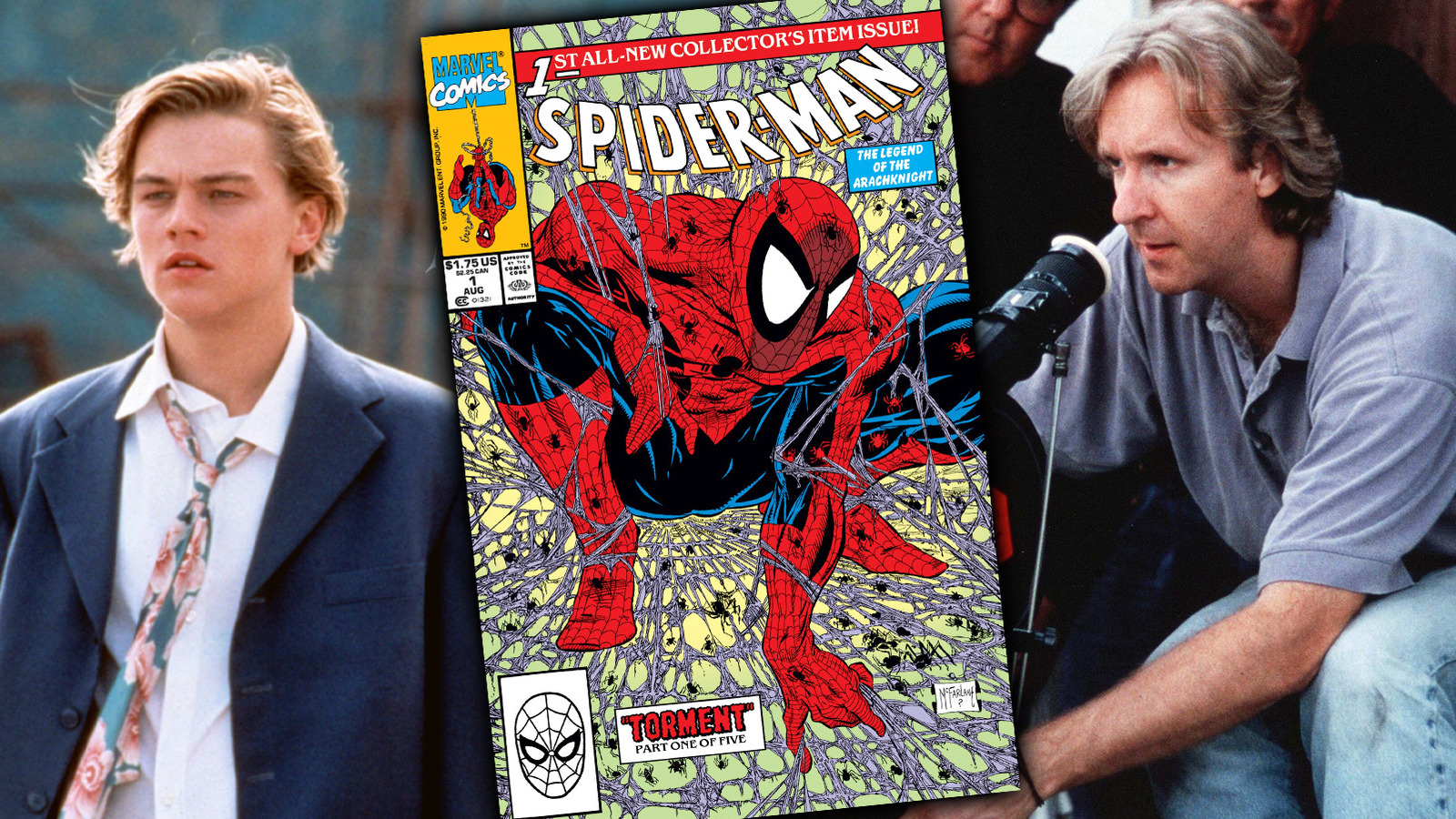
It’s the greatest movie James Cameron never made: “Spider-Man.” Long before Sam Raimi delivered his take on the webslinger, Cameron was preparing his big screen vision for the Marvel icon. Between 1991’s “Terminator 2: Judgment Day” and 1994’s “True Lies,” the esteemed filmmaker did his best to realize that vision, which he outlined in a document — part script, part treatment — that has since become both legendary and infamous among fans. Cameron’s “scriptment” is known for being the blueprint to an oddly mature Spider-Man movie that many fans are happy never came to fruition.
Myriad Reddit threads showcase fans’ distaste for Cameron’s inclusion of swear words and a Brooklyn Bridge-set sex scene between Spider-Man and Mary Jane Watson. Meanwhile, a brief internet search will turn up no shortage of begrudging headlines claiming that, as interesting as the director’s “Spider-Man” was, it’s a good thing it never happened.
Make no mistake. This unmade Spidey flick would have been brilliant.
Today, it’s time for superhero movies to take a long break. But in the early ’90s, Hollywood had only just started to explore the cinematic potential of these pop culture legends. Marvel was struggling to do so. Though there are some gems among the pre-MCU movies, the Marvel films of the 1980s are some of the most abject superhero features ever made. Cameron could have been the company’s savior. In fact, his plan for Spidey would have completely changed the course of comic book movie evolution, delivering a grounded and serious take on the character more than a decade before Christopher Nolan brought that same sensibility to his “Dark Knight” trilogy.
Though it often gets a bad rap among fans who balk at the idea of an R-rated Spider-Man, Cameron’s unmade movie could have been truly revolutionary.
James Cameron couldn’t turn down the chance to direct a Spider-Man movie
Spider-Man fans don’t have a great record of speculating about certain directors’ visions for the character. As Sam Raimi told Variety, fans were mad at him prior to “Spider-Man” (2002) for a ridiculous reason. “I don’t think that the fans thought I was the right person to direct ‘Spider-Man’ in general,” he said, before highlighting the inclusion of organic web shooters — a major change from the comics in which Peter Parker creates his own web shooters. “When the fans found out I was going that way, they tried to have me removed from the picture.”
The thing is, the organic web shooters were James Cameron’s idea, not Raimi’s. What’s more, when the latter’s film arrived, this apparently controversial aspect of Peter’s transformation worked perfectly well, raising the question of what else from Cameron’s scriptment would have panned out. Well, aside from overt wet dream metaphors and a questionable love scene, the answer is: most of it.
Ironically, in the early-90s, Cameron and his company Lightstorm Entertainment were originally developing an “X-Men” feature. But that quickly fell apart after Stan Lee offered the director a shot at Spidey. As comic book writer and “X-Men” stalwart Chris Claremont remembered during a 2012 Columbia University panel (via TheWrap), he and Stan Lee met with Cameron about the “X-Men” movie but things quickly got off-track. “We’re chatting and at one point Stan looks at Cameron and says ‘I hear you like Spider-Man,'” recalled Claremont. “Cameron’s eyes lit up. And they start talking. And talking. And talking. About twenty minutes later, all the Lightstorm guys and I are looking at each other, and we all know the X-Men deal has just evaporated.” Cameron’s “X-Men” movie had just been ruined by Spider-Man.
What happens in James Cameron’s Spider-Man?
James Cameron’s “Spider-Man” scriptment captured the classic essence of Peter Parker. Like the Steve Ditko-era Peter, Cameron’s version is troubled and conflicted. He’s more human, making his struggle to come to terms with his abilities all the more compelling.
In Cameron’s story, Peter is transformed after being bitten by a spider altered due to having eaten a genetically modified fruit fly, sending him into a hallucinatory fever dream. He awakens in his bed only to find that he’s involuntarily expelled “a sticky, white mass” while asleep. It’s webbing, but the metaphor is obvious. Still, it’s a brief moment in a much bigger, more complex story.
Cameron’s mature sensibility is expressed not only through R-rated dialogue and on-the-nose puberty metaphors, but through his focus on class stratifications and Peter’s social isolation. In the scriptment, Peter lives in a lower income neighborhood but attends school in an affluent area, making him “a poor kid from the wrong side of the tracks in the eyes of his status conscious schoolmates.” Rather then being a timid, kind-hearted loner, however, Cameron’s Peter is “defiant,” and “wears his isolation like a badge.”
The class motif recurs when Peter discovers $20,000 dollars in a drug-dealer’s house and finds himself “hovering on the brink of going over the line… of becoming a criminal himself.” Instead, he casts the cash into the wind above a low-income neighborhood as citizens excitedly clamor for bills in the wind. Later, he repeats this act, releasing $250 million above Manhattan in a “green cloud” that turns the metropolis into “one big street party.” For a story that was supposedly too dark, this would have been an uplifting sequence, affirming Spider-Man’s standing as a champion of the oppressed. In Cameron’s hands, it would have been pure magic.
James Cameron’s Spider-Man would have delivered pure action majesty
A dodgy sex scene wherein Peter seduces Mary Jane Watson with lines about how certain crab spiders “attach strands of silk to the female… tying her limbs” has enraged fans for decades. But again, it’s one moment in a first-draft scriptment. Otherwise, the darker moments of James Cameron’s scriptment serve a real purpose. At one point Spider-Man confronts thieves only to discover they’re kids, one of whom flees, slips off a fire-escape, and dies. Such a thing might seem inappropriate, but this is Cameron grounding his story in a world with real consequences.
The primary villain of the film is Carlton Strand, a supervillain who’s a cross between Electro and Kingpin. “The image of vast wealth attained not inherited,” as Cameron describes him, this new money psychopath provides an intriguing counterbalance to Spider-Man in that, like the hero, Strand sees humanity’s failings. Having teetered on the edge of all out cynicism, however, he took the plunge while Spidey didn’t.
His henchman is Sandman, referred to as “Boyd” here. Cameron was in familiar territory with Sandman as, like Robert Patrick’s T-1000 in “Terminator 2,” the villain reforms at will. With this villainous pairing, Cameron’s “Spider-Man” movie cost the animated series Sandman and Electro, but it would have been worth it. The pair ultimately face Spidey in a climactic scene atop the World Trade Center, where Mary Jane Watson’s life hangs in the balance. Spider-Man and Sandman engage in an all-out slug fest during which they “pound each other mercilessly and reduce every object in sight to junk.” Considering his action bonafides, Cameron would have delivered the goods. Likewise, the final fight between Strand and Spidey sees them tumbling between the Twin Towers amid lightning arcs, ending a set-piece that reads like pure action majesty.
What would James Cameron’s Spider-Man have looked like and who would have starred in it?
A significant element of James Cameron’s “Spider-Man,” ultimately preserved by Sam Raimi in 2002’s “Spider-Man,” is the organic web-shooters. This bio-webbing is also featured as Tom Holland’s Spidey undergoes major changes in “Spider-Man: Brand New Day.” Cameron later told ScreenCrush that he saw Spider-Man’s transformation as “a metaphor for puberty and all the changes to your body, your anxieties about society, about society’s expectations, your relationships with your gender of choice that you’re attracted to.”
In terms of what Cameron’s “Spider-Man” might have looked like, a piece of concept art was revealed in the book “Tech Noir: The Art of James Cameron,” which contained an image of the wall-crawler scaling a Manhattan skyscraper.
James Cameron’s drawings for his never-made SPIDER-MAN movie pic.twitter.com/ilsYkYkwYV
— Chris Evangelista (@cevangelista413) December 23, 2022
Otherwise, Variety spoke to Marvel rep Pamela Rutt in 1993, who said, “I understand that the new design of Spider-Man will revert back to his look in earlier days. It will be more faithful to the original rendering of the character, with changes around the eyes.”
Meanwhile, Leonardo DiCaprio was reported as being in contention for the lead role. But in a 2015 Shortlist interview, he was asked how close he came and downplayed his involvement, saying, “That was another one of those situations, similar to Robin, where I didn’t feel ready to put on that suit yet.” According to Spider-Man News, when asked the same question by Empire Magazine, he said, “Not very close, but there was a screenplay […] [Cameron and I] had a couple of chats. I think there was a screenplay that I read, but I don’t remember.” Lance Henrikson and Michael Biehn were also reportedly in line to play Carlton Strand and Boyd respectively, but nothing was ever made official.
James Cameron’s unrealized Spider-Man movie is a historic cinematic tragedy
Many fans recoiled at James Cameron’s mature take on Spider-Man. But back up from the pop culture icon we all know, for a moment, and consider: This is a story about a kid who becomes indirectly responsible for his uncle’s murder. The director understood the inherent seriousness, and had already proved he could expertly combine darker themes, all-out action, and comic relief moments to create a unique cinematic experience of which Spidey was surely deserving. What’s more, the scriptment would have been refined before shooting, so that by the time it hit theaters, Cameron’s movie may have looked more like “Batman Begins.”
The director even evoked the spirit of Christopher Nolan’s Batman films when he told ScreenCrush, “I wanted to make something that had a kind of gritty reality to it. Superheroes in general always came off as kind of fanciful to me, and I wanted to do something that would have been more in the vein of ‘Terminator’ and ‘Aliens,’ that you buy into the reality right away.” That’s almost exactly what Nolan said in a featurette for “Batman Begins”: “It’s not necessarily about a direct reality […] it’s about what I supposed you might term a ‘cinematic reality.’ It’s about giving the world of the films and the characters as much weight and validity as they would if your source material were not a comic book.” Cameron was thinking about this stuff more than a decade prior.
Not that this is surprising. The director had publicly grappled with the implications of artificial intelligence all the way back in 1984 with “The Terminator.” Cameron even wrote the greatest anti-AI scene in movie history for “T2” in 1991. The fact he was trying to make a grounded superhero movie years before his contemporaries is just more proof he was way ahead of his time.


Leave a Reply