
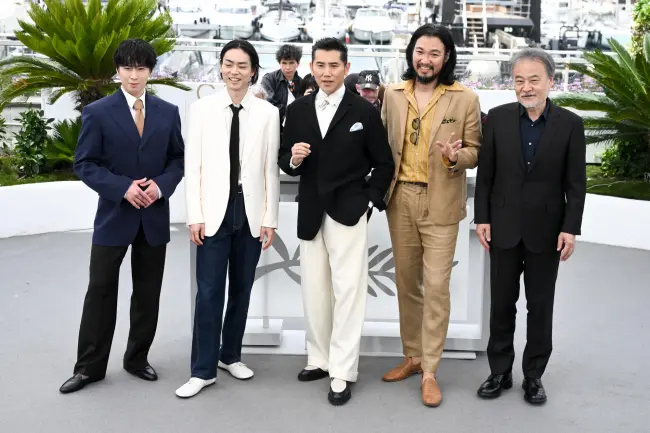
Ever watch a murder mystery and wonder how it might improve if all the characters were samurai? Director Kiyoshi Kurosawa (“Pulse,” “Cure”) has crafted a film that speaks directly to that fantasy with his latest film, “The Samurai and the Prisoner.”
Kurosawa adapts Honobu Yonezawa’s book, “Kokurojo: The Samurai and the Prisoner,” to tell the story of Lord Murashige Araki (Motoki Masahiro), a samurai warlord who has rebelled against a rival warlord, Nobunaga Oda. While dealing with an impending counterattack from Oda, Murashige finds that trouble stirs in his own courts as mysterious deaths, from a child prisoner to other officials, end up mysteriously murdered. Murashige forms an uneasy alliance with the prisoner Kanbei Kuroda (Suda Masaki), a war strategist of a rival clan who was spared by Murashige, to help solve the murders.


For “The Samurai and the Prisoner,” Kurosawa mixes whodunit tropes with jidaigeki ones (think: “Katanas Out” or “Wake Up Beheaded Man”), until the mystery transforms into a treatise on weaponized religion, and how those in power can exploit people’s fears about what comes after death, which makes them more pliable to be used as agents of state violence. If followers are the highest currency — an endless supply of bodies to burn through — then there’s nothing more powerful than a group ready to throw everything in this life away for the next, to fasten their flesh into sacrifices.
When I met with Kurosawa at the JW Marriott during Cannes, he evoked the very spirit of Murashige: calm, calculated, and focused, seemingly not letting the film’s rapturous response (or any past victories) get to his head. We discussed his approach to depicting violence, the role of mystery, the afterlife, and faith in his work, and what made him want to tackle a story set in this time period, with all of its logistical challenges but anachronistic joys.
The following interview has been edited and condensed for clarity and length; it was conducted via translator.
IndieWire: It was touching to see Ryusuke Hamaguchi, Hirokazu Koreeda, and Kōji Fukada all at the premiere. What did it mean to connect former students, colleagues, collaborators at the festival?
Kiyoshi Kurosawa: Seeing them made me realize how special film festivals are. I used to see Hamaguchi and Fukada quite often, but I don’t get to see them as much these days. All of us, director Koreeda included, are doing our own work and making each of our films in our own ways, so it’s nice when I find myself in these situations where I get to re-encounter and see them after some time. It’s quite special and wouldn’t be possible without film festivals.
You are all samurai of cinema in your own right, but that makes the reunion sweeter.
[Laughs] You have to be careful with this analogy because then we might start fighting.
Your producer recommended the novel “Kokurojo: The Samurai and the Prisoner” from Honobu Yonezawa for you to read. Why did you want to adapt it?
Even before I was given the book, I was already interested in the historical figure, Araki Murashige, who is a 16th-century figure who used to be a vassal to Nobunaga Oda and then, of course, betrayed him and then also stayed in this castle and is surrounded by Oda’s army. After that, a few months later, he leaves behind his own people and escapes, and he’s actually known quite well as this person who acted very un-samurai-like and cowardly. He’s almost seen as a bad guy in history.
I was always curious as to why he was compelled to first betray Oda, but then also why he decided to run away. That’s always been a historical mystery. I was really interested in this particular figure who sort of stepped away from social standards of the time to run away. I’ve had my own speculation, and once I read this book–though it was fictitious — it explored questions that I had, which is why I wanted to turn it into a film.

Mystery and the fear of the unknown are themes that characterize your work. There’s a built-in mystery with this plot, in that, as you articulated, we don’t know why Murashige walked out of the castle.
As interesting as I found the book, I realized that it was also difficult to adapt. I’m not talking about the mystery of why Murashige decided to leave the castle, but more so the structure of the story. In the story, Murashige acts almost as a detective in solving the murder mysteries that are happening in the castle, as if he’s like Sherlock Holmes. That can be a difficult structure to undertake in a film, because the “mystery” is something that happened in the past. When you’re reading an entertaining book, but when you rewind time in film, that can be tedious.
It’s different from if I’m working in a thriller or horror genre where the mystery is something that happens in the future, or you’re headed towards the unknown. For example, you can go into a mansion, and you don’t know what’s going to happen, but that’s something that’s happening in the future and that creates a powerful energy within the film. Yet when that mystery is happening in the past, going back to the past can stop the propelling movement forward for the film. On a script level, I had to think about this issue.
What I then decided to do was to not go back in time at all within the story and instead have the mystery solving happening through the dialogue. By depicting details from this process by showing Kuroda giving Murashige clues, I figured that I could also express the change that happens within Murashige himself. By depicting the “why” of Murashige in parallel with how his relationships are shifting, I figured that might speak to the mystery.
In the middle of the film, you take time to show Araki Murashige preparing tea. There’s an invitation to stillness and contemplation, and I’d love to hear why you chose to include that scene and the importance of showing the whole process of making tea.
For Sengoku-period samurai, the tea ceremony was not just about enjoying tea. It served as a space where they could speak candidly beyond the master-servant relationship, hold secret discussions and negotiations, or persuade opponents without relying on military force. While I depicted such scenes, I also wanted to show how the protagonist, Murashige, lost sight of the original purpose of the meeting and genuinely became absorbed in the tea ceremony itself. During filming, Masahiro Motoki’s movements were so beautiful that I made sure not to cut too much during editing. As a result, in a film filled with an immense amount of dialogue, it became a deeply memorable and uniquely silent scene.
I find the film to be in fascinating conversation with one of your latest films, “Cloud.” Those characters are nonviolent, but by the end of the film they’re thrust into violence whether they want to or not. With “The Samurai and the Prisoner, these are characters who crave violence, so many of them want or need to die. What was it like to dive into and write characters who in many respects were holding the opposite worldviews of “Cloud?”
That’s a really interesting point that you’re making here, but ultimately “Cloud” is set in contemporary Japan. In that sense, I understand what normalcy might feel like in the world of “Cloud” because I can base it on my own ways of how I’m experiencing daily life. Of course, some of those characters can step out of normalcy, but with something like “The Samurai and the Prisoner,” I’m working with the source material of the book, but also that Murashige is a real historical figure. There are certain sources I can turn to, but I just have no idea what normalcy was like back in the day for these people and what kind of daily life they were leading. I don’t know what their value system is or how they might have conceived of violence. I would think they’re not always thinking “kill me,” but when they’re not under crisis, it’s hard to imagine what their “normal” is.
While writing this script, I decided to just give up on understanding what normalcy might in fact be and instead try to concentrate on the fact that I don’t know. What I can do is focus on the exact moment I’m depicting and, using the resources around me, think about what their relationship to violence might be. I don’t think there’s a way for me as a contemporary person to understand what it’s like to have your child be taken hostage, knowing that they might actually be killed, because from my modern perspective, that feels wild and crazy. Even in the absence of knowing what might be normal for Murashige, I figured what we needed to do was have Murashige get closer to what we might see as normal, at least in how we conceive of it now.
I’m struck by your approach to action: it’s unglamorous and horrific, and you’re often keeping the camera static whenever there are skirmishes. Can you speak about your approach and working with cinematographer Yasuyuki Sasaki to film these scenes?
So this is a jidaigeki samurai film, and I was particularly inspired by some of the 1950s classical ones. Ultimately, with this film, violence is not necessarily at the center of the story; conversations are. Those classical films were more restrained, so I felt I could go in that direction.
But when I say restrained, I do think that that’s different from a kind of fakeness. When I’m depicting, say, a beheading, I didn’t want to show the action clearly, but I also wanted to feel like it did actually happen. In some ways, I had contradictory goals in what I was trying to achieve with Sasaki. It was a difficult task and something I want to continue to take on and understand. Now that I’ve worked with swords and have more familiarity, I’m still trying to get to that place of the violence feeling real and restrained. I’m studying more and hope to try something better in my next films.

You can explore those ideas more in “The Samurai and the Prisoner 2”. The conversation between Murashige and Chiyoho stood out to me, particularly this idea that if people believe there’s a heaven or hell for them to go to, their devotion can be weaponized.
I do not want to be controlled by being told about what happens in the afterlife, and what I mean by that is that ultimately, as people who are alive, we have no idea what is going to happen after you die. This is an unfortunate fact that we can’t ever really know, but I don’t like the idea of somebody using that to apply some kind of imaginary situation and try to change and affect the way people live.
I do have the sense that something is going to happen when you die. I think there is the idea that you become nothing or nothing exists beyond the afterlife. But even when you say nothing is there, I wonder what “nothingness” even is. I also think to just say that nothing will happen is sort of a cop out in a way because it stops you from actually thinking about it. I think there is some kind of change that happens in the afterlife. But again, we have no idea what will happen. We only know when we die.
Chiyoyo and Araki Murashige’s debate about divine punishment and intervention is one of the most theologically rich conversations I’ve seen put to screen. It’s also cleverly choreographed and almost feels conducted as if it were a fight scene, even though only words, no swords, are exchanged. Can you speak about your approach to filming that scene?
While flashbacks are common in such cases, I decided from the very beginning not to use them. Instead, the past events are entirely expressed through long monologues delivered by the actors. Among them, the scene near the end where Chiyoho speaks to Murashige was particularly lengthy and vital. What the audience witnesses is not a flashback, but rather the mannerisms of a person recounting an experience, the reaction of the person listening, and the distance between the two. Another crucial element in this scene was the relationship with the altar. The audience would also see the contrasting attitudes of Chiyoho, who clings to it, and Murashige, who turns his back on it. To pull off this long scene combining these elements, a considerably spacious environment was required, and we found the perfect temple in a remote corner of Kyoto. All I did was draw up a plan that utilized every inch of this location. The rest was thanks to the wonderful work of the actors, the camera crew, and the lighting team.
The line “Advance to paradise, retreat to Hell” made me think of a line from “Dune: Part Two,” where Zendaya’s Chani says, “You want to control people? You tell them a messiah will come.” It was making me think about religious extremity.
I think, to borrow Chiyoho’s words from the film, she is interrogating the veracity of that Buddhist phrase, “Advance to paradise, retreat to Hell.” Even if you go backwards, even if you retreat, you can still find paradise. These are ancient words, but when Murashige hears them, it makes him realize that even if he lets go of his power, lets go of his pride as a samurai, he can still find happiness. I think these words have much to say to us in our contemporary times.

One of the most powerful lines in the film comes from Murashige when he says, “You never considered turning over the status quo.” The scary thing about turning over the status quo is that in doing so, you don’t know if history will be fair to you. The trailblazer may be vilified in the moment but may not be celebrated till later.
I would say I have a certain sense of what you may be able to call romanticism to this idea of changing the system entirely and to break certain social standards or the structure that’s in place. I have this sort of broad desire towards something like that, but when I consider what that looks like in reality, I think that we’re faced with a situation such as one that Murashige faced. What we see with his final actions is that he’s not trying to take on society in general, but he escapes his own shell, and by doing this, he’s able to achieve his own biggest happiness and joy. Inspired by Murashige, I was writing a story that considers that the way you change a system is that you first try to change yourself.
You have spoken about coming from old days where you shoot the film and the director or DP don’t know what the film looks like until it has developed. You come from the filmmaker philosophy of “I can’t control it, we’ll just have to see what happens when I look at the footage.” This film and your words have made me think about filmmaking as an act of faith in many ways. How does faith manifest in your creative process?
That question strikes at the very essence of filmmaking. It is incredibly difficult to give a precise answer, but I will share what I think right now.
In live-action film, our subjects are people, streets, forests, and oceans — all of which are parts of the world or nature that have existed around me long before I ever tried to film them. A camera, on the other hand, is merely an optical machine; it possesses no inherent ability to automatically capture its surroundings. We cannot recognize the object beyond the lens unless we cast light upon it and bring it into focus, nor can we see what lies beyond the frame, what is behind a door, or the face of a person who is turned away. In other words, despite clearly existing right in front of us, most things in the world and in nature are incredibly difficult to capture with a camera.
Still, we point our cameras at people and streets, desperately trying to film something — even though most things can’t be captured! It’s enough to drive one to despair. Are the things left uncaptured by the camera worthless to a movie? No. The world and nature are undeniably there, so a fragment of that larger whole must absolutely be captured somewhere on film. But where? And how?
I believe the only way to overcome this greatest hurdle of filmmaking is to “believe.” Believing that something undeniably exists there, even if it is not visibly captured, is essential — not only for making a film but also for watching one. Believing that the same world continues beyond the frame and behind closed doors (even if it is just a set); believing that an actor made a deeply memorable, once-in-a-lifetime expression (even if they rehearsed it a hundred times); believing that the sunlight filtering through the trees is breathtakingly beautiful (even if that shot was originally a bad take) — what supports cinematic expression at its very core is this deceptive, illusionary, magic-trick-like effect.
Yet, it is precisely there that people catch a clear glimpse of the world and nature. And that glimpse should expand beyond the boundaries of the screen, filling the entire theater. This is what I consider the apparatus called “cinema” to be. It would not be an exaggeration to call this a form of “faith.”
Janus fiLMS releases “The Samurai and the Prisoner” in theaters on Friday, July 31.



Leave a Reply