
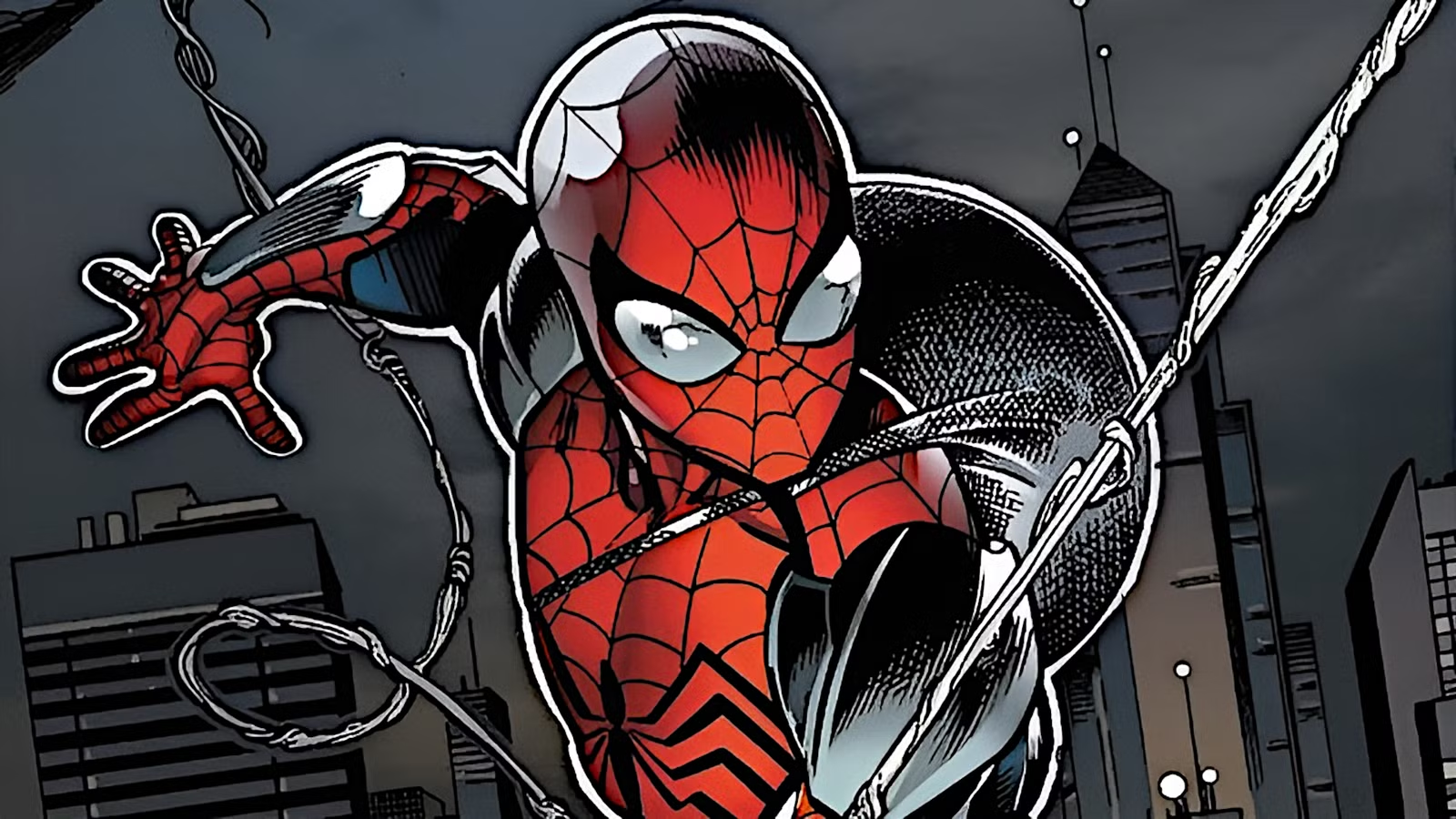
When it came to taking pride in the magic of comic books, Stan Lee remains one of history’s most prominent figures from the scene. But despite his referral to Marvel fans as “True Believers”, the truth behind said magic was far more grounded as seen in its comics, featuring flawed, troubled characters with incredible abilities designed to be relatable enough to want to cheer for. It’s resulted in multiple legends with their own triumphs and struggles, from the Fantastic Four, to Tony Stark, to the most bankable superhero in the world, Spider-Man, himself being synonymous with the legacy of Stan Lee.
Regardless of one’s stance about Lee’s contributions to the scene compared to his contemporaries like Jack Kirby or Steve Ditko, his input and leadership style, such as the Marvel Method, continue to be felt today. It led to trusting relationships with creative professionals at the top of their games, with one particular Spider-Man story honoring Lee’s past, and arguably, carrying his legacy into the future. This story is fairly well-known by plenty in the circle as a gorgeous celebration of Marvel’s 80th Anniversary, 2019’s Spider-Man: Life Story, and it’d surely have done its most famous creative trailblazer proud.
Spider-Man’s Best Modern Story Celebrates Its Star’s Complicated History
In an ambitious retelling of the highs and lows of Peter Parker’s superhero career from age 15 to 73, Spider-Man: Life Story teases Spider-Man’s origins, while ultimately diving into his life across each decade of his existence. This meant that, from his humble beginnings in 1962, an obvious homage to his Amazing Fantasy #15 debut in August 1962, to his final days in 2019, the strange and occasionally mind-bending story of Earth-19529 Peter Parker would remix some truly classic storylines while keeping a close eye on the character’s foundations. With great power comes great responsibility, but for this Peter Parker, this also entailed the harrowing realities of a rapidly-changing world.
Spider-Man: Life Story’s creative team features the following members:
- Writer: Chip Zdarsky
- Penciler: Mark Bagley
- Inker: John Dell
- Color Artist: Frank D’Armata
- Letterer: Travis Lanham (Virtual Calligrapher)
Spider-Man: Life Story in a way was like a modern time capsule looking into the writing that went into each decade of Marvel Comics, and the sort of geopolitical woes and overarching crossover narratives that occurred. The first of six issues, set in 1966, depicts familiar characters like Flash Thompson as he goes off to fight in Vietnam, whose bullying left a searing mental scar on Peter even in his adulthood. But when confronted about what this could mean for his life, Flash would tell Peter that he’s doing what he believed his idol, Spider-Man would do, unaware of Peter’s secret, and how Spider-Man would indeed not fight in the war.
This storyline in particular especially ties into Lee and Kirby’s decision not to put Captain America in the Vietnam War, given its far more polarizing status among readers. While this story’s version of Cap winds up going, he ultimately decides to protect innocent civilians in the process. It’s interesting, bold, yet entirely in keeping with the Marvel mythos, while lingering on how its characters age as the decades pass. Peter does not always age gracefully, and nor do his friends. Flash going off to war, with his ultimate fate triggering each of them to enter various darker phases of their lives, including issue #2 in which Peter reunites with a troubled Harry Osborn and Mary Jane Watson.
But yet, even as Peter sees better days, from his initially happy days with Gwen Stacy being upended, to enabling a dangerous symbiote in an alternate spin of the Secret Wars plotline, to having choice words with Reed Richards and a truly upsetting new uncle, he never truly loses sight of who he is. This is in spite of even actively retreating from his life at one point, only for other heroic family members to remind him of what he stands for as he ultimately ushers in a new generation of superheroes. But even though Spider-Man: Life Story is enough of a limited six-issue series to make Stan Lee proud, it’s also genuinely fascinating as an incorporation both of real events and past storylines.
Spider-Man: Life Story Is At Times Uplifting & Mindbending

Despite an homage to a superhero utterly born out of the silliest era of comics, the Silver Age, Spider-Man often feels far more cerebral yet in tune with how its star operates. Peter Parker still makes corny jokes, but he also encounters what is often a long, sustained parade of misery seemingly hell-bent on dragging him down. His duties such as on Battleworld pulled him away from being there for the birth of his children, and being corrupted by the Venom symbiote nearly caused horrific tragedy were it not for intervention by those he trusted above all others. But even in the wake of relentless tragedy and a world rapidly changing faster than he can adjust, Peter keeps his eye on the ball, ultimately being there for his family.
Yet, not everything is as clear-cut in Spider-Man: Life Story. Multiple plot points feel somewhat soap opera-esque in their delivery, yet condense messier, convoluted plotlines such as Miles Warren’s creation of clones in cooperation with a fiendish plot by Norman Osborn, only for various twists and turns to create a postmodern nightmare. It is a nicely streamlined way to experience the origins of Ben Reilly alongside the psychological implications of who bears the moniker of “the true Peter Parker”, while transitioning strongly back into reiterations like the Civil War storyline as a response to 9/11, in which Parker is seen humbly helping New York survivors out of the rubble.
Spider-Man: Life Story is everything there is to love about the character, but also a strong distillation of Marvel as a whole. Not only is it a fascinating way for readers to see Peter Parker escape perpetual teens-to-twenties status which remains unlikely to be seen in movie form; it’s a great set of nods to Marvel’s long history, along with some uncalled-for jabs about Susan Storm and Namor along the way. Heroic icons of the Marvel mythos become complicated, occasionally twisted versions of themselves as they too occasionally buckle under the world’s pressures. Supervillains rise, fall, and occasionally live to curse Spider-Man with their dying breaths, or indeed have their remains desecrated in pursuit of the Wall-Crawler one more time.
Truthfully, there’s little not to love about Spider-Man: Life Story. It’s a brief enough read to not risk dragging on, and enough of a portal into the life of Stan Lee with Stan’s Soapbox columns to feel like an organic monument to his work, alongside Steve Ditko and indeed the many comic creators who made the character great across each concerned decade. Spider-Man is still demonstrably Marvel’s greatest singular superhero asset, as proven by its enormous box office success, merchandise, video games, television shows, and indeed, some truly fantastic comic books, but Life Story is an essential read for all True Believers.
Spider-Man: Life Story is both out in print via local and online retailers, and can be read on-demand via Marvel Unlimited.
- Movie(s)
-
Spider-Man, Spider-Man Strikes Back, Spider-Man: The Dragon’s Challenge, Spider-Man, Spider-Man 2, Spider-Man 3, The Amazing Spider-Man, The Amazing Spider-Man 2, Spider-Man: Homecoming, Spider-Man: Into The Spider-Verse, Spider-Man: Far from Home, Spider-Man: No Way Home, Spider-Man: Across the Spider-Verse, Spider-Man: Brand New Day, Spider-Man: Beyond the Spider-Verse
- TV Show(s)
-
Spider-Man, Spider-Man, Spider-Man and His Amazing Friends, Spider-Man: The Animated Series, Spider-Man Unlimited, Spider-Man: The New Animated Series, The Spectacular Spider-Man, Ultimate Spider-Man, Spider-Man, Your Friendly Neighborhood Spider-Man, Spider-Noir
- Comic
-
The Amazing Spider-Man
- First Film
-
Spider-Man







Leave a Reply