
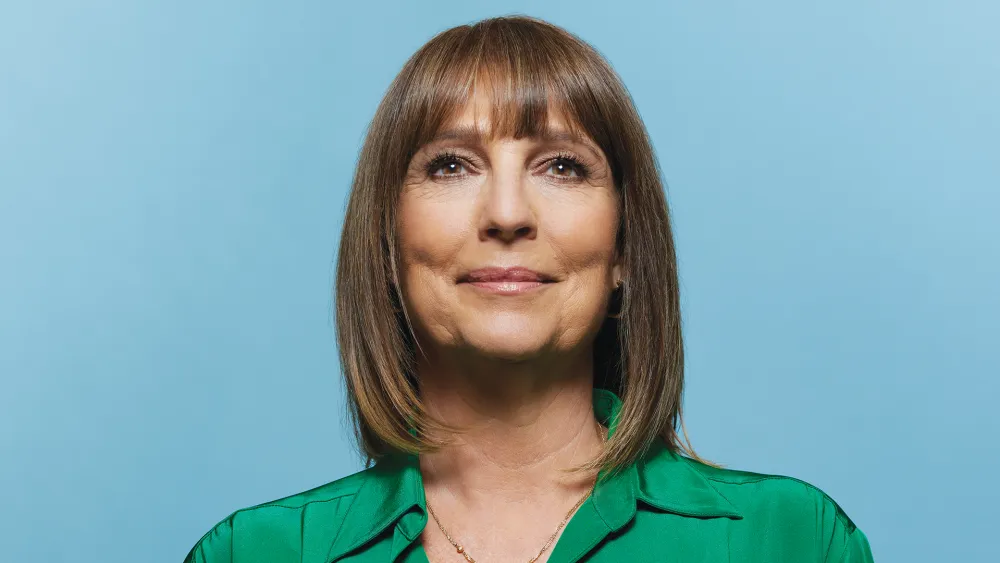
Following news on Monday morning that NBCUniversal-owned Sky is acquiring 70-year-old British public service broadcaster ITV, ITV CEO Carolyn McCall joined a series of calls with investors and media to talk through logistics.
On the investor call following the announcement, McCall said the sale reflects years of the ITV board weighing its strategic options — and that Sky was ITV’s preferred partner from the start. “It is worth also saying that through all our strategic thinking on the ExCo and the board, the company at the top of the list to do anything with was Sky. And so ITV did approach Sky, actually, to just say, ‘Do you want to chat and do you want to talk further?’ And that’s really how this happened,” McCall said, adding that shifts in viewing habits since the pandemic and the accelerating scale of global streamers in the U.K. made the timing right.
Chris Kennedy, ITV’s chief financial officer, detailed the mechanics of the deal’s earn-out on the call: the additional up to £200 million ($268 million) in contingent consideration becomes payable only if ITV’s total advertising revenue for 2027 exceeds £1.7 billion ($2.27 billion), with the maximum payout triggered at £1.8 billion ($2.41 billion) in TAR. Current analyst consensus puts 2027 TAR at roughly £1.75 billion ($2.34 billion), Kennedy said.
He also pointed to the recent Banijay–All3Media merger, which was valued at 10 times EBITDA, as a benchmark for how production businesses are trading, against ITV Studios’ 2025 EBITDA of £330 million ($441 million) and a market capitalization of roughly £2.5 billion ($3.34 billion) for ITV plc before deal speculation began.
On a follow-up phone call with media, McCall answered further questions. Here are the highlights along with Variety‘s analysis.
Why are Sky and ITV embarking on this deal?
McCall says: We’re very complementary, so you go from free to air all the way to high-end subscription service, and so I think as a combined business, it becomes relevant to many, many, many more people. I think Sky have already said there will be more sport on free to air, which is fantastic. The 2.1 billion commission means all the flagship programs of ITV will remain… on free to air. Dana has actually talked about the fact that she sees regional news as a massive opportunity for Sky, because they don’t do regional news.
Reality: The fracture of the media landscape means for many legacy media companies scale is the only way to compete. In the short-term it could be good news for viewers but the hangover might kick in in 2034 when ITV’s current PSB license expires.
Will the deal get through the regulators?
McCall says: We don’t expect it to be a quick review. We know it is likely to go to phase two, and there will be a public interest test as well. So we’re under no illusion it will be a thorough review. We’re hopeful, and we believe the conditions are right, because the market has changed so fundamentally, I think it’s very difficult not to see that.
…When you look at the advertising market, it’s not three broadcasters anymore competing with each other for linear advertising. It is now just enormous numbers of people competing for video advertising … and actually, if you look at that market, Sky and ITV combined would be about 20% of advertising, it’s very low. So I actually think the whole world has changed for everybody, including viewers and advertisers, so hopefully that will be recognized.
Reality: McCall is correct that while regulators in the U.K. will scrutinize the deal closely — including the Competition and Markets Authority, Ofcom and the Department of Culture, Media and Sport — ultimately it is likely to pass because it is one of the few ways in which U.K. media companies can compete against U.S. giants such as YouTube.
Will there be job losses?
McCall says: As you’d expect, when two companies come together, there will always be some duplication. So, I think what Dana [Strong, Sky CEO] referred to was that there could be. I think she’s also made it very, very clear that it will be primarily around the areas she’s already highlighted, which are: you bring two marketing departments together, you bring technology platform together, and then non-U.K. content, because we actually currently spend over 100 million on non-U.K. content, and they are obviously a large American company…And they’ve talked about a joint integration program, so it will be Sky and ITV, so it’s not all about ITV in terms of jobs, it will also be about Sky.
Reality: Currently unknown but likely yes. Having said that, most media companies in the U.K., including ITV, have already embarked on numerous rounds of job cuts over the past few years as the post-pandemic advertising market shrunk. Last year ITV cut 220 jobs in daytime and slashed commissioning budgets.
With ITV Studios set to become independent, is it a prime acquisition target?
McCall Says: Well, I mean, today I would say that’s unlikely, because we’re very proud that we’re going to be a listed independent global studios business. Our shareholders are hugely supportive of that. They’re really looking forward to it being a listed business and they see lots of opportunities there. So, yeah, there’s consolidation everywhere, so you know, I don’t think anything changes, but I think actually there’s a huge amount of confidence in ITV Studios as a large global studio.
Reality: ITV Studios is a prime acquisition target, especially following the Banijay/All3Media merger, and would-be-buyers are already said to be circling.
Is the consolidation bad news for independent producers?
McCall says: I think this may be worth reminding everyone about the PSB requirements, they go up to 2034. It means 25% of qualifying programming must be made by independent producers. So I think independent producers are very secure in this. 35% of the U.K. commissioned content has to be made outside London, that has to be honored, and 85% of peak-time programming, Kevin, from 6 till 10.30 must be original programs, so that ensures that U.K. content production continues at scale. So I think that’s kind of why we think this is very good for viewers, and also therefore for advertisers.
Reality: Nobody knows. While ITV maintains its PSB status and particularly with the divestment of ITV Studios, there is a certain amount of protection and opportunity for indies, but given the deal includes an a £2.1 billion output commitment it’s questionable whether indies will see much if any benefit.

Leave a Reply