The Dungeon Crawler Carl TV adaptation has a lot to live up to and quite a few things that are essential to get right. Pulling off the visual spectacle of the show will be a grind in every single episode, but the tone of the show will be a major hurdle as well. The book series has exploded in popularity largely because of how it balances irreverent humor with genuine heart. As it is, that has been a tight rope walk for the books since the beginning, and it’s daunting to imagine how the Peacock show will handle it. It’s not something that can be set up once and left on autopilot — it demands care and consideration at every major plot point throughout the story. However, there’s a simpler way of considering this whole issue: Princess Donut. If the show can get this hilarious yet complex character right, everything else will fall into place.
GC, BWR, NW Princess Donut the Queen Anne Chonk is the most important character in Dungeon Crawler Carl, without question. The show already has a strong start by casting audiobook narrator Jeff Hays to play Donut on TV as well. Still, the writers will have to plan carefully to make the most of Donut’s gag humor and clever one-liners without turning her into a comic relief character overall. Donut is the most outwardly funny character in the main cast, yet she is also the emotional heart of the story, and the one with the most growth and development as it goes on. That’s a lot of responsibility to put on any character — let alone a talking cat. The best place for the TV writers to start is by studying how author Matt Dinniman has written Donut so far and following his example.
Carl is the Narrator, But Donut is the Focus
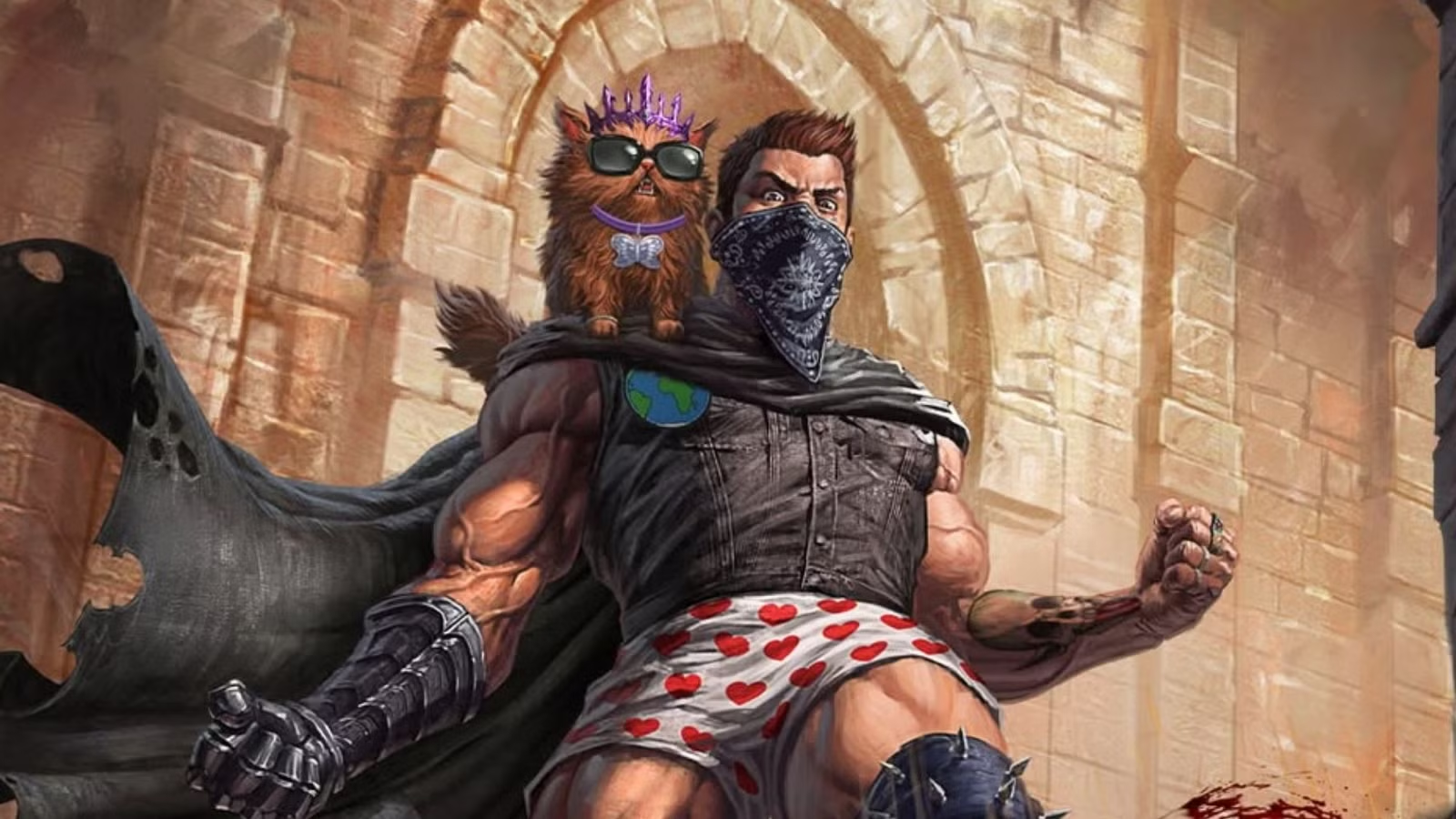
Dungeon Crawler Carl on the cover of The Butcher’s MasqueradeImage via Dandy House Publishers
Some fans may try to debate whether Donut is the most important character in the Dungeon Crawler Carl series, especially as the story goes on. After all, the titular hero is also the first-person narrator of the story, and he often needs to work around Donut’s antics — or even separate from her for long periods of time. However, the point of these encounters is always to demonstrate the lengths Carl will go to in order to protect Donut. Not only does he shield her from harm, he protects her fragile ego and does his best to leave space for her sense of hope in humanity.
As for the times that Carl and Donut are forced to split up, these adventures are generally defined by their reunions. These books often skip over planning and training so that the action scenes will have maximum effect, yet Dinniman always spares time for the moments where Carl and Donut come together, take stock of their emotions, and decompress. Carl is not a static character by any means, but his development is entirely shaped around Donut, and nurturing Donut’s development is his top priority. This is never stated directly, but illustrated time and again as the story goes on. That means the show will need to be as consistent as the books in depicting their relationship.
Admittedly, the visual medium of TV might make this a bit trickier than it is on the page. It’s one thing to read or listen to a scene where Donut confronts her trauma after a narrow escape, or trembles and develops tics as she grapples with the scale of destruction she has done. To depict a realistic cat going through all of that on screen is another matter, and it risks alienating squeamish viewers. This is one of the many reasons fans hoped this show would be animated — it might be easier to make non-human characters like Donut feel expressive and authentic that way.
Note that the character arc I’m describing for Donut is not formulaic or repetitive. This will be an ongoing challenge for the show just as it’s an ongoing challenge for the books, because Donut is a fully-realized character on a hero’s journey. Digesting her experiences isn’t a down-time activity to be optimized, it’s the ultimate point of all the magic missiles and enchanted hats. These somber beats are also essential to justifying Donut’s increase in power and intelligence — and even her witty dialogue. If the moments of reflection and growth don’t feel genuine, the whole show could collapse into a parody of itself.
The ‘Dungeon Crawler Carl’ Team is Well-Aware of This Task
Matt Dinniman and Jeff Hays talk Dungeon Crawler Carl.Image by Jefferson Chacon
The good news is that the minds behind the Dungeon Crawler Carl series seem to be aware of the task before them — at least according to Dinniman and Hays. The two sat down for an interview with The Direct at San Diego Comic Con earlier this year, and they raised the issue of balancing comedy with character. At the time, Dinniman said that he believes the “most untouchable element” of the story is “the tone, the underlying horror of” Dungeon Crawler World. He added: “The bond between Carl and Donut is tantamount to the success of the story,” and Hays chimed in specifically on behalf of the princess.
“I think that it’s very important for them to maintain how clever she is,” he said. “She’s very much about appearance, right? But somehow that’s seamless with her ability to engage Carl and to be emotionally intelligent when it counts… And she’s also plotting behind the scenes through the entire book. There’s always these hints, but the hints don’t come from her. The hints come from the comment sections and the way things unfold. So hopefully they don’t dumb her down and make her into comic relief or whatever.”
Collider Exclusive · Sci-Fi Survival Quiz Which Sci-Fi World Would You Survive? The Matrix · Mad Max · Blade Runner · Dune · Star Wars
Five universes. Five completely different ways the future went wrong — or sideways, or up in flames. Only one of them is the world your instincts were built for. Eight questions will figure out which dystopia, galaxy, or desert wasteland you’d actually make it out of alive.
💊The Matrix
🔥Mad Max
🌧️Blade Runner
🏜️Dune
🚀Star Wars
01
You sense something is deeply wrong with the world around you. What do you do? The first instinct is often the truest one.
02
In a world of scarcity, what resource do you guard most fiercely? What we protect reveals what we believe survival actually requires.
03
What kind of threat keeps you up at night? Fear is useful data — if you’re honest about what you’re actually afraid of.
04
How do you deal with authority you don’t trust? Every dystopia has a power structure. Your approach to it determines everything.
05
Which environment could you actually endure long-term? Survival isn’t just tactical — it’s physical, psychological, and very much about where you are.
06
Who do you want in your corner when things fall apart? The company you keep is the clearest signal of who you actually are.
07
Where do you draw the line — if you draw one at all? Every survivor eventually faces a moment that tests what they’re actually made of.
08
What would actually make survival worth it? Staying alive is one thing. Having a reason to is another.
Your Fate Has Been Calculated You’d Survive In…
Your answers point to the world your instincts were built for. This is the universe your temperament, your survival instincts, and your particular brand of stubbornness were made for.
The Resistance, Zion
The Matrix
You took the red pill a long time ago — probably before anyone offered it to you. You’re a systems thinker who can’t help but notice the seams in things.
You’re drawn to understanding how the system works before figuring out how to break it.
You’d find the Resistance, or it would find you — your instinct for spotting constructed realities is the machines’ worst nightmare.
You function best when you have access to information and the freedom to act on it.
The Matrix built an airtight prison. You’d be the one probing the walls for the door.
The Wasteland
Mad Max
The wasteland doesn’t reward the clever or the well-connected — it rewards those who are hard to kill and harder to break. That’s you.
You don’t need comfort, community, or a cause larger than the next horizon.
You need a vehicle, a clear threat, and enough fuel to outrun it — and you’re good at all three.
You are unsentimental enough to survive that world, and decent enough — just barely — to be something more than another raider.
In the wasteland, that distinction is everything.
Los Angeles, 2049
Blade Runner
You’d survive here because you know how to exist in moral grey areas without losing yourself completely.
You read people accurately, keep your circle small, and ask the questions others prefer not to answer.
In a city where humanity is a legal designation rather than a feeling, you hold onto something that keeps you functional.
You’re not a hero. But you’re not lost, either.
In Blade Runner’s world, that distinction is everything.
Arrakis
Dune
Arrakis is the most hostile environment in the known universe — and you are precisely the kind of person it rewards.
Patience, discipline, and political awareness are your core strengths — and on Arrakis, they’re survival tools.
You understand that the long game matters more than any single victory.
Others come to Dune and are consumed by it. You’d learn its logic and earn its respect.
In time, you wouldn’t just survive Arrakis — you’d begin to reshape it.
A Galaxy Far, Far Away
Star Wars
The galaxy far, far away is vast, loud, and in a constant state of violent political upheaval — and you wouldn’t have it any other way.
You find meaning in being part of something larger than yourself — a cause, a crew, a rebellion.
You’d gravitate toward the Rebellion, or the fringes, or whatever pocket of the galaxy still believes the Empire’s grip can be broken.
You fight — not because you have to, but because standing aside isn’t something you’re capable of.
In Star Wars, that willingness is what makes all the difference.
The Dungeon Crawler Carl TV adaptation has officially been ordered by Peacock, but it is still in the very early stages of production with no release date or concrete news so far. The series comes from Universal International Studios and Seth MacFarlane‘s Fuzzy Door Productions. Dinniman is an executive producer, while the scripts come from veteran comic book and movie writer Christopher Yost. Yost is co-showrunner along with Eric Heisserer, best known for writing and producing both Arrival and Bird Box. He was also the showrunner of Netflix‘s Shadow & Bone adaptation.
While the TV series has some major hurdles ahead, Dinniman has a long way to go in order to stick the landing on the books. There are currently eight volumes of Dungeon Crawler Carl available in print, digital, and audiobook formats. Dinniman plans to conclude the series with two more books, though he describes it as one more book that will simply be too big to print in a single volume. He will need to continue threading the needle of comedy and emotional impact in these final pages, just as the show gets started in his wake.






Leave a Reply