
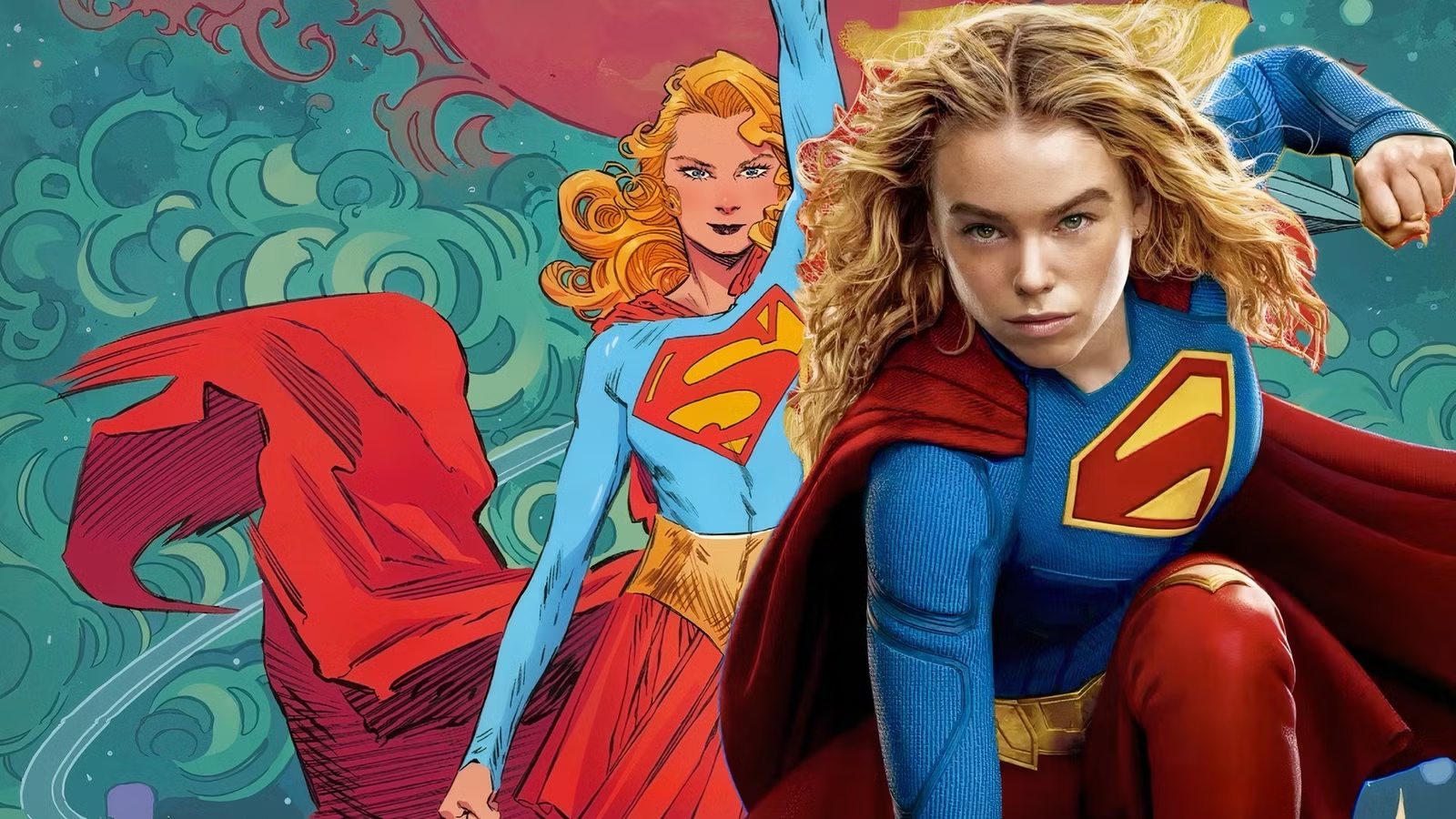
It’s difficult to imagine a DC Comics Universe without its Supergirl. Even harder still to think how many outstanding storylines would have been forfeited had the post-Crisis continuity stuck. To so many dedicated readers, the Maid of Might’s sacrifice during the classic Crisis on Infinite Earths maxi-series, next to that of The Flash, remains one of the biggest moments in modern mythic storytelling.
Since then, and after several reboots (or retcons, or rebirths) later, Kara Zor-El, Superman’s cousin, remains one of the publishing imprint’s most popular characters, with a legacy of her own making that rivals that of Man of Steel. This summer she’ll be headlining a return to the multiplex in the big-budget Supergirl that has a lot riding on it as DC Studios expands its cinematic presence to take on the box office competition.
The Maid of Steel Arrives in Comics and Sticks The Landing

Making a big splash in 1959’s Action Comics #252, the Last Daughter of Krypton arrived on Earth courtesy of a story penned by Otto Binder with art by Al Plastino. With the arrival of Supergirl, also a Kryptonian, Superman was no longer alone — he had a family, but what sets them apart is that Kara remembers their home world. She is very much an alien, and Earth customs are strange to her.
It’s up to Superman to help steer his newfound cousin on a path, especially given that under the Earth’s yellow sun, Kara is as powerful, possessing all the same superpowers, as he. The newly minted Supergirl is a hit with readers and eventually becomes a prominent figure in her own tales, appearing in Adventure Comics before getting a monthly title of her own.
In the 1980s, the character reached new heights of popularity and was heralded in a solo title, The Daring New Adventures of Supergirl (later retitled simply Supergirl), written by the iconic Paul Kupperberg and drawn by Carmine Infantino. The series gains traction with readers and expands DC Comics’ audience. For critics who may have only perceived her as just “Superman in a skirt,” Supergirl proves formidable.
Unfortunately for her and the legion of fans she had gained, Supergirl was canceled in 1984 as editorial shifts and DC’s streamlining of many of its series titles took effect. After 50 years leading the charge, it was time to take a fresh approach to its comics’ storytelling, especially as the tastes of its readership became more sophisticated. Also looming on the horizon was a “crisis” that was about to cause shattering changes.
A Multiverse in Crisis Lead To The Comic World’s Ultimate Sacrifice

By 1984, DC Comics was positioned to make significant changes to many of its titles. In fact, the directive had come down from above that, to compete with Marvel, the imprint had to take drastic measures. In an effort to streamline 50 years of continuity, Marv Wolfman and George Pérez initiated Crisis on Infinite Earths, the epic 12-part maxi-series, unlike anything published before.
Over the course of its yearlong storyline, the DC multiverse is embroiled in a conflict with an indomitable foe, the Anti-Monitor, who is destroying all parallel worlds and universes. Rallying together to take the battle to their enemy, all the assembled heroes journey into the antimatter universe, where Superman engages the Anti-Monitor in combat.
Unfortunately, the Man of Steel underestimates his opponent, and although he inflicts serious damage on him, the Anti-Monitor stands prepared to fatally strike him down; before he can land his attack, the Anti-Monitor is struck by Supergirl. In the brutal melee that ensues, Kara successfully tears her enemy’s containment suit apart, but not before the Anti-Monitor unleashes a blast that mortally wounds Supergirl.
The cover art for Crisis on Infinite Earths #7 by George Pérez ranks among the most iconic in DC’s history, and the issue is a landmark moment in the imprint’s publishing run. It is one of the most highly prized comic books by collectors of the era. Superman is left alone to mourn his cousin, wrapping her in a red cape and carrying her lifeless body; Kara Zor-El is laid to rest…for now.
A Super Girl Reborn Better Than Before

Although there was some semblance of a “Supergirl” that emerged in a post-Crisis DC, it would take a significantly long period of time, two decades in fact, before Kara Zor-El would be properly reinserted into existing continuity. In 2004, a mysterious ship crashes into Gotham City Harbor, and what Batman discovers inside worries him to the core.
A Kryptonian, a teenage girl, and the cousin of Superman. Concerned that her arrival on Earth might signal something nefarious, Batman suggests that Superman proceed with caution. Kara is temperamental and undisciplined, frightened and alone, and has all the same powers as her cousin. In a fascinating arc by Jeff Loeb, with art by Michael Turner, appearing in Batman/Superman #8-13, Supergirl is reintroduced.
The Maid of Might has remained a significant part of DC mythology ever since, surviving into 2011’s “The New 52,” the most consequential reboot of the full line of series in circulation at the time. In this new origin, Kara’s ship crashes in Siberia, and she experiences a much more challenging adjustment to life on Earth, especially given her superpowers. It leads to a much more incompatible relationship between the cousins.
Much of this backstory has since been retconned as per the eventual “Rebirth” arc, but much of the free-spirited and much more individualized identity of this Kara Zor-El remains. The modern Supergirl doesn’t exist in the shadow of her cousin. She is more of an equal, with a Kryptonian insight that Clark Kent/Kal-El isn’t privy to, having arrived on Earth as a baby, and a deeply protective disposition.
The Woman of Tomorrow, A Big Screen Star for Today

This summer, James Gunn’s DC Studios is following up on his hit feature Superman with Supergirl starring House of Dragons’ own Milly Alcock. The film, directed by Craig Gillespie and based on the much-acclaimed graphic novel Supergirl: Woman of Tomorrow by Tom King, is adapted from a screenplay by Ana Nogueira. A space-faring adventure that has Kara wrestling with rogue pirates and a particular intergalactic biker.
It’s an unorthodox decision to follow up Man of Steel’s big-screen return with an even-bigger space opera, gambling that movie audiences will be inclined to buy tickets to a “Super-girl in Space” epic, but Alcock’s smashingly unforgettable cameo at the end of Superman has piqued fans’ interest. Not to mention the even more anticipated DCEU return of Jason Momoa, this time as the mercenary, Lobo.
With the current Supergirl having such a much more richly developed backstory, it makes sense that she has a place in the cinematic universe that James Gunn appears to be assembling. Whatever direction the core thread of stories takes, with Kara Zor-El as a touchstone in so many critical moments in DC mythology, there appears to be room for character resonance that might otherwise have been missing from previous film iterations.
It’ll be an exciting journey for moviegoers, with an extended cinematic continuity that will likely reflect and resonate with DC’s core readership. Supergirl charts her own course, has taken her fanbase to one end of the universe and back, and has stood toe-to-toe with Superman when Earth has been threatened by forces beyond human comprehension. Whatever crisis — or endgame — Gunn has planned, let’s hope it hits the mark and makes the price of that super-sized bucket of popcorn worth it.

Supergirl
- Release Date
-
June 26, 2026
- Runtime
-
110 Minutes
- Director
-
Craig Gillespie
- Writers
-
Ana Nogueira, Otto Binder, Tom King, Al Plastino, Jerry Siegel, Joe Shuster, Bilquis Evely
-

Milly Alcock
Kara Zor-El / Supergirl
-

Matthias Schoenaerts
Krem of the Yellow Hills
-

Eve Ridley
Ruthye Mary Knolle
-










Leave a Reply