
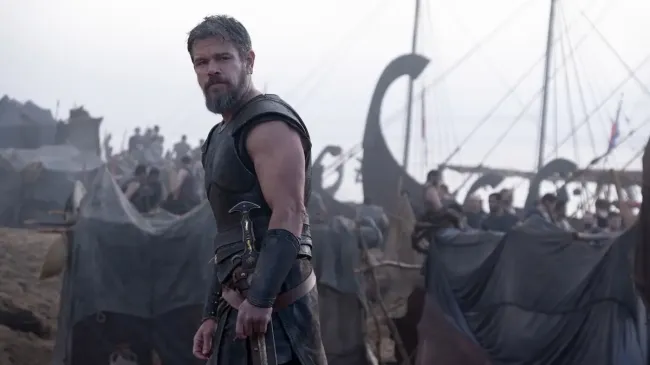

Christopher Nolan has always loved to work backwards, and with “The Odyssey” — his raw, rich, and rapturously thunderous adaptation of a Homeric song first sung more than 2,800 years ago — the modern world’s most dominant pop auteur finally arrives at the start, the source code, the pre-Christian epic from which his previous blockbusters were born full-grown like the goddess Athena from her father Zeus’ head. At this stage in the director’s career, it’s a miracle the movie isn’t completely redundant, let alone that it’s so fresh and burning with urgency that you can almost smell the walls of Troy as they crumble into cinder.


It certainly sounds familiar on paper.
A densely layered and nonlinear saga about a hyper-capable but profoundly heartsick middle-aged man whose job isolates him from his loved ones — and indeed from humanity itself — to such an extreme that it becomes the only viable means by which he might ever make his way back home, “The Odyssey” is so foundational to Nolan’s interests and instincts as a storyteller that I feared it would be a waste of time for him to tackle it head-on. That, despite being forced to keep the hero’s wife alive for once, the director’s latest would still be safe and obvious to a degree that negated the monumental ambition of transposing an ancient Greek legend into the stuff of a hyper-real IMAX experience.
My only curiosity was how such an avowed rationalist would reconcile himself to a narrative that hinges on a wide array of gods and monsters, especially considering that Nolan’s most fantastical movies — “The Prestige,” “Interstellar,” and “Tenet” — each twist themselves into knots in order to argue that we make our own fates, no matter how magical or predestined they might appear upon first blush. It’s one thing to eliminate any trace of cartoonishness from a trilogy of Batman films, but it’s a much greater and/or more foolhardy challenge to keep the same leash on a mythical adventure that confronts its hero with a 60-foot cyclops, a sentient whirlpool in the middle of the sea, and a detour to the black shores of hell itself. I mean, there’s a scene in “The Odyssey” where Samantha Morton violently molds former New York Rangers forward Sean Avery into a squealing pig as if the bones of his face were made out of wet clay (a marvelously tactile effect in a film bursting with them).
It’s true, of course, that Nolan diminishes the role of the supernatural in his telling of Homer’s poem. Classical studies majors will surely be aghast at how the likes of Zeus and Poseidon are sublimated into social mores and choppy waves (just as Zendaya fans might rage at how her disapproving Athena only cameos as Odysseus’ invisible friend). Then again, it’s also true that Nolan’s films are always sustained — or at least haunted — by the Homeric friction between divine fortune and free will. By the agony of adhering to a perfect circle, the self-deception that can make it seem like a straight line, and the hubris required to wrest control of the future away from the fates through the perversion of time, space, and the other inviolable laws of our universe.
I could not have been less surprised that Nolan’s version of “The Odyssey” takes great pains to revisit those same ideas. I was, however, utterly ambushed by how bruising and immediate those ideas become in the context of this millennia-old story. The awesome power of “The Odyssey,” and the primary reason why Nolan’s ultra-grounded version of its story is as reinvigorating for Homer’s epic as Homer’s epic is for him, is rooted in a gambit worthy of the Trojan horse itself. Nolan’s casually radical translation uses its mythic setting to smuggle in his most grounded exploration of his “faith in the mechanics of the world” (to borrow a phrase from a wise man called Neil in “Tenet”).
Following his most frustratingly internalized film with his most unabashedly full-bodied one, the “Oppenheimer” director returns with another somber epic about a man who dares to defy the gods (and Nolan makes sure to stress that defiance at almost every chance he gets, while also eliding much of the help that the gods offer Odysseus in the poem). Only this time, the gods are real, the man is a myth, and the civilization he’s partially responsible for dooming to centuries of darkness spirals into entropy at the start of the action rather than at the end.
Where Oppenheimer waited until the final reels to become death, the destroyer of worlds, Odysseus (Matt Damon, in one of the defining performances of his career) is already hiding from that distinction in Limbo by the time we first meet him, from which point he ultimately embarks upon a journey to shed his inner Shiva and reclaim what’s left of his humanity. The distance he travels from one Greek island to another can’t hope to compare against the cosmos and dreamscapes that Nolan’s protagonists have traversed in the past, and yet — in this sweeping and anachronistically believable display of blunt-force cinema — it comes to feel as vast as the space between gods and men. Between the fault in our stars, and that which we still have the power to address here on Earth.
It is a power that Odysseus has surrendered at some point on his endless trek home from winning the Trojan War. Like the poem on which it’s based and like virtually all the other Nolan movies that bear its influence, “The Odyssey” begins in medias res, though some time passes before we catch up with its namesake character. The opening 25 minutes or so unfolds in a wild flurry of detail, as Nolan and editor Jennifer Lame blitz through the opening chapters of Homer’s sprawling epic with a clippiness that screams “IMAX platters can only fit 165 minutes of film!” (The towering size of the IMAX presentation only enhances this early disorientation, a prime display of why the fluidity of Nolan’s filmmaking isn’t always well-served by the scale of his chosen format, even if the experience is breathtaking more often than not.)

The action mercifully settles into a less disorienting rhythm before too long, but the choppy prologue at least has the benefit of conveying the tense disarray that has gripped the shores of Ithaca in the decades since King Odysseus left for battle. His wife Penelope — played by a resplendently peevish and wounded Anne Hathaway, embittered by the 20 years her character has been sitting on an “empty” throne — has been doing everything she can to ward off the horde of boorish suitors who’ve moved into her palace. But their patience dwindles, her son Telemachus (Tom Holland, his eternal boyishness put to great use) is getting easier to goad into a fight, and the blind swineherd Eumaeus (John Leguizamo) is all that’s left of the king’s loyal servants. And what’s this about gradually encroaching attacks from “the sea people”?
Like most of the people who’ve taken up residence in the mountain fortress, top-seeded suitor Antinous is convinced that Odysseus is dead. (All hail a sniveling and magnificent Robert Pattinson, who spits into his own wine cup with such entitled disdain that Eumaeus can sense it from across the great hall.) But Odysseus is not dead! Which isn’t to suggest that he’s particularly alive, either. Waylaid on the trip home from Troy and plagued by recent folly, the war hero has retreated into the embrace of the immortal nymph Calypso (Charlize Theron), who’s spent years soothing her crush with brain-fogging lotus flowers and swaddling him in the comfort of their “Obsession”-like situationship. Eventually Odysseus’ exploits begin to creep back in, and he relays to his adoring captor the story of how he came to wind up on her shores — a tragic voyage that Nolan characteristically intercuts with the devolving situation back in Ithaca, as the film skips between past and “present” with an ease that allows memory to blur into myth.
“A man. A fleet. A war.” So Travis Scott’s bard speak-sings to the suitors between heavy pounds of his staff, as Nolan uses the rapper’s cadence to help colloquialize this ancient tale. “Ten years on this fucking beach,” Odysseus scoffs to his men in flashback after the fall of Troy. “Let’s go home.” The unadorned dialogue, heightened by a cast of Brits all speaking in American accents so as to convey a total lack of affect, aims to strip “The Odyssey” of the liberal arts prestige that has crusted around it like bedsores over the years. Purists might flinch, but the approach works brilliantly in context, as Nolan — drawing on Emily Wilson’s prose-like translation, which he frequently cites as a reference — strips away anything that might interfere with the rough-and-ready immersiveness of his spectacle.
It’s undeniable that the American veneer suits Odysseus’ colonist approach to foreign relations, as the Trojan War hero — mastermind of the deception that allowed Agamemnon’s army inside the walls of the enemy capital — happily encourages his men to pillage their way back to Ithaca. Neither the famous episode with the wooden horse nor the trauma that followed are fully explored until much later in the film, but it’s clear from the start that Nolan is compelled by the concept of xenia (aka Zeus’ Law, aka the golden rule), and this story’s many violations thereof.
It is the greatest force holding the ancient Greek world together, or was until torn asunder by the abduction of Helen (Lupita Nyong’o, luminous and envenomed in a double role as the “face that launched 1,000 ships” as well as her twin sister Clytemnestra), and the war that Agamemnon (Benny Safdie, wearing an enormous suit of black armor as if he were piloting a mech) waged in her name. Until Odysseus — kind enough to pluck his bow so that the animals he hunts for food have a fighting chance — exploited the Trojans’ hospitality to slip past their defenses and slit their throats in the night. That was the night he saw what a land absent xenia could be, the night he became death and eternal all at once.

The opening words of Wilson’s translation introduce Odysseus as “a complicated man,” and Nolan’s film honors that description to a greater degree than his previous work suggested he might, or could, in the context of such an enormous adventure. By turns loving, arrogant, sensitive, guilt-stricken, blameless, pig-headed (almost literally), brilliant, and foolish, Damon’s Odysseus is a monument to his multifacetedness as an actor — to the snake-like sincerity that he’s previously exploited in films like “The Talented Mr. Ripley,” “The Informant!,” and even “Good Will Hunting,” where his irrepressible intelligence added an oily agenda to his most natural charms. As Odysseus leads his lieutenant Eurylochus (Himesh Patel) and the rest of his men to their doom across a series of deadly encounters that chip away at their confidence in him, Nolan leans on Damon’s inborn sense of contradiction so that every new chapter reinforces his character’s humanity for its folly, longing, and resolve. (“Don’t look for gods in men,” Odysseus carps at one point, “you’ll be disappointed”).
Case in point: The awkwardly arranged but thrilling sequence where Odysseus and his troops find themselves uninvited guests in the cave of the cyclops, Polyphemus (Bill “TARS” Irwin, collaborating with a 60-foot puppet to bring the movie’s first monster to fully realized life). More than just a showcase for Nolan’s latent skill as a horror director, which is on far more prominent display here than it was in “Oppenheimer,” this Goya-like episode of head-chewing violence emphasizes Odysseus as both a skillful tactician and an inveterate braggart. That combination soon condemns the dwindling Ithacans to three scenes in which they flee back to their ship from some holy terror, as “The Odyssey” settles into the long crescendo of its homecoming.
For all his narrative elegance, Nolan still adopts a bludgeoning approach to his images (a tendency that has only been exacerbated by his commendable fetish for IMAX), and it remains frustrating that his visual imagination sometimes lags behind the velocity of his storytelling. The ship-devouring vortex Charybdis — depicted as a little-seen whirlpool before it’s upstaged by a slightly more interesting monster — reflects how Nolan’s distaste for fantasy can impede his drive for momentum, while the man-eating Laestrygonians are a crushing bore whose silver armor and giant swords betray a lack of better ideas.
But Odysseus’ travels prove arresting in spite of these flaws, as the earthy grit of Hoyte van Hoytema’s cinematography and the virtuosic zeal of Ludwig Göransson’s score — which careens from plucked lyres to thunderous gongs without missing a beat, and at one climactic moment syncs up with the action on screen in a way that recalls the thematic richness of Hans Zimmer’s scores for “Interstellar” and “Dunkirk” — contribute to the propulsive momentum of an increasingly panicked voyage.
“To burn the walls of Troy was to burn the world entire,” Odysseus laments, and “The Odyssey” is so vividly steeped in the rot and ruin left behind by the war that Nolan’s epic is able to survive its unconvincing depiction of the attack itself, which conveys little of the trauma described by Odysseus’ voiceover, and leaves us to take his word for it (we do). It’s a bizarre failing in a film that otherwise creates such a remarkably visceral sense of time and place, as Nolan’s commitment to shooting in some of Europe and Iceland’s most foreboding locations endows this intimate journey home with a sense that civilization itself has lost its way.
Zeus’ law has been cast aside, Pandora’s box has been opened, and Odysseus is the only man alive who can put the world to rights. We know that he’s fated to make it back to Ithaca, but it remains an open question what kind of man he will be by the time he gets there. A complicated one to be sure, but will he be the Odysseus who shot Polyphemus in the face for sport, or the Odysseus who wept tears of sorrow at the fall of Troy? Will he be the Odysseus who once ruled over Ithaca, or will he be the Odysseus who recognizes that his Ithaca is gone — that the past is a foreign country, and that, in vintage Nolan fashion, his only hope for lasting peace lies in accepting that what he most wants is what he most can’t have, and what he most can’t have is what he already had and lost? Not even the gods can decide that for him. I suspect they share in the pleasure of watching Odysseus skulk and stab toward his ultimate conclusion during this story’s barnburner of a climax, which roils with uncompromising emotion as Nolan finally gets to linger on the homecoming that his other films have been forced to squeeze into just a few quick shots.
As is always the case in Nolan’s films, whose stories unfold at a Tralfamadorian remove that seamlessly flattens action together with consequence until life itself begins to feel like the stuff of a temporal pincer movement, exercising the power to change one’s fate is far less important than earning the clarity to understand it. Nothing Odysseus can do will be able to stop Oppenheimer from stealing fire away from Prometheus several thousand years later. Entropy is inevitable for any civilization so prone to forgetting its past, and it will wax and wane across the centuries like the moon. People won’t fear it until they understand it, and they won’t understand it until they’ve seen it for themselves. But what starts as a quest to reclaim Ithaca from the ashes is gradually reframed as a journey to recognize why the world burns to begin with: not because men defy the gods, but rather because they betray each other.
Perhaps, Nolan wonders, that’s ultimately the same thing. As Telemachus reminds us, the Greeks honor Zeus’ law because even a humble beggar could be a god in disguise. And what could resonate more with the director of “Tenet,” “Interstellar,” “Inception,” and “Dunkirk” than the notion that we forge our own destinies? We are the time-inverted enemy we’re fighting for control of the future. We are the mysterious space travelers who planted a black hole for us to find. Our own minds are the scene of the heist; our greatest battle is against ourselves.
While the future may be predetermined, this world is still the sum of what we choose to make of it. To surrender our role in that is to forfeit our humanity, and the opposite will always be true as well. The gods speak obtusely, even in Nolan’s script, but this magnificent epic leaves us with the ability to heed their meaning.
Grade: A-
Universal Pictures will release “The Odyssey” in theaters on Friday, July 17.
Want to stay up to date on IndieWire’s film reviews and critical thoughts? Subscribe here to our newsletter In Review by David Ehrlich, in which our Chief Film Critic and Head Reviews Editor rounds up the best new reviews and streaming picks along with some exclusive musings — all only available to subscribers.







Leave a Reply