
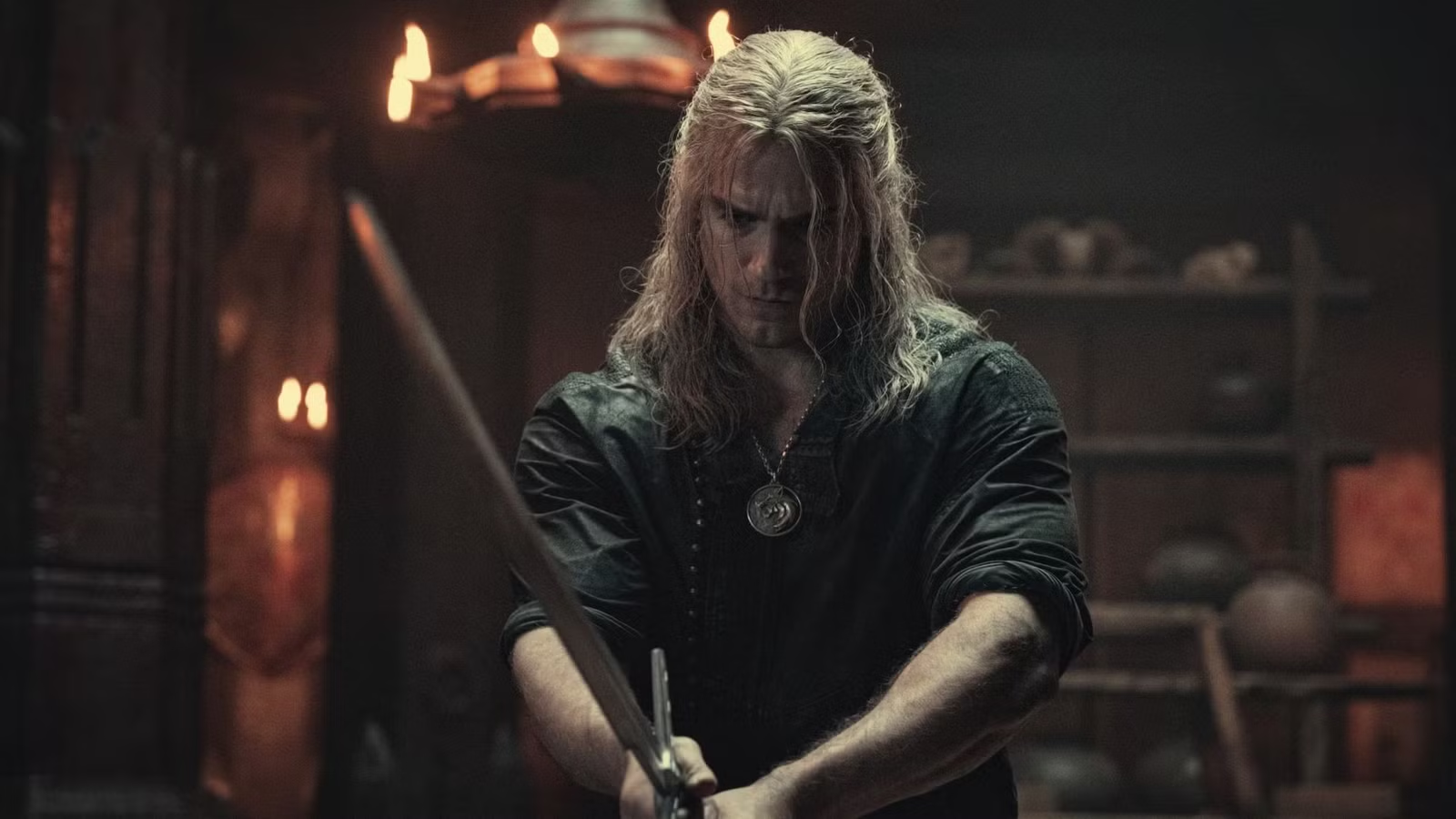
In the past couple of decades, The Witcher has expanded from a series of fantasy novels by Polish author Andrzej Sapkowski into a major multimedia franchise. CD Projekt Red’s trilogy of video games and Netflix’s live-action series introduced the world of The Witcher to a much wider audience. However, the franchise has found little success on the big screen.
In an interview from the late 1990s, Sapkowski revealed that he is not a fan of most fantasy films, believing them overly cheesy and poor representations of the genre. In fact, there are only four fantasy films that Sapkowski believed would stand the test of time, and fans of The Witcher may be surprised by the author’s choices.
Excalibur Captured the Majesty of Arthurian Fantasy

King Arthur and the Knights of the Round Table are quintessential British mythology, and they have inspired countless fantasy stories. John Boorman left his mark on the genre with Excalibur in 1981. The film was based on Thomas Malory’s Le Morte d’Arthur, or The Death of Arthur, and it reused some concepts from Boorman’s scrapped The Lord of the Rings adaptation. It focused on the final days of the reign of King Arthur, including the search for the Holy Grail.
Excalibur was an aesthetically unique film, especially in comparison to Hollywood’s later depictions of the medieval era. Boorman’s version of Camelot was bright and colorful, with every piece of metal polished to a reflective sheen. Reception to Excalibur was mixed at the time of its release. It was praised for its visuals and acting, but the fast-paced plot left many viewers wanting. Still, the film is remembered fondly as a beautiful reinterpretation of Arthurian lore.
Conan the Barbarian Popularized a Brutal Form of Fantasy
Robert E. Howard’s Conan short stories were highly influential works of early fantasy, and the franchise was first brought to the big screen by John Milius’ 1982 film Conan the Barbarian. It starred Arnold Schwarzenegger in his breakout role as a muscle-bound warrior out for revenge against the wicked sorcerer Thulsa Doom.
Like the literature that inspired it, Conan the Barbarian was a more mature take on the genre, deviating from the usually family-friendly nature of fantasy films. It even sparked some controversy over the copious amounts of blood on display. Conan the Barbarian nonetheless proved extremely popular, spawning many imitators throughout the 1980s. It also received a more horrific sequel, Conan the Destroyer. These adaptations of Howard’s work helped popularize the barbarian archetype so prevalent in modern fantasy media.
Ladyhawke Was a Touching Love Story in a Fantasy World

Richard Donner is best known for Superman, The Goonies, and Lethal Weapon, but in 1985, he made a foray into medieval fantasy with Ladyhawke. The film followed Phillipe “The Mouse” Gaston, a young thief who lent aid to a knight and his beloved, who were kept apart by a curse. The former turned into a wolf every night, and the latter turned into a hawk every day.
Ladyhawke placed a greater focus on romance than many fantasy films, and aside from the central curse, there was little magic. It flopped at the box office, making just $18.4 million on a budget of $20 million. Despite some distractingly anachronistic elements, such as its soundtrack, the film was generally well received by the few theatergoers who gave it a chance.
Willow Applied Lucasfilm’s Magic to the Realm of Fantasy

One of the last fantasy films of the 1980s was Ron Howard’s Willow from 1988. The story was written by George Lucas of Star Wars fame and produced by Lucasfilm. It starred Val Kilmer as Madmartigan, a mercenary tasked with protecting a baby destined to bring about the downfall of the evil Queen Bavmorda.
Compared to Sapkowski’s other favorite fantasy films, which were somewhat grounded in medieval history, Willow leaned further into high fantasy. It included magical beings such as trolls, brownies, and fairies, and it possessed an overall more whimsical tone. Willow was also the most successful fantasy film on this list, earning over $137 million at the box office. It did not receive a sequel until Disney+’s ill-fated Willow series in 2022, but it has lived on in the hearts of many fantasy fans over the years.
- Video Game(s)
-
The Witcher, The Witcher 2: Assassins of Kings, The Witcher 3: Wild Hunt
- First Film
-
The Hexer (Wiedźmin)
- First TV Show
-
The Hexer (Wiedźmin)
- Cast
-
Henry Cavill, Liam Hemsworth, Freya Allan, Anya Chalotra, Joey Batey
- Created by
-
Andrzej Sapkowski
- Latest Film
-
The Witcher: Nightmare of the Wolf





Leave a Reply