
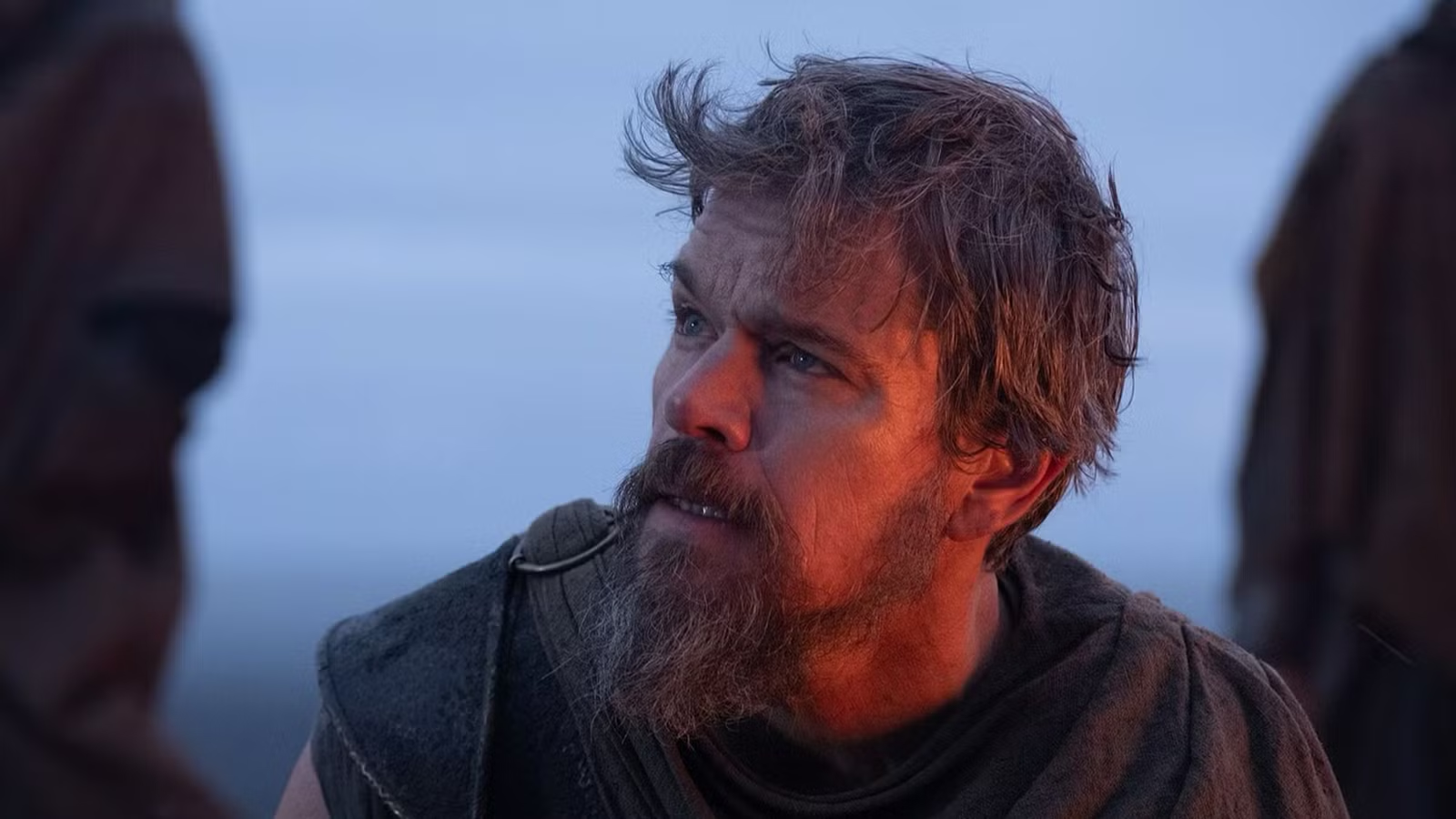
As Christopher Nolan’s The Odyssey continues its epic run at the summer box office, the impact of Homer’s ancient poem on innumerable tales that have followed is freshly apparent. Turning over the details of Nolan’s movie in the mind, it’s easy to draw connections and parallels to other movies. One movie that might not immediately come to mind introduced America to its own unlikely Odysseus.
The movie is Robert Zemeckis’ 1994 Best Picture-winner, Forrest Gump. On the surface, Tom Hanks’ Forrest and Matt Damon’s Odysseus would seem to have little in common. One is a cunning warrior and leader of men, the other scarcely understands the way the world works. Yet both are lost and in search of a way home. Odysseus longs for the shores of Ithaca and his beloved Penelope, Forrest for the live oaks of Greenbow, Alabama, and his life-long crush, Jenny. Before each character can reach their goal, a series of trials awaits.
The Trials of Gump Are Akin to ‘The Odyssey’

On a bus stop bench in Savannah, Georgia, Forrest begins as his own Homer, reciting the epic of his Zelig-like journey through mid-20th century American history, a time – very much like Nolan’s characterization of the late Bronze Age – “of apparent magic.” As in The Odyssey, reality and myth coexist in Forrest’s story, which sees him launch from rural Greenbow to the University of Alabama, where his Hermes-like speed serves him well as a kick returner for legendary coach Paul “Bear” Bryant’s Crimson Tide. Similar to Odysseus, Forrest acquits himself as a soldier in an American war that — like the Trojan War to the Achaeans — long felt unwinnable. While under ambush by Viet Cong, Forrest rushes into gunfire, risking his life to save others in his platoon, including Lieutenant Dan and Bubba, his beloved friend, who does not survive. It’s the first of several painful losses.
Post-Vietnam, Forrest begins his wandering phase. His journey is decidedly sunnier than that of Odysseus. There are no witches, no Cyclops, no lotus-bearing nymphs, though he does encounter his share of American monsters, from grade school bullies to Richard Nixon (whom he inadvertently fells). He becomes a ping-pong champion, traveling to China on a diplomacy arc. At sea, he fulfills a promise to Bubba, operating a shrimp boat with the help of Lieutenant Dan. Where Odysseus and his crew were cursed by Poseidon, Forrest is ultimately favored by the gods. A powerful hurricane knocks out rival boats, delivering him a shrimp windfall, and a canny investment in nascent Apple Inc. by Lieutenant Dan turns Forrest into a wealthy philanthropist. When an encounter with Jenny leaves him spurned, he puts on his running shoes, testing his own endurance by running from sea to shining sea for three years.
Jenny is Forrest’s Penelope

As Odysseus longs to return to Penelope, Forrest’s ultimate goal is to be united with his “peas and carrots” ride or die. Odysseus has loyal Penelope waiting for him, but Forrest is often the one waiting for Jenny’s return. She is wandering, too, perhaps the most lost of all. In encounters with Jenny over their long years apart, Forrest fights off suitors, aiming to protect her from exploitative men. Visiting Jenny at her all-girls college, Forrest punches her date, Billy, believing he is attacking her during a make-out session. In a room full of Black Panthers at an anti-war rally in Washington, D.C., he beats the proverbial tar out of Jenny’s radical boyfriend, Wesley, for striking her. Not exactly ripping through scores of parasitic noblemen and slaying Robert Pattinson’s Antinous, but on the wavelength.
Forrest’s Ithaca moment occurs on a lawn mower, when Jenny finally returns to Greenbow. Like Odysseus’ return, it’s a bittersweet moment. Though it seems as though Jenny is home to stay, she reveals her fatal illness. On the positive side, Forrest has a Telemachus! Jenny reveals Haley Joel Osment’s Forrest Junior. Unable to overcome his Trojan Horse guilt, Odysseus ultimately leaves Ithaca and sails into self-imposed exile. Jenny passes away, leaving Forrest to bring up their son alone. For both heroes, the journey continues.
Forrest Is A Uniquely American Odysseus

In the time of Homer, Odysseus was the embodiment of the ancient Greek virtue metis, a catch-all for cunning intelligence, clever resourcefulness, and artifice. He was the guy who came up with the Trojan Horse, after all. No one of sound mind would ascribe metis to Forrest Gump. A character less capable of artifice has likely never been conjured on film. Intelligence is certainly not Forrest’s gift. We’re told early on his IQ is 75. Of course, brains aren’t everything.
In Nolan’s Odyssey, Odysseus’ shrewdness leads him to an all-consuming sense of guilt. Forrest, by contrast, is all naivety and innocence, characteristics that help define him as a uniquely American hero. The myth of American innocence – the belief that the United States operates with morally pure intentions – sits at the core of American exceptionalism. Forrest’s intentions are as pure as they come. His status as avatar of American values runs even deeper. In words and deeds, Forrest embodies the simplicity, nose-to-the-grindstone perseverance, and opportunism at the heart of the American myth. In line with a long streak of American anti-intellectualism, Forrest’s many successes are attributable not to suspect book smarts or cunning, but to bootstrap hard work, raw adaptability, and a knack for landing in the right place at the right time.
Decades on, critics continue to debate where Forrest Gump lies on the political spectrum. For their part, Zemeckis and Hanks have long resisted a political reading of the movie, though it’s hard to view a movie that covers so much political ground without seeing angles. Wherever it sits, Forrest’s box of chocolates remains a resonant, undeniably American odyssey.

- Release Date
-
July 6, 1994
- Runtime
-
142 minutes
- Director
-
Robert Zemeckis
- Writers
-
Eric Roth, Winston Groom
- Producers
-
Steve Starkey, Steve Tisch, Wendy Finerman






Leave a Reply