
As a writer, few things are scarier than the prospect of following up a massive success with an underwhelming sequel. Many book series have been derailed by a weak sequel that fails to live up to the standards set by their predecessor. Sometimes it’s because the story goes out of the writer’s hands, and other times it’s because the narrative choices are unsatisfying for the readers. And then there are those rare books where the writer’s reach far exceeds their grasp: such is the case for James Islington‘s 2025 fantasy epic The Strength of the Few.
The sequel to the 2023 sensation The Will of the Many, the book continues the story of protagonist Vis Telemus following a cliffhanger ending that promised a wild, sprawling follow-up. On that end, it delivers: The Strength of the Few is sprawling, to its ultimate detriment. Indeed, the plot spreads too thin, and Islington finds himself juggling too many characters and plot points, leading to an unsatisfying experience that, while not bad by any means, is nowhere near the level of his 2023 masterpiece. In fact, it’s not an overstatement to say that The Strength of the Few is simply too ambitious to be truly satisfying. Beware, as this article will feature heavy spoilers.
What Is ‘The Strength of the Few’ About?

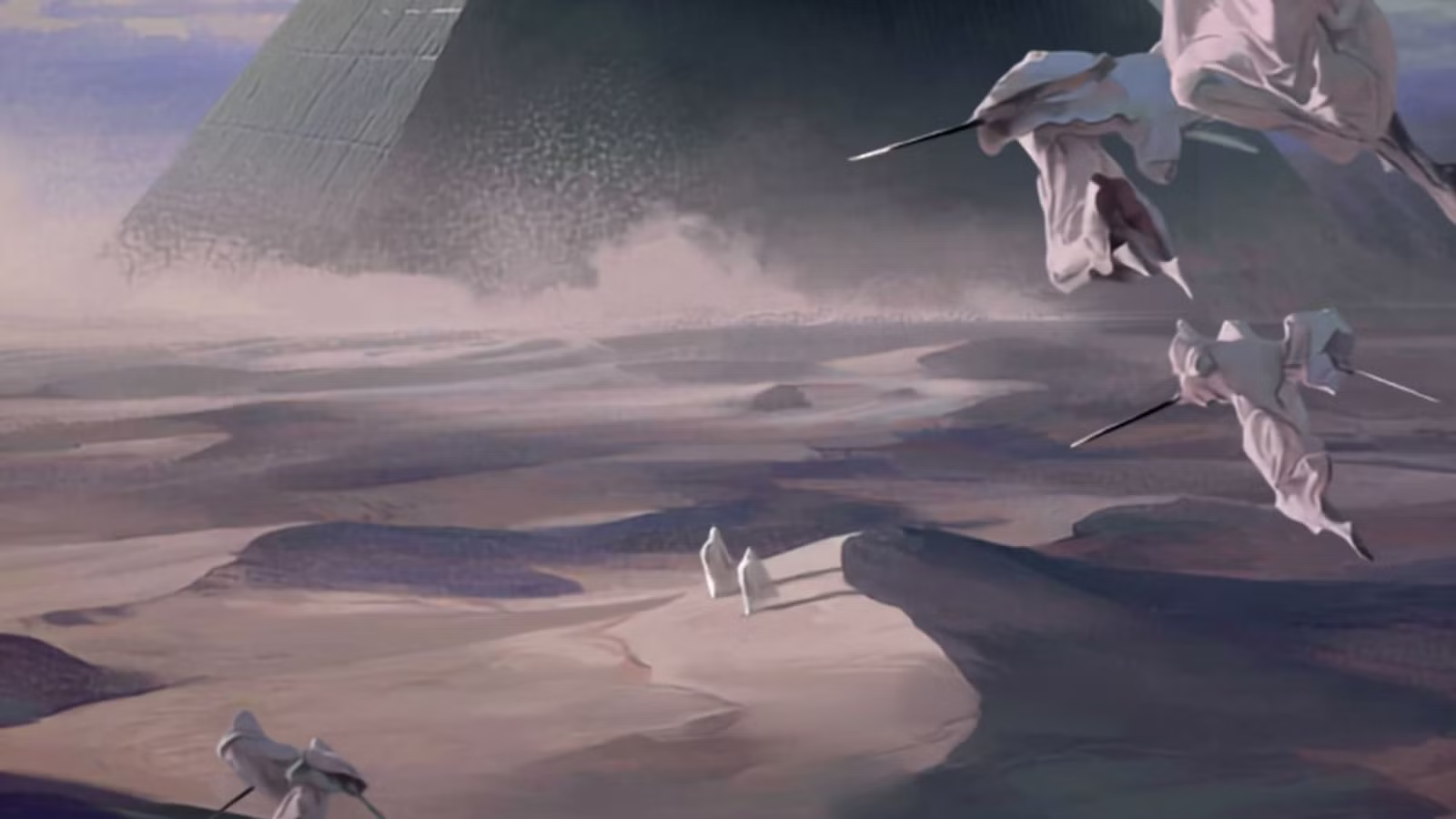
The Strength of the Few picks up right where The Will of the Many left off. As hinted by the latter’s epilogue, Vis Telimus has been “split” and now exists simultaneously between three different worlds: Res, where The Will of the Many took place; Luceum, a Celtic-inspired realm populated by druids and ruled by kings; and Obiteum, which borrows heavily from Ancient Egypt and where Vis meets Caeror, Ulciscor’s brother.
In Res, Vis is dealing with a lot. The tension between Religion, Military, and Governance is at an all-time high, and civil war is inevitable. He’s also grieving the death of his friend, Callidus, uncertain of who to trust, considering the events of the Iudicium, and still under the Angruis’ control. A new character, the mysterious Ostius, also arrives to make things even harder for Vis. In Luceum, Vis, unaware that he’s been copied and is now in an entirely different world, adopts the name Deaglán and seemingly finds peace in a quiet life. Things change when his path crosses that of the druids, as the kingdom is threatened by a druid king named Ruarc. Lastly, in Obiteum, Vis adopts the name Siamun and is guided by Caeror on a quest to kill a man known as Ka, who will presumably cause the next Cataclysm.
‘The Strength of the Few’ Tries to Cover Too Much Ground

The Strength of the Few features eighty chapters, structured as follows: 32 taking place in Res, 23 in Obiteum, and 23 in Luceum, with two set in Luceum but from the POV of Res’ Vis. However, Islington freely jumps from one world to the other: rather than following a Res-Luceum-Obiteum structure, the author opts for a more chaotic approach. He’ll offer one Res chapter, then three Obiteum, then two Luceum, then finally back to Res. The result is a book that suffers from severe pacing issues; just when things are picking up in one world, the chapter ends, and we’re in an entirely different world the next. The pacing grinds to a halt, and the cliffhangers become rather frustrating, especially when you have to wait three, four, sometimes five chapters for a resolution.
The Strength of the Few is the second in a planned four-book series; by its very nature, it’s meant to be a bridge between the introductory section of the saga and the eventual climax. Yet, because of its unique structure, the book self-sabotages. The Res chapters do feel like a bridge: the story threads set in The Will of the Many continue, even if long-promised answers arrive only in pieces. Despite the occasional large gaps between chapters, the Res plot does move the overall plot forward and is undeniably the strongest part of the book.
The issues come in the Obiteum and the Luceum sections. Because Islington is introducing brand new worlds here, these portions feel like a step backwards, like redoing the tutorial in a video game after you’ve already played for several hours. Islington needs to lay the foundation of these worlds, the structures, and the key players. Unlike The Will of the Many, where he got to painstakingly construct Caten through Vis’ eyes, he simply can’t do that in The Strength of the Few. Here, we have two worlds that feel half-done, despite the undeniably compelling elements in each.
Nowhere is this flaw more notorious than in Luceum. These chapters feel the most incomplete because Islington does all telling and very little showing. Much of Deaglán’s choices during the book’s third part are driven by his supposed closeness to the friends he made during his time training at Loch Traenala, another school he attends. Yet, we meet these characters for what feels like two chapters before Deaglán is literally getting ready to die for them. In The Will of the Many, we saw Vis construct his friendship with Callidus, Eidhin, Aequa, and Emisa with every chapter; Islington showed us how those bonds were built. The opposite is true in The Strength of the Few, leading to friendships that feel unearned and, unfortunately, unbelievable.
‘The Strength of the Few’ Fails Its Most Compelling Characters

Perhaps the greatest mistake in The Strength of the Few is how it treats its best characters. I’m, of course, talking about Aequa’s fate. What Islington does to her is nothing short of fridging—if you’re unaware of what fridging is, it’s a trope where a female character is killed off in service of a male character’s progression. Aequa is unceremoniously killed in the book’s final chapters by a villain with barely any development, who might as well be twirling his moustache while doing it.
The execution is also unnecessarily gruesome. Compare Aequa’s death to Callidus’ in The Will of the Many. We don’t see the Anguis torturing Callidus because we don’t need to; the death is still impactful because we’ve gotten to know Callidus and know the impact his loss will have on Vis. Aequa doesn’t get the same courtesy. Instead, Islington forces us to read (or hear, if you, like me, experience this story as an audiobook) how Aequa’s head is crushed, and her body left there to rot. It’s pure shock value, and a rather crass choice that feels distasteful at best and outright reprehensible at worst.
Aequa isn’t the only character who suffers the consequences of the sprawling plot. Excellent, key players from The Will of the Many—Lanistia, Emissa, Veridius, Relucia—are completely sidelined. Logically, the new characters also suffer, especially those from Luceum, who are too many to register save for a few that Islington clearly wants you to remember. I will say, however, that the Obiteum characters are largely successful. Caeror forms a great bond with Vis throughout the book’s first part, and the duo of the iunctus Ahmose and the assassin Netiqret is especially compelling, equal parts engaging and tragic. Netiqret is particularly good, and I hope the upcoming The Justice of One doesn’t sideline her as The Strength of the Few did to most female characters.
The Hierarchy Series Is Still Worth Reading

It’s very clear that The Strength of the Few is biting off more than it can chew. As a would-be writer, I can’t help but be in awe of Islington’s ambitions; his imagination is alive, and this project has allowed it to run wild. Creativity should never be constrained, and I’m glad he’s bringing his vision to life. As a reader, however, I couldn’t help but feel deeply unsatisfied after finishing The Strength of the Few, largely because the book’s structure leads to a disjointed, overly complicated, and ultimately underwhelming experience.
That said, I very much look forward to The Justice of One. Knowing what comes, structure-wise, will surely lead to less whiplash when reading, and with Obiteum and Luceum properly introduced, the upcoming third book should fire on all cylinders. Islington’s Hierarchy is still among the best book series of the last decade, and a stumble doesn’t mean the whole thing is hopeless. Let’s just hope The Justice of One has better chapter distribution.










Leave a Reply