
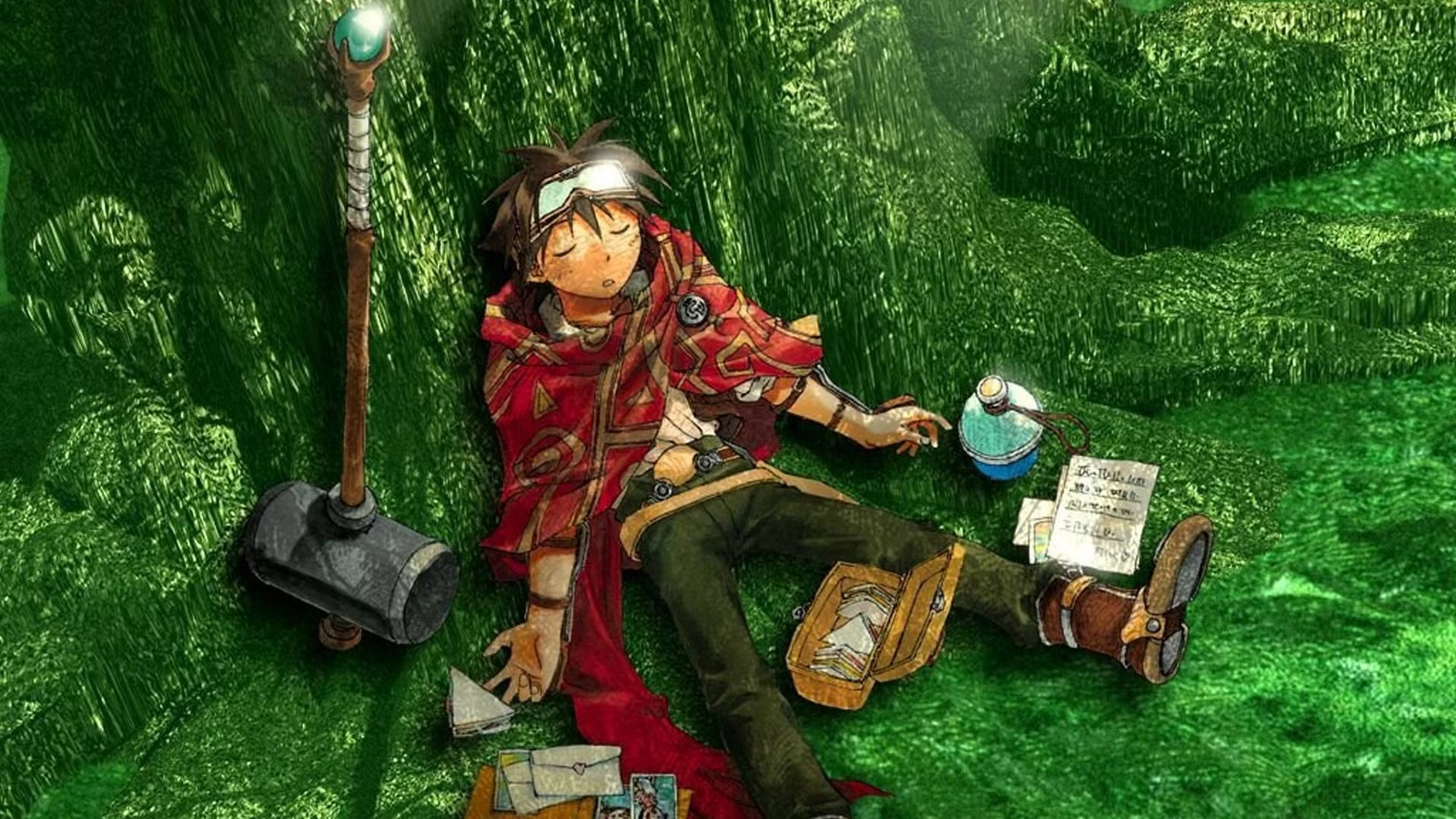
Even though JRPGs are fairly popular today, they were a niche genre for most of the ’80s and ’90s, which meant many would-be classics flew under the radar. Games like Thousand Arms had all the makings of a hit, but not enough people played them, and few people remember them today.
Some amazing JRPGs were very localized, while others had the misfortune of releasing on systems that were reaching the end of their lifespan. While JRPGs like Bahamut Lagoon haven’t gotten much attention, they’re still must-play games that fans of the genre should take the time to check out.
Bahamut Lagoon Is a Lost Classic From Square Enix

The 90s were a golden age for Square Enix, but some of its best games failed to make it to the West. Bahamut Lagoon was a game that pushed the SNES to its limits, with incredible pixel art and a gripping political fantasy narrative.
This fantasy RPG features grid-based tactical combat similar to titles like Final Fantasy Tactics, but the twist is that there are dragons that act autonomously during battle. Even though it’s never gotten an official English-language release, there’s a fan translation available for anyone who wants to play it for themselves.
Treasure of the Rudras Was the Last SNES Game from Square

Another lost Square classic is Treasure of Rudras. Released in 1996, the same year as Bahamut Lagoon, this SNES classic takes place in a dark steampunk world. The story spans 15 days and follows a group fighting to stop humanity from going extinct.
It’s a little like Octopath Traveler, with each protagonist’s story eventually intersecting for a more connected narrative. Combat is turn-based and easy to pick up, but the big hook is the Mantra system, which lets players build custom spells. Treasure of the Rudras also has an excellent fan translation and is a must-play for retro JRPG fans.
Luminous Arc Is an Underrated JRPG Trilogy

Luminous Arc is a forgotten tactical JRPG that managed to spawn a franchise. Released in 2007 for the Nintendo DS, this RPG puts some twists on the strategy RPG formula, letting players build a Flash Drive to unleash powerful attacks, then link with party members for devastating moves.
There’s also something called the Vitae System, which lets magical elements be imbued into weapons, adding new abilities and more tactical depth. The story gets pretty melodramatic, which might be a turn-off, but it’s still fun. At around 25 hours, it’s a short, easy-to-jump-into adventure, which makes Luminous Arc easy to recommend.

Grasshopper Manufacture has a history of making strange games, and Contact is one of the developer’s weirdest. This fourth-wall-breaking JRPG has players exploring an alien world on the bottom screen while an irreverent professor offers hints and commentary on the top.
The story follows Terry, a young boy tasked with collecting energy cells so the Professor can repair his spaceship and return to his planet. In combat, Terry attacks automatically, and the player’s role is purely supportive. Contact is a thoroughly enjoyable adventure that plays with genre tropes and always keeps players in on the joke.
Tsugunai: Atonement Is a Dark PS2 Adventure Game

Even in niche JRPG circles, Tsugunai: Atonement is almost completely unknown. It’s a 2001 PS2 release that was likely overshadowed by flashier next-gen games, which helps explain why it’s been so overlooked. That’s a shame, because it uses its narrative setup to subvert genre conventions and deliver something genuinely different.
Like Shadow Hearts and The Legend of Dragoon, combat relies on precise button presses to execute actions. Tsugunai: Atonement is dark and moody, with a surprisingly deep, philosophical narrative.
Sweet Home Famously Inspired Resident Evil

Without Sweet Home, there would be no Resident Evil. Based on the 1989 J-horror film, it was one of the earliest horror RPGs and went on to inspire developers for years. Released on the NES, it never made it to the West, and the movie has since become an obscure cult classic, mostly brought up in relation to Capcom’s blockbuster franchise.
The story follows five documentary filmmakers investigating the Mamiya Mansion, a decrepit home with a tragic, haunting past. Players control the team, each with a unique tool or ability, like a vacuum or a lighter. Resident Evil later drew on the game’s then-revolutionary survival horror elements, including locked doors, puzzle-solving, and limited inventory.
Crimson Gem Saga Is a Sequel to a Cult Classic

Astonishia Story has become one of the best cult classic games, but the sequel has faded into obscurity. Released in 2009 for the PSP, Crimson Gem Saga is a love letter to classic SNES-era JRPGs, with an art style and battle system that echo some of the genre’s defining titles.
Even though this tactical, turn-based RPG doesn’t do much to shake up the usual formula, the mechanics are solid. The game leans hard into comedy, with the adventure’s weight only settling in late. Crimson Gem Saga stands as proof that games don’t need to be revolutionary to be amazing.
ASH: Archaic Sealed Heat Was Made By the Creator of Final Fantasy

After departing Square Enix, Final Fantasy creator Hironobu Sakaguchi founded Mistwalker, a studio focused on more experimental JRPGs. The team produced several great titles, including ASH: Archaic Sealed Heat. Released for the Nintendo DS in 2007, it shipped on a 2GB card to fit its well-rendered 3D graphics and full-motion video.
ASH is a grid-based strategy RPG in the vein of Final Fantasy Tactics. There’s no need to worry about permadeath, since Aiya can resurrect fallen party members if she’s fast enough. The game was Japan-exclusive, but a fan translation is available for anyone looking to experience one of the DS’s most technically demanding games.
Thousand Arms Is an RPG/Dating Sim Hybrid

The PS1 has tons of forgotten JRPGs that deserve a second look, and Thousand Arms is one of them. Released in 1999, it’s a lighthearted, comedic adventure that often pokes fun at the genre’s familiar tropes. Thousand Arms is one of the most underrated JRPGs ever, and it was surprisingly innovative for its time.
Combat is mostly conventional turn-based fare with a twist: only one character can take the front spot, while other party members support with spells and buffs. Another unique mechanic is the dating system, which lets the main character woo female party members to build relationships and unlock new abilities for the weapon-forging system.
Septerra Core Is a Western JRPG

PC-exclusive JRPGs are rare, which is probably why so few people know Septerra Core. It isn’t strictly a JRPG since it was made by a Western studio, but it feels like part of the genre. Released in 1999, it follows Maya, a scavenger pulled into a conflict involving ancient technology, a divine prophecy, and a mysterious being known as the Creator.
Septerra Core’s combat takes clear cues from classic Final Fantasy games. Actions revolve around an Active Time Bar, and players can skip a turn to unleash a stronger attack. Visually, it has a very 90s style, with 3D character models set against pre-rendered backgrounds. It starts slow, but it’s worth sticking with for the deep, thoughtful story.









Leave a Reply