
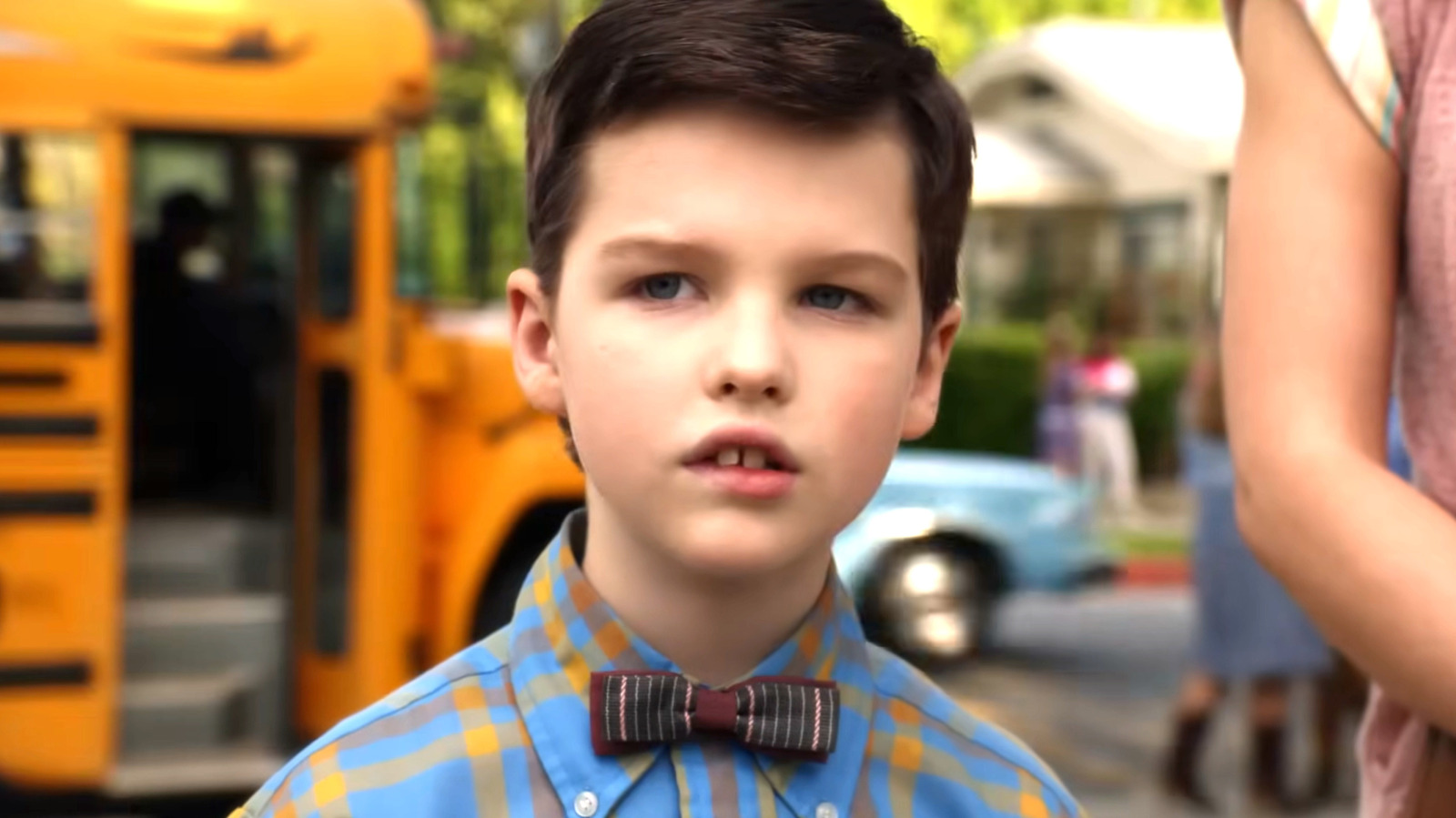
For the most part, “Young Sheldon” stays true to its parents series, “The Big Bang Theory.” The prequel show commits to George Cooper Sr.’s (Lance Barber’s) devastating fate, Mary’s (Zoe Perry) religious zealotry, and young Sheldon (Iain Armitage) speeding through high school and college at a lightning fast pace.
While many may point to the abundance of spin-offs as a sign that Hollywood’s out of ideas, the fact that “Young Sheldon” was beholden to another show’s canon gave it an extra edge. An original series about a boy genius character would’ve been allowed to play things safer, keeping Sheldon in high school longer or George Sr. alive forever, but “Young Sheldon” was basically forced to take the story in fresh and interesting directions.
Still, there were some points where staying true to “The Big Bang Theory” was nearly impossible. In these five instances, “Young Sheldon” decided they were better off retconning the Cooper family lore.
Sheldon never actually attends boarding school
In the pilot of “The Big Bang Theory,” Leonard (Johnny Galecki) mentions that Sheldon had been sent off to boarding school as a child. In “Young Sheldon,” however, Sheldon stays with his family all throughout high school and only moves away during his college years. Granted, one could argue that Sheldon’s college experience functions similarly to boarding school for him. It isolates him somewhat from his family, a status quo change the series would explore in-depth in its later seasons.
Unlike some of the other changes on this list, “Young Sheldon” never outright addresses the claim that Sheldon went to boarding school, which makes it come across as if adult Sheldon simply lied for no reason. Although this is a fairly tame thing to lie about, when added to some of the other lies on this list, it paints a pretty negative picture of Sheldon. Fans have complained for years about Sheldon essentially slandering his family on “TBBT,” and discrepancies like this one haven’t helped his case.
Sheldon’s trip to Germany happens earlier than he claimed
This one’s another innocent discrepancy: In “The Big Bang Theory,” Sheldon mentions having been a visiting professor at the Heidelberg Institute in Germany when he was 15. In “Young Sheldon,” Sheldon does visit the Heidelberg Institute, but as a 13-year-old, and only as a participant in a summer research program.
It’s a relatively minor retcon that seems like a clear case of the writers having not yet figured out Sheldon’s entire past. When they revealed Sheldon’s backstory with Germany, “TBBT” had not yet decided that Sheldon’s father died when he was 14. Sheldon doesn’t reveal that key moment in his life until Season 7.
As creator Chuck Lorre made clear in his vanity card for the “Young Sheldon” finale, a lot of Sheldon’s backstory was written with no idea that there’d be a Sheldon prequel series down the road. “Eighteen years ago, when we were writing and producing ‘The Big Bang Theory,’ it seemed like a good idea to imagine that Sheldon’s childhood was deeply disrupted by the loss of his father,” Lorre wrote. “No one could have thought that someday we would regret that decision. That someday is now.”
Sheldon didn’t actually walk in on George Sr. having an affair
In Season 10 of “TBBT,” Sheldon tells Penny (Kaley Cuoco) about a particularly devastating childhood memory: “I was 13 years old, and on spring break from college. My mother was in bible study, I walked in the house expecting to find it empty, and I heard a sound coming from my parents’ bedroom. When I opened the door, I saw my father having relations with another woman. We locked eyes, I ran to my room, and we never, ever spoke of it.”
Many “Young Sheldon” fans were dreading the moment when the show would follow through on this claim, but the prequel found a clever way around it. In Season 7, Episode 4, “Ants on a Log and a Cheating Winker,” young Sheldon walks in on George Sr. sleeping with his wife, Mary. Sheldon only thinks it’s another woman because Mary’s wearing a blonde wig and roleplaying as a German woman named Helga.
It turns out that this particular childhood trauma was all a misunderstanding on Sheldon’s part, and he never figured out that his dad wasn’t cheating. The only true discrepancy here is adult Sheldon’s line about having “locked eyes” with his father. That part definitely didn’t happen in the prequel’s version of events.
Billy Sparks was not Sheldon’s childhood bully
According to adult Sheldon, young William “Billy” Sparks (Wyatt McClure) was a total monster. Sheldon claimed that Billy had “put dog poop on the handles of my bicycle,” and that, when he was five, Billy shoved a Mexican peso up his nose, which is still lodged up there to this day. When he was eight, adult Sheldon claims Billy beat him up so bad, he broke his collar bone.
“Young Sheldon” begins when Sheldon is already nine years old, so technically all these examples could indeed have happened before the start of the series. Still, it’s difficult to imagine the prequel’s version of Billy doing any of these things. Billy in “Young Sheldon” is simply dim-witted, not cruel. He’s at his meanest in the first season, but, even then, he never lives up to adult Sheldon’s descriptions of him.
Billy was upgraded to series regular in “Young Sheldon” Season 5. Throughout the final few seasons, he’d keep charming viewers, making it clear there really was no reason for adult Sheldon to have him ranked high on his list of mortal enemies.
George Sr. was not a thieving degenerate father
This is the part of “TBBT” that angers “Young Sheldon” fans most: Almost all of adult Sheldon’s anecdotes about his father paint a very negative picture of the man. Sheldon describes his dad’s parenting style as, “coasting ’til the day he died.” He claims George Sr. had a crass, out-of-character saying that went, “A woman is like an egg-salad sandwich on a warm Texas day.” At one point, Sheldon claims his dad would force him to watch football and that he once shot the TV with his gun when his team lost.
Adult Sheldon occasionally depicts his father as a full-on criminal, such as in in Season 9 when he recalls watching his dad steal from the cash register at his own job. In Season 6, he mentions his father’s “driving whiskey,” implying that drinking and driving was a regular hobby of his. Needless to say, none of this reflects the real George Sr. fans loved on “Young Sheldon.”
Fans have often debated whether this discrepancy is a result of Sheldon being a jerk, or the writers simply retconning the character to make for a more wholesome sitcom. The answer is a bit of both. As adult Sheldon admitted in the penultimate episode of the prequel series, “For a long time, I focused on my father’s shortcomings. Now that I’m his age and have kids of my own, I realize he was just a person doing the best he could, and he did a lot.”



Leave a Reply