
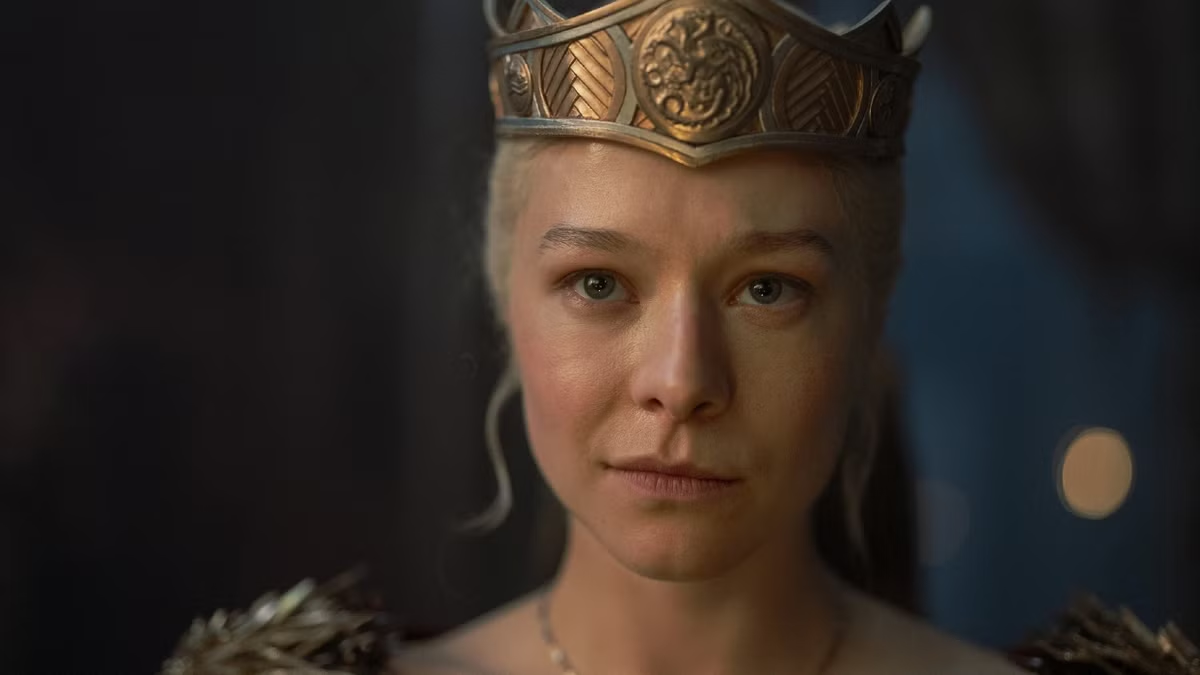
Since Game of Thrones concluded its epic and contentious run, new fantasy or political dramas are often judged against George R. R. Martin’s TV adaptation. Interestingly, the most insightful comparison isn’t with another series but with its prequel, House of the Dragon. Many anticipated it would merely replicate the original’s successful formula — featuring more dragons, intrigue, and shocking twists.
However, as the prequel has developed, it becomes evident that House of the Dragon doesn’t quite match the spirit of Game of Thrones; instead, it serves as a well-crafted “anti-Game of Thrones.” It replaces the continent-wide chaos of a world at war with the horror of a single family unraveling from within. While the original series focused on the relentless, intoxicating pursuit of power, its successor offers a sobering look at how that same power subtly destroys those connected through blood.
House of the Dragon Turns Intense Politics Into Personal Tragedy
Game of Thrones, in a true sense, was a very gifted show. The story had incredible characters, breathtaking visuals, one of the best plot twists in television history, performances, and more. But in its prime, it thrived mostly on one particular aspect: its impressive political tension. A story about a dozen different factions, all making calculated moves on a giant chessboard.
Moments like Tywin Lannister coolly skinning a stag while dismantling his son’s ego, or Olenna Tyrell, in her final moments, looking Jaime Lannister in the eye and admitting, “Tell Cersei. I want her to know it was me.” It was an epic about smart, cynical people like Littlefinger and Varys playing a brutal game of chess across an entire continent.
Even the show’s most “emotional” moments, like the infamous Red Wedding, were, at their core, acts of political and military strategy. There are no Tywins or Littlefingers in House of the Dragon. King Viserys isn’t a political player; he’s a man slowly dying from the physical and emotional weight of his own guilt.
Rhaenyra and Alicent aren’t brilliant schemers; even Daemon, the most experienced “player,” is a creature of pure impulse and chaos. The only character who comes closest to embodying that cunning edge is Alicent and Viserys’s son Aemond Targaryen, and even he is driven more by a simmering, lifelong rage than by cold calculation.
House of the Dragon trades all of Game of Thrones‘ unpredictability and political maneuvering for something far more personal and, in many ways, more painful. It thrives on psychological and generational drama. The betrayals in this show are deeply emotional. The show’s entire narrative is built on a foundation of personal relationships that have curdled into resentment.
The central conflict is between Rhaenyra and Alicent, whose intimate childhood friendship was systematically destroyed by the men around them, turning a broken bond into the engine for a civil war. This was a deliberate choice by the showrunners, who made the characters contemporaries to ensure their broken bond would become the story’s emotional core.
This is where House of the Dragon deviates from how Game of Thrones used to approach its characters. For Game of Thrones, it was all about power; every decision, personal or political, was made on the lines of political benefit. In House of the Dragon, the show’s horror is not in the plotting, but in the hot, messy consequences of love, guilt, and family loyalty gone wrong. That is a very different ambition from its predecessor.
The Iron Throne Is a Curse Instead of a Goal in House of the Dragon

In Game of Thrones, the Iron Throne was the goal. It was the ultimate prize, a symbol of conquest and absolute power. Characters like Cersei, Daenerys, and Stannis were all driven by a burning desire to win it. Cersei’s famous line, “When you play the Game of Thrones, you win, or you die,” perfectly frames the throne as the entire point of the show. It was a game, and the throne was the final boss.
House of the Dragon brilliantly flips this entire idea on its head. From the very first episode, the Iron Throne acts as a slow-acting poison, a curse that rots its occupants from the inside out. The show’s creators even redesigned the throne to be a “killer-looking” and menacing object, a jagged mass of melted swords that literally and physically cuts the person who sits on it.
This isn’t just a cool design choice; it’s a powerful visual metaphor for the show’s central theme. The throne is an active antagonist that visibly rejects its rulers, and the descent of King Viserys, played heartbreakingly by Paddy Considine, is the biggest example. His reign is not one of glory, but of slow, agonizing decay.
He is repeatedly cut by the throne, and these small wounds fester and refuse to heal, leading to a leprosy-like disease that eats him alive over decades. His physical rot is a perfect mirror of the political rot spreading through his kingdom. In this world, power is not a reward; it is a burden that infects, isolates, and ultimately destroys everyone who gets close to it, and thus is what exactly happened to Viserys, who was living through the burden of his wife’s death, his one true love.
During an interview with The New York Times, Considine explained how his body represented his political decline. He said, “From the minute of his wife’s funeral, I think Viserys starts to die. It’s a slow death. Nowhere in the story does Viserys ask the maesters to cure him… I think he accepts it as part of the guilt of the decision he makes to put his wife through a terrible, horrible procedure.”
House of the Dragon Is the Anti-Game of Thrones

There’s a very popular and telling criticism of House of the Dragon that gets right to the heart of what makes it so different from its predecessor. A fan on Reddit once wrote, “The Red Wedding was devastating. Rhaenyra could die in the next episode, and I wouldn’t lose a second’s thought.” While that sounds harsh, it’s not a criticism of the show’s quality; it’s a perfect observation of its deliberate tonal pivot.
Game of Thrones made audiences love the Starks for three seasons, and the Red Wedding was a shocking, unbearable betrayal of that love. But House of the Dragon isn’t trying to make you love its characters; it’s forcing you to watch a house of morally broken heirs tear each other to pieces. Rhaenyra, Alicent, and Daemon are all creatures of impulse, jealousy, and deep-seated trauma.
This is why the show’s most powerful, game-changing moment isn’t a calculated betrayal. It’s the tragic, messy, and accidental death of Lucerys Velaryon. The civil war wasn’t started by a brilliant political move; it was started by a childish grudge between two cousins and their giant, uncontrollable dragons. Aemond didn’t mean to kill Luke; he just wanted to scare him.
This is not a “game of thrones” played by some higher-level political strategist and masterminds. It’s a family feud that has gotten horribly, violently out of control. It’s not a downgrade; it’s a tragedy. House of the Dragon is not just a prequel trying to outdo Game of Thrones with more dragons or bigger battles; it is a mature, sophisticated redefinition of what makes the world of Westeros worth watching.
By replacing the original show’s political scheming with a deep, emotional, and almost psychological exploration of generational trauma, HBO has created a drama that feels older, wiser, and far more haunting. As former co-showrunner Miguel Sapochnik explained, the series was always intended to have its “own tone” and needed to be “something else.” That “something else” is a classical tragedy.
Co-creator Ryan Condal has been clear that this story is a “Shakespearean or Greek tragedy,” one that is “very much about a house tearing itself apart from within.” This is the show’s greatest strength. It’s no longer a story about the game; it is a story about people who were born into a game they never wanted to play.
This makes it a compelling and heartbreaking look at how a dynasty at the absolute height of its power rots from the inside out, not because of an external enemy but because of its own broken family bonds. It is not just a worthy successor to Game of Thrones; it is its perfect antithesis.
-

House of the Dragon
- Release Date
-
August 21, 2022
- Network
-
HBO
-

Matt Smith
Prince Daemon Targaryen
-

Fabien Frankel
Ser Criston Cole
-

Game Of Thrones
- Release Date
-
2011 – 2019-00-00
- Showrunner
-
David Benioff, D.B. Weiss
- Directors
-
David Nutter, Alan Taylor, D.B. Weiss, David Benioff
- Writers
-
D.B. Weiss, George R.R. Martin, David Benioff
- Franchise(s)
-
Game of Thrones







Leave a Reply