
There are a lot of Stephen King stories, be they novels, novellas, or works of short fiction, but there are almost just as many movies based on Stephen King stories. There are a few unadapted ones, but it comes down to some having multiple adaptations, and you usually get more than one a year, while King publishes novels or story collections at what’s “technically” a slower rate of only one or two a year, most years. Slack, in all honesty.
No, not really. You can complain about other things when it comes to Stephen King, but not his work ethic. Also praiseworthy is his ability to write in multiple genres, because despite him being best known for horror, he’s written a fair few stories that inspire, to a greater extent, emotions besides fear. Some of the saddest ones he’s done that were then made into (also) dramatic and sad movies are ranked below, starting with the fairly sad and ending with the saddest. Some of them are also horror stories, so with those, you get a good (or bad?) mix of sadness and unease, simultaneously.
8
‘The Life of Chuck’ (2024)

The novella “The Life of Chuck” takes a concept that’s kind of apocalyptic, and with some fantasy elements, and spins it into something sentimental, and unapologetically tear-jerking. The novella appears in If It Bleeds, and isn’t so much a highlight there, because all four novellas in that collection are honestly pretty good. And then it got a movie adaptation only a few years after that collection was first published, and the film version of The Life of Chuck is incredibly faithful to the source material.
It helps that the novella isn’t very long, so there aren’t too many scenes that are cut, while Mike Flanagan directly puts plenty of lines straight from the novella into the movie. Now, some of them read better on the page, compared to when they’re said by the actors in this movie, which does make The Life of Chuck (2024… though it got a wide release in 2025) a bit corny, but not corny to the point of overshadowing some of the genuine emotion here. Both as a novella and movie, The Life of Chuck is structurally interesting, sometimes touching, and capable of getting you to think about very broad themes (life, death, existence, connection… all that inevitable stuff).
7
‘Pet Sematary’ (1989)

As you might expect from a movie with a misspelled version of the word “cemetery” in its title, Pet Sematary is all about death. To its credit, this 1989 movie adaptation doesn’t shy away from the general darkness of the source material, since Pet Sematary is one of Stephen King’s bleakest and heaviest books. You could perhaps say the same about Cujo, but that movie adaptation did avoid adapting the darkest part of that book, which cheapened the experience a bit.
That being said, Pet Sematary (1989) is not quite as good as Pet Sematary (1983), with the original novel being a little scarier and also arguably sadder. But the movie is still a solid adaptation, and there aren’t really any punches pulled, which ultimately makes it one of the more despairing movies based on a Stephen King story. The sadness here isn’t really cathartic or in any way bittersweet, and the parts that revolve around grief and death mostly serve as deeply bitter icing on an already bitter/scary cake (if a cake can be scary).
6
‘The Long Walk’ (2025)

Stephen King tackles science fiction well, with The Long Walk, which is technically more dystopian than science fiction in the traditional sense, but still qualifies for the label, broadly speaking. It takes place in some kind of desolate future, or a bleak alternate reality, with the titular “long walk” being an annual event that teenage boys take part in, knowing that if they win, they’ll become obscenely wealthy and well-off in a world where no one else really seems to be either of those things.
The catch is that if they lose, they die. In The Long Walk, people walk until they can’t anymore, and when they can’t walk (or if they break too many rules), they’re executed on the spot. It’s very high stakes and more than efficient with its overall horror, and the movie adaptation, which took almost 50 years before it was actually tackled and subsequently made, does maintain the intensity and misery of the source material, to an extent that might well sometimes be too much to handle. It’s a feel-bad film and novel for sure, with the despair ultimately also proving saddening.
5
‘Carrie’ (1976)

Carrie was both Stephen King’s first published horror novel and his first overall novel, so it’s understandable why it helped establish him as a horror writer early on. Of course, the story here is a little more than just horror-focused, with the title character here being a tragic figure, rather than an outright villain, with her telekinetic powers getting increasingly out of control the more she’s bullied at school and abused at home, resulting in an eventual snap.
This was the first feature film adaptation of a Stephen King novel, and it still feels like one of the very best, half a century later.
The film adaptation of Carrie captures the important parts of the book well, even if the climax is a little condensed, and the structure of the book does arguably make things a bit more suspenseful and dramatic. Still, this was the first feature film adaptation of a Stephen King novel (also, far from the only Carrie adaptation), and it still feels like one of the very best, half a century later, not to mention one of the most tragic.
4
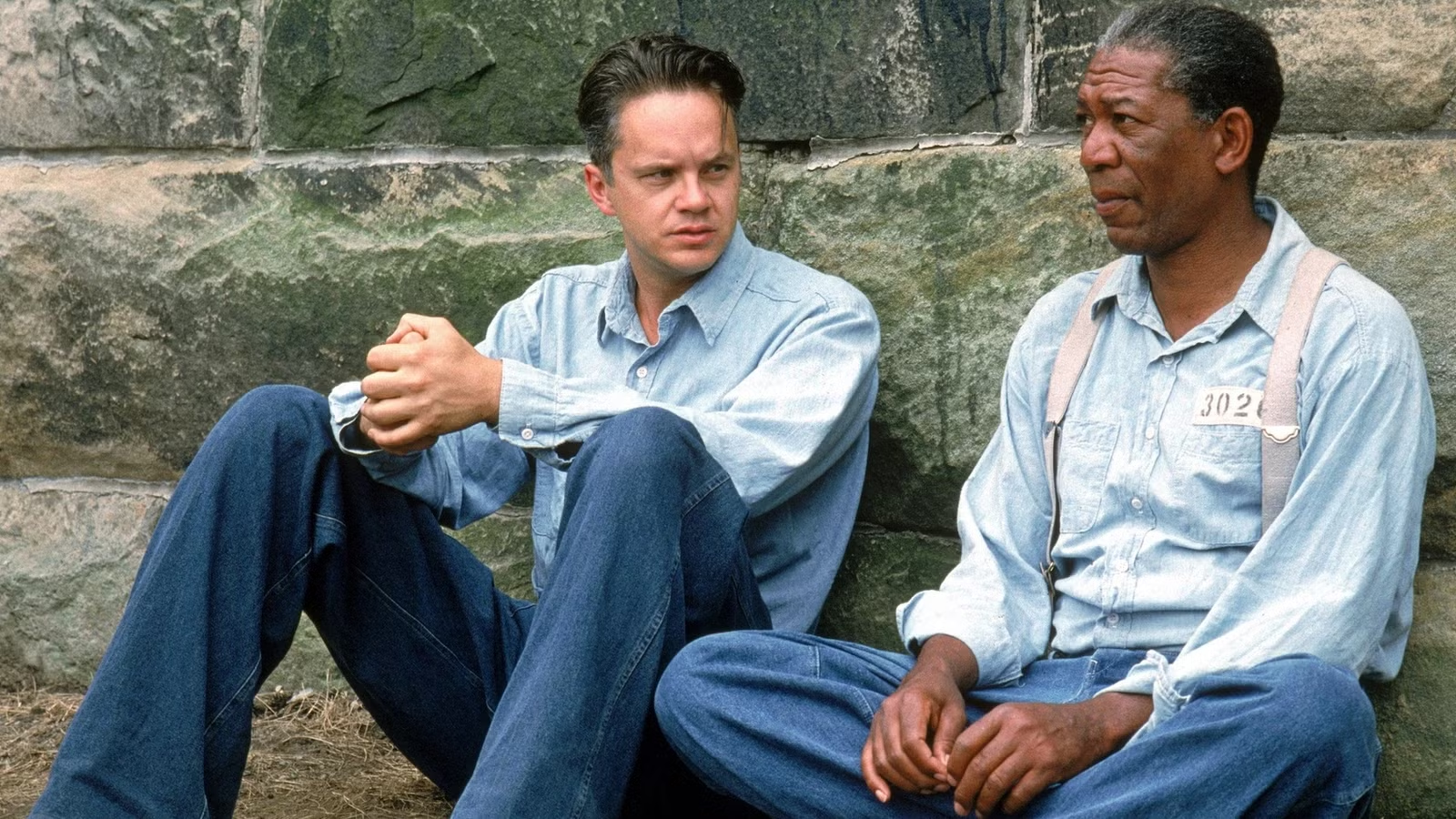
‘The Shawshank Redemption’ (1994)

If It Bleeds was mentioned before as a pretty good novella collection, but it’s Different Seasons that stands, quite comfortably, as the best of Stephen King’s collections of novellas. Three of the four stories here have had movie adaptations, and two of them are among the best movies… maybe ever? Well, at least right up there as the best Stephen King movies, but they’re also all-timers generally speaking, which can especially be said regarding The Shawshank Redemption.
This one’s based on the novella “Rita Hayworth and Shawshank Redemption,” with it being set inside a prison and dealing with the friendship that forms between two men with very different outlooks on life and what the future might entail, or not entail. The Shawshank Redemption and its source material deal with broad themes incredibly well, and both versions of the story are undoubtedly moving. Frank Darabont proved particularly good at adapting Stephen King stories to the big screen, with The Shawshank Redemption being his first, and the next two he made being arguably even more impactful in terms of sadness (though The Shawshank Redemption is his best overall, and only ranks lower because it’s more bittersweet, with the sweetness eventually overpowering the bitterness). And speaking of emotionally hard-hitting Frank Darabont movies…
3
‘The Mist’ (2007)

The Mist takes an already unnerving novella and makes it all the more impactful, mostly thanks to the way it shakes things up near the story’s end. That’s about as vague as things should remain, when talking about this movie, because the ways it gets sad are easy to spoil. Hell, suggesting it gets sad, and mentioning it has a different final act to the novella? That could already be saying a little too much.
There is still a heaviness to the source material, with “The Mist” being about people defending themselves from unusual creatures by hiding out in a supermarket, after the titular mist spreads through town and brings with it all the monsters. Frank Darabont, helming his third Stephen King adaptation, is quite faithful to the original novella until he isn’t, with his primary change to King’s source material elevating an already good story considerably.
2
‘Stand by Me’ (1986)
Like “Rita Hayworth and Shawshank Redemption,” “The Body” appears in Different Seasons, and it was another Stephen King novella that got a different title when it came to making the movie adaptation. “The Body” became Stand by Me, with a couple of tangents (plus some darker moments/implications) taken out for the movie adaptation, yet the core coming-of-age story remains very much intact.
Stand by Me is an honest and easy-to-like movie, but in many ways, it’s also quite devastating. The honesty is eventually brutal, in terms of what it has to say about growing up and maybe drifting apart from people who once meant the world to you, and once you reach a certain age, it’s difficult not to relate to that, to some extent. Stand by Me, and “The Body,” are about confronting death and mortality while growing up and feeling like your own life is entirely ahead of you. The contrast, dramatically speaking, leaves a mark, with the balance between the bitter and sweet here proving undeniably even.
1
‘The Green Mile’ (1999)

There is a supernatural element to The Green Mile, and that sets it apart from The Shawshank Redemption, Frank Darabont’s prior prison movie based on a Stephen King story. It’s technically a fantasy film alongside being a drama, but it’s a subdued kind of fantasy, and the drama-heavy parts of The Green Mile are ultimately the parts that have the biggest impact, and linger in one’s mind the longest.
Basically, much of the film’s set in and around death row, with The Green Mile focusing on prison guards and some of the condemned men they have to watch over before they’re to be executed. One prisoner has strange, mystical abilities, but he’s still slated to die, and everyone has to reckon with that inevitability, even once it becomes apparent that he’s innocent of the crime he’s been sentenced for. It’s obviously a tear-jerker, yet one that’s well-made enough to make it compelling and maybe even easy to revisit… so long as you don’t mind spending three hours on a movie just to feel sad, once all’s said and done.

The Green Mile
- Release Date
-
December 10, 1999
- Runtime
-
189 minutes
- Director
-
Frank Darabont



Leave a Reply