
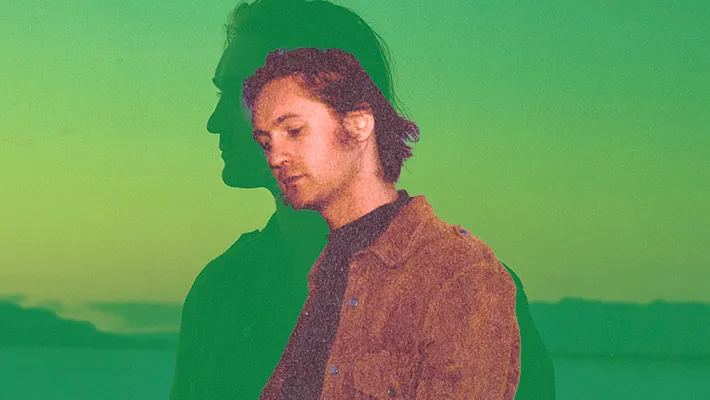
An interesting factoid about Miles Hewitt is that he studied poetry at Harvard. It was interesting to me, anyway. I assumed that the talented 31-year-old singer-songwriter would volunteer this in conversation, especially since his background suggests far greater knowledge of what good constitutes “good lyrics” than the music critic interviewing him. But “Harvard” did not come up in our 32-minute conversation until just over 21 minutes in, and only because I was the one who brought it up.
“You learn to pay attention to stuff,” he said during a Zoom call last month, after sounding slightly embarrassed by my Ivy League name-dropping. “Even just small technical things like, what if this period is a comma? That can change everything in a line of poetry. You don’t have periods and commas in songwriting, but the principles apply. Like, what if you change the word? What if this song that I thought was about “I” is actually happening to “you” instead? It’s like the feeling of pushing on something and feeling how it will push back on you, finding worlds and worlds and worlds within a single image or a single word. Even the idea that the world is really that alive, and that full of meaning, if you are willing to go looking for it and to find what’s there.”
Based on talking to him for a half-hour, I would say the title of Hewitt’s stunning new album out July 24 does not apply to him. Instead, Vainglory refers to some greater sense of mankind’s misplaced confidence in his own ability to control technology — or to prevent it from stripping humanity from the very things that once defined it. “It’s so Western colonial, so Enlightenment. It’s like Ecclesiastes — it’s vanity of vanities to believe that people have some kind of rare perspective, or rarefied power over the universe. That’s part of what the album title means to me,” he explained.
“It also has a second meaning underneath, which has to do with my own struggle in making it, and the desire to make something that is really glorious, and to feel the torturous artistic process that can get you there.”
If you can’t already tell, Hewitt is an artist interested in applying grand themes to grandly realized music. And on Vainglory, his first album in four years — his 2022 debut Heartfall was a critical hit — he achieves peak grandiosity, singing foreboding and apocalyptic songs about the dehumanization of modern life (by A.I., in particular) over spectral folk-rock that evokes the desolate, haunted landscapes depicted on the album’s cover. A fan of prime-era English folk (Nick Drake is among his inspirations), Hewitt’s music achieves a similar sort of slow-building, fully immersive despair, with his sensitive, reedy voice — a strange but alluring synthesis of Dan Bejar and Marianne Faithfull — softly intoning over music that glides from one mood piece to the next.
The attention to detail Hewitt pays to his words also applies to the music, which came together over the course of several years after the tour cycle for Heartfall ended. His support musicians come from a who’s-who of well-regarded indie-rock acts, from Destroyer to Cass McCombs to Andy Schauf. In some cases, he worked with different combinations of players to produce different versions of songs as Hewitt searched for what he wanted, a process that mirrored the spiritually questing of his lyrics.
“For me, what makes an album really special isn’t just that it’s good or that it sounds good, but it has that feeling to it,” he said. “It feels like something emotional that you can tell is coming from a particular place. And it just took a while to find that. It took going through a lot of iterations. I think by the end of the process, some of the musicians were just like, ‘Man, why are we doing version six when version three was just as strong?’
“I think that the album is a search. It’s both a search on the level of the sort of sociopolitical things, technological things we’re talking about, but it’s also about searching for the truth on a purely aesthetic level as well.”
You talked about chasing a certain feeling with this record. What was that feeling?
When I started writing the songs that would become this album — which was in 2021, 2022, and 2023 — I found myself writing a lot from almost like a bird’s-eye view down on the world. It didn’t feel like “Miles Hewitt” was the main character or the most important part of what was going on at all. I felt a little shy about doing that at first, because it was like, “Who gives you the right to write on such a large scale?” But these are concerns that are on everyone’s minds. The feeling of living through maybe not the end of the world, but an end of a world that we thought we were living in, is very much in the air right now.
When you say there’s a “bird’s eye view” in these songs, do you mean a God’s-eye view? Or is there no god in these songs?
That’s a really good question.
I feel like there’s no god in the world of these songs.
Dude, I love that your second question to me in this interview is like, “Is there a God?” That’s awesome.
Hey, there’s no time for small talk.
No, we’re getting right in. I love that. It’s searching for something. It’s seeking something beyond the barbarity and materialism, I think, of the world that we’re living in right now. So, I can’t say if it’s a God’s-eye view. It’s definitely a view that feels much more important than my personal troubles or whatever, though.
Something I’ve been thinking a lot about for years now is the tension between a worldview in which everything is material, everything is data, everything can be measured, everything can be quantified, and therefore controlled and marketed. As a friend of mine says, we’re in a really rapid reframing and re-understanding of what it is to be human. I think that’s the question, one of the big questions, that we’re facing in our time, and I think that this record is partially about trying to follow that question, basically. Like, who are we? Are we data points, or are we something that the quantification of our world can’t actually quite grasp?
Is it fair to call this a song cycle or a concept album?
I guess so, yeah. I hadn’t really thought about it that way. I don’t know if it’s a concept album because there’s no alter egos involved.
There aren’t any characters or a plot. It’s not Tommy.
But song cycle probably feels right. Albums are my favorite medium of human creativity. I’ve always loved albums. Even when I was a kid and I was just getting into listening to contemporary music, I was just immediately drawn to the mystique of making albums, and how the whole is greater than the sum of its parts. I do feel like this album is trying to be that kind of album, where all the songs are in dialogue. It’s not just a bunch of songs that happened to be recorded around the same time. A lot of thought went into the sequencing. Even the sound of one song might be a reaction to another song. There’s a striving for them to all connect with each other in some way.
It sounds like you reworked these songs quite a few times.
I am unbelievably lucky to live in New York and get to make music with truly some of the best musicians in the world. People who specialize in making records and in touring, it’s what they’ve devoted their lives to. They’re the kind of musicians who, by the end of the first time ever playing the song with them, they’ve tried three things and figured out what the right part is. There’s no self-indulgence in anyone’s playing. And that’s an amazing gift, as a songwriter, to work with people who are that pure, and dialed in about what their role is in the creative process.
Heartfall came out of the pandemic. I had written a bunch of the songs beforehand, but then the pandemic happened and I was forced to slow down and really imagine all the songs in my mind. I had these really elaborate blueprints, about each of the sounds that constituted each of the songs on Heartfall. I was making these mood boards almost of like, “The drums on this song are going to be mono, and the guitars are going to be this kind of thing.” When I was done with it, I was like, “Now I know exactly who I want to call, and what studios to use. This next record will cost half as much and take half as much time to complete.” And of course, it took twice as long and cost twice as much to make as the first one. I’ve given a lot of thought as to why, and I think it had a lot to do with the fact that on Vainglory, I knew that there was a mood that I wanted it to have and I knew what the songs were saying, but there wasn’t really that step of imagining everything in careful detail first. It was much more about going into the studio and seeing what we would get. It took a while, in some cases, to really feel like it reached that feeling or that spirit that the music wanted to have.
It’s interesting how much time you spend on the music despite being a “lyrics-forward” artist, ostensibly, given your background.
The thing is I was writing songs before I was writing poems, I think. It was high school, so it’s all roughly the same time. But I got into Allen Ginsberg via Bob Dylan, not the other way around. Music just has — what’s the word? — an unstoppable quality to it. If you hear a song that moves you, there’s nothing else in your mind. There’s no other feeling. If you sit down on a piano, and you just push a key and you hear that sound back, that is such a visceral feeling. I think that was the original love for me, and writing words is just another part of the art.

Leave a Reply