
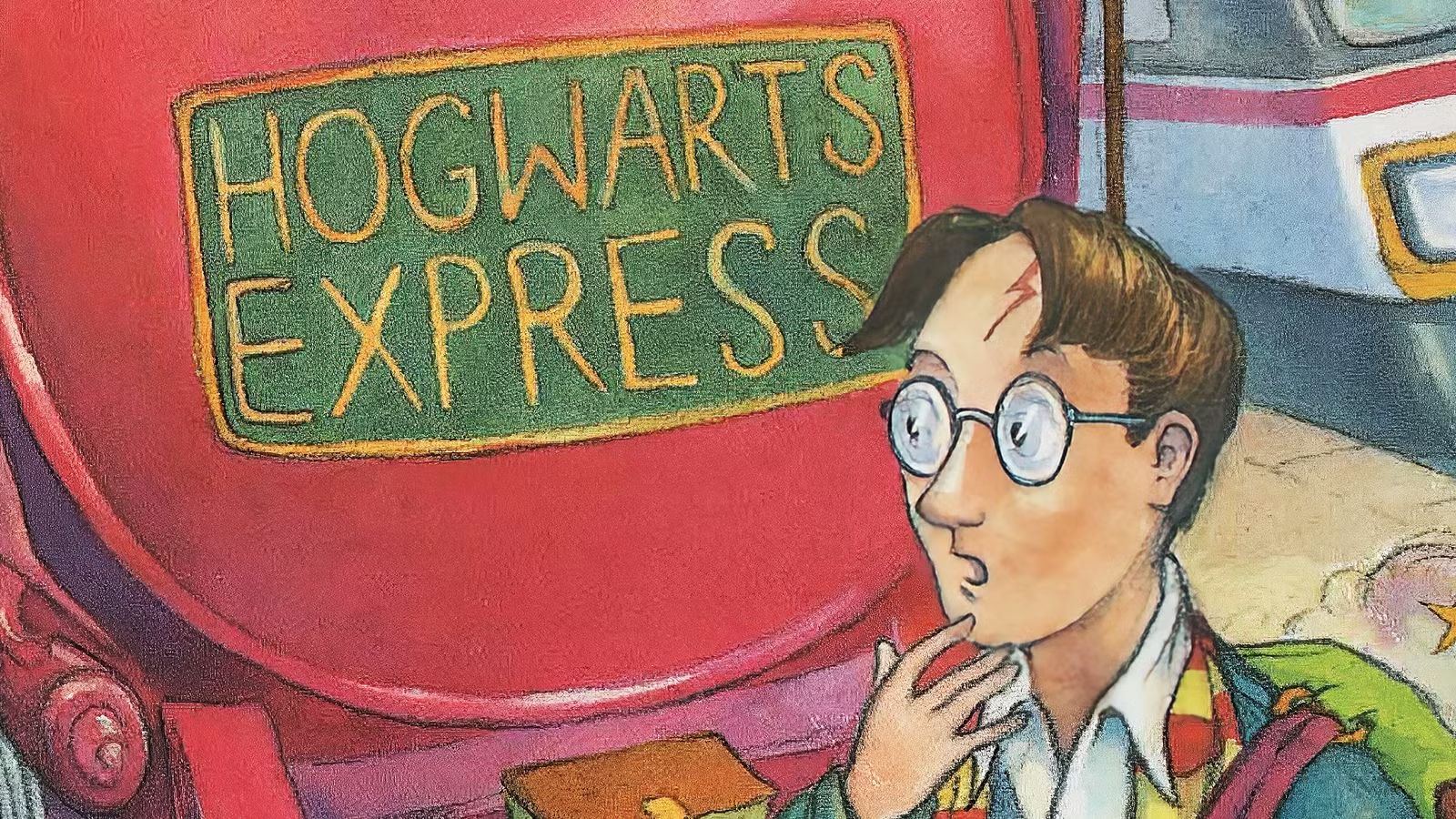
The reason J.K. Rowling‘s Harry Potter franchise is still so culturally significant is that readers never really wanted to leave its world. Hogwarts is still this magical, comfortable place that feels like it actually exists. The lessons, rivalries, traditions, hidden rooms, and so many other small details made the world feel lived-in instead of just simply invented for the plot.
That is an incredibly difficult feeling for another fantasy series to recreate, but a handful of modern books have managed to capture the same level of wonder in completely different ways. These modern fantasy books and series may not be Harry Potter, but they understand exactly why readers fell in love with it in the first place.
The ‘Nevermoor’ Series (2017–2025)

Jessica Townsend‘s Nevermoor series is bound to give readers that same cozy feeling that Harry Potter is known for. The fantasy books follow Morrigan Crow, a girl born on an unlucky day and blamed for practically every misfortune that happens around her. What’s worse is that she is expected to die on her eleventh birthday. However, the eccentric Jupiter North appears, rescues her at the last possible moment, and takes her to Nevermoor — a hidden city filled with impossible hotels, strange creatures, secret societies, and magic that seems to operate by its own rules. Morrigan soon gets the chance to compete for a place in the prestigious Wundrous Society, although passing its trials means proving she possesses a talent nobody seems able to identify.
That setup naturally invites comparisons to Harry Potter, but Nevermore creates its own magical world that feels entirely distinct. The later books are especially important in proving that, as Morrigan begins to fully explore the dangerous abilities she has spent most of her life being taught to fear. Every book pushes the mythology further, and that progression is what makes the Nevermore series feel much bigger than its initially familiar premise. There’s no denying that Townsend captured the very same sentiment that Rowling did with Harry Potter, but Nevermore eventually developed enough imagination, mystery, and personality to carve out a space of its own in the genre.
The ‘Legacy of Orïsha’ Trilogy (2018–2024)

Children of Blood and Bone by Tomi Adeyemi opens the Legacy of Orïsha trilogy in a world where magic has already been taken away. The story begins with Zélie Adebola, who remembers when the maji of Orïsha could command everything from fire and water to life and death, but King Saran’s violent campaign against them wiped out an entire generation, including Zélie’s mother. Years later, a chance encounter with runaway princess Amari allows Zélie to restore that magic. This sends the two across Orïsha while Crown Prince Inan hunts them down. The first book works especially well because Adeyemi directly ties this world’s magic to ancestry, identity, and power. Zélie’s fight is about reclaiming something that was violently taken from her family and her people, which roots all the fantasy and spectacle in something that feels real.
The series continues with Children of Virtue and Vengeance and Children of Anguish and Anarchy, which expand the conflict and explore what happens after magic returns to Orïsha. Across all three books, Adeyemi keeps building on the same world instead of simply repeating the first novel’s formula. The author creates a world with its own rich history, social divisions, and rules that keep getting more complicated as the characters grow. Adeyemi always leaves another corner of the world to uncover, while West African mythology and Yoruba-inspired culture give the series a distinct identity.
The ‘Supernatural Investigations’ Series (2021–2026)

B.B. Alston‘s Supernatural Investigations series begins with Amari and the Night Brothers, where thirteen-year-old Amari Peters tries to understand the disappearance of her older brother, Quinton. Her search leads her to a hidden briefcase, and eventually the Bureau of Supernatural Affairs, an organization responsible for everything from magicians and mermaids to creatures most people do not even know exist. Amari joins its summer training program hoping to find answers about Quinton, but she immediately stands out for all the wrong reasons when her supernatural ability is revealed to be something the Bureau considers dangerous. The series keeps expanding in the most interesting directions from there. Amari and the Great Game places the protagonist in the middle of a much larger conflict over the future of magicians, while Amari and the Despicable Wonders turns that tension into open war.
The fourth book, Amari and the Metalwork Menace, pushes the story forward again with a new threat that begins turning people into machines. Supernatural Investigations never gets boring because the Bureau is full of strange departments, hidden rules, rival students, magical creatures, and corners of the supernatural world that Amari is discovering at the same time as the reader. That keeps the world from ever feeling simple, especially since Amari is navigating all this while also being judged for the way she is. Alston’s work is at its best when Amari’s status as a magician turns the Bureau from a place of wonder into something she has to constantly challenge, especially as she realizes its rules were never built with people like her in mind.
The ‘School for Good and Evil’ Series (2013–2023)

Soman Chainani‘s The School for Good and Evil follows best friends Sophie and Agatha, who are taken from their village to a mysterious school where children are trained to become the heroes and villains of future fairy tales. Sophie has spent her whole life believing she belongs in the School for Good, while Agatha seems like an obvious fit for Evil. Naturally, they are placed in the opposite schools. That becomes the foundation for the entire story, as both girls try to prove they have been put in the wrong place while slowly realizing that the labels of “good” and “evil” are much less reliable than they expected. The school itself is packed with strange classes, magical trials, rival students, and fairy-tale traditions that make it easy to understand why readers get so invested in the world.
What gives the series real staying power, though, is how far it pushes that original idea. Chainani keeps changing the rules of the world. The story expands way beyond the school and into the territories its students are eventually meant to enter. At the same time, Sophie and Agatha’s friendship becomes increasingly complicated as both discover that being good or evil has much more to do with choices than appearances. That gives the books a sharper edge than the whimsical setup initially suggests. The School for Good and Evil has the same kind of addictive appeal as Harry Potter because readers get to immerse themselves in a fascinating magical institution, but the real hook is watching all its rules slowly fall apart.
The ‘Keeper of the Lost Cities’ Series (2012–2024)

Keeper of the Lost Cities by Shannon Messenger begins with twelve-year-old Sophie Foster, a human girl who has spent most of her life hiding the fact that she can read minds. Everything changes when she meets Fitz Vacker, another Telepath who reveals that Sophie is actually an elf and belongs in the Lost Cities, a hidden civilization she never knew existed. Sophie then leaves her human family behind, enrolls at Foxfire, and finally finds people with abilities like hers. However, fitting in does not suddenly become easy because Sophie’s powers are unusually strong, and a mysterious organization known as the Black Swan seems to know far more about who she is than she does.
The intrigue around that is what drives the story. Sophie soon discovers that her existence is connected to plans that began long before she arrived in the Lost Cities, while another organization, the Neverseen, suddenly becomes a dangerous threat. Her search for answers pulls Fitz, Biana, Dex, Keefe, and the rest of her friends into kidnappings, secret hideouts, political conflicts, and discoveries that expose uncomfortable truths about the supposedly perfect elven world. This progression of events is addictive since one mystery almost always leads to another. However, Messenger keeps that mystery running alongside the friendships and rivalries readers become attached to, so her enormous world never feels overwhelming.
The ‘Grishaverse’ Series (2012–2021)

Leigh Bardugo‘s Grishaverse has taken over BookTok, and it’s easy to understand why the books blew up almost overnight. The story begins in Shadow and Bone and follows orphan Alina Starkov, who is serving in Ravka’s army when she discovers that she is a Sun Summoner, the one Grisha who might actually be capable of destroying the Fold. This brings her into the world of Ravka’s magical elite and directly under the influence of the Darkling. Across Siege and Storm and Ruin and Rising, that discovery grows into a much larger fight over Ravka itself, as Alina learns that becoming the person everyone expects to save the country comes with its own dangers.
What makes the Grishaverse especially impressive, though, is what happens after that story ends. Six of Crows moves two years forward and leaves Ravka behind for Ketterdam, where criminal prodigy Kaz Brekker assembles Inej, Jesper, Nina, Matthias, and Wylan for an almost impossible heist. The magic is still there, but suddenly Bardugo is using the same world to tell a crime thriller story complete with rival gangs and elaborate schemes. Then the King of Scars duology returns to Ravka through Nikolai Lantsov, Zoya Nazyalensky, and Nina Zenik and connects consequences of both earlier series while pushing the Grisha conflict into politics, war, and questions about what Ravka can become after everything it has survived. Bardugo delivers a masterclass in interconnected storytelling that makes one magical community feel enormous and layered. No single character, city, or even genre is big enough to contain the Grishaverse, and that is what makes it such a treat to read.
The ‘Scholomance’ Trilogy (2020–2022)

Naomi Novik’s Scholomance trilogy begins with A Deadly Education. The story follows Galadriel “El” Higgins, a student trapped inside a magical school where graduating is less about passing exams and more about surviving long enough to reach the exit. The Scholomance has no teachers, almost no adult supervision, and is constantly invaded by monsters known as maleficaria that feed on young wizards. El is especially dangerous because her natural talent leans toward destructive magic, which means everyone assumes she is destined to become some kind of dark sorceress. The one person who keeps complicating that reputation is Orion Lake, a ridiculously powerful student who has made a habit of saving everyone around him.
The setup is great, but the trilogy gets so much more interesting than its deadly magic school premise when Novik starts revealing why the system works this way in the first place. Wealthy magical families live in protected enclaves and have access to resources that ordinary students can only dream of, while everyone else survives by making alliances, trading favors, and hoping they are useful enough to someone stronger. The story gradually reveals how inequality inside the Scholomance was only a smaller version of how the wider magical world operates. The Scholomance trilogy takes the familiar excitement of a magical school and asks what that world would actually look like if safety, education, and power were distributed according to wealth, much like they are in the real world. That makes the trilogy darker than Harry Potter, but it still captures the same addictive feeling of getting lost in a hidden magical society where every new rule reveals something more unsettling.
The ‘Percy Jackson & the Olympians’ Series (2005–2024)

Rick Riordan‘s Percy Jackson & the Olympians begins with The Lightning Thief, where twelve-year-old Percy Jackson discovers that the Greek gods are real, and Poseidon is his father. Percy is then taken to Camp Half-Blood, a refuge for demigods where he finally meets other kids dealing with the same monsters, powers, and complicated divine parents. Soon enough, he is sent across the United States with Annabeth Chase and Grover Underwood to recover Zeus’ stolen master bolt and prevent a war between the gods. That first quest opens the door to a much larger story.
Each book introduces another piece of Greek mythology while gradually building toward the return of Kronos, with Luke Castellan’s betrayal becoming one of the series’ most important threads. Percy and his friends fight everything from the Minotaur and Medusa to Titans, monsters, and gods, but Riordan ensures that the mythology remains accessible. He takes stories that are thousands of years old and drops them into modern America, where Mount Olympus sits above Manhattan, the entrance to the Underworld is in Los Angeles, and ancient monsters keep finding new ways to blend into everyday life. This balance between ancient mythology and modern humor is what turned Percy Jackson into such a lasting pop-culture phenomenon.

Percy Jackson & the Olympians
- Release Date
-
December 19, 2023
- Network
-
Disney+
- Showrunner
-
Jonathan E. Steinberg, Dan Shotz
-

Walker Scobell
Percy Jackson
-
Leah Sava Jeffries
Annabeth Chase








Leave a Reply