
While The Far Side mostly kept its storytelling eye inward, it wasn’t quite as rare for Gary Larson to sometimes have fun with the limits of his comic strip. Sometimes, the cartoonist’s panels looked directly at viewers, confronting its readership with hilarious punchlines and jokes. Confined to a single panel, the feats Larson managed within said panels were as impressive as they were revolutionary. Having amassed a fanbase that continues to delight in The Far Side despite the passing of time and the evolving platforms for comics, Larson’s work created something unique that, much like other renowned comic strips, will never be able to be replicated or recreated.
Because of such a limited space, a creator and artist like Larson had to get creative in his execution and storytelling elements. From such a need came the breaking of the fourth wall, the meta panels, and the self-referential moments that stopped pretending to exist within a confined bubble and instead turned its focus to readers in a way not many newspaper comics had before. Larson experimented with comics in fresh and fun ways, demonstrating that the act of reading a single-panel comic wasn’t as brief or short-lived as it seemed. Self-referential panels were some of his best and most successful experiments, which pulled The Far Side even further ahead of its time.
All Creators Run Out Of Ideas At Some Point
Larson Knew How To Use Writer’s Block To His Advantage

Divided into the rare multi-panel strip, this entry shows four ducks quacking at each other. Suddenly (and rather nonsensically), one of them yells, “Chicken!” In the next panel, they are seen ducking (pun not intended) just as a chicken passes by in midair. Finally, in the last panel, the ducks continue quacking. As a Far Side, this isn’t Larson’s brightest or deepest. It may be one of his mildest and simplest comics to date.
However, just as this panel is about to become simple (and quick), its caption takes readers behind the curtain: “‘And so,’ the interviewer asked, ‘Do you ever have trouble coming up with ideas?’ ‘Well, sometimes,’ the cartoonist replied.” Pairing them together then creates an admission — Larson struggled to find a good idea for one of his daily panels and opted instead for sincerity. Admitting he was running short on ideas gave him an idea, so this panel made its way onto the list in the last spot, mainly for its almost accidental existence.
No Character Is Safe From Fourth Wall Breaks
Not Even In One’s Own Mind

Of the many elements Larson used in his comics, there wasn’t a lot he employed very often, but in this panel, he uses the rare thought bubble in quite a clever way. While two workers sit at their desks, when their boss comes in, one of the workers thinks:
Oh, great. Here comes my boss, that big, dumb geek. I hate him so…
While it’s perfectly acceptable to think whatever one pleases in one’s head, it becomes apparent that the worker struck some bad luck at this specific moment. In a classic fourth-wall break, the boss reads the man’s thoughts in his thought bubble, letting readers know he is very aware they are in a comic but that he is more preoccupied with the thoughts his employee is thinking. As hilarious as this panel is, an element of witty cleverness drives it home and places it among the best in the self-referential Far Sides.
Drive-By Erasings Are On The Rise
The Far Side Characters Are Horrified

Larson often tortured his characters for readers’ enjoyment. In this panel, however, he tortures the characters so that the focus is on them in ways his comic strip hadn’t done before. As much as it was hilarious to see cows tasting their own meat out of curiosity or seeing a horde of zombie squirrels about to eat a human, the threat to characters is universal in this scene.
Larson breaches an unspoken barrier with the most hilarious of intents by breaking the fourth wall and acknowledging that the characters are drawn and not real. If “erasings” are possible in The Far Side, then the possibilities for fourth-wall breaks become endless. Larson seemed to have the foresight to present his comic strip with opportunities to multiply — he created scenes that had the potential to keep going far beyond their first iteration. Just one of the many things that made this strip special.
Very Serious Characters Knock At the Far Side’s Door
Obviously, They Are In The Wrong Apartment

Of all the things Far Side characters were, serious or stoic was never one of them. Far Side characters were purposefully silly-looking, settled in their childish ways, and quite unserious. It was one of the many reasons some readers could never “get” The Far Side. While other cartoons were lighthearted and sometimes even educational, The Far Side was an unapologetically immature comic strip, and it was one of the many reasons parents disagreed with its existence.
This panel directly acknowledges that divide, contrasting The Far Side‘s absurdity with the more traditional newspaper strips that prided themselves on dramatic scenes or wholesome life lessons. The chaotic scene of the familiar characters all living together only highlights how out-of-place conventional comic characters look there. It’s a rare moment where The Far Side knowingly winks at its own reputation, drawing a line between its bizarre world and other comics it shared a page with.
Far Side Characters Get Worried When Things Are Calm
It May Have Been The Only Day Things Were Calm

Paranoia was most relevant and constant in Far Side panels. As the sole element inciting panic and fear, paranoia was the perfect emotion Larson could instill into his characters. From such an emotion, endless opportunities for scenarios and scenes presented themselves. Breaking the fourth wall for readers’ enjoyment became a trend as The Far Side moved along a strong 15-year run.
By 1987, the comic strip had gathered enough of a following that panels like this one were worth holding out on. As a man from “Bud’s Cartoon Repair” arrives to help a man make his panel less quiet and normal, it is evident there is a blatant acknowledgment from the characters that they are in a comic. The paranoid feeling from the characters elevates the joke further, showing that, according to Larson, his character could not exist in too much peace, and panic would ensue.
Farsidians Capture Some Other Comic Explorers
It’s A Mystery What Happened To Them

Crossovers weren’t unheard of in The Far Side, but Larson rarely introduced one unless it was worth the effort. In this panel, for example, Larson introduces his Far Side characters to two characters that look like how parents would’ve described the ideal and “safe” family-friendly cartoon character in their newspapers.
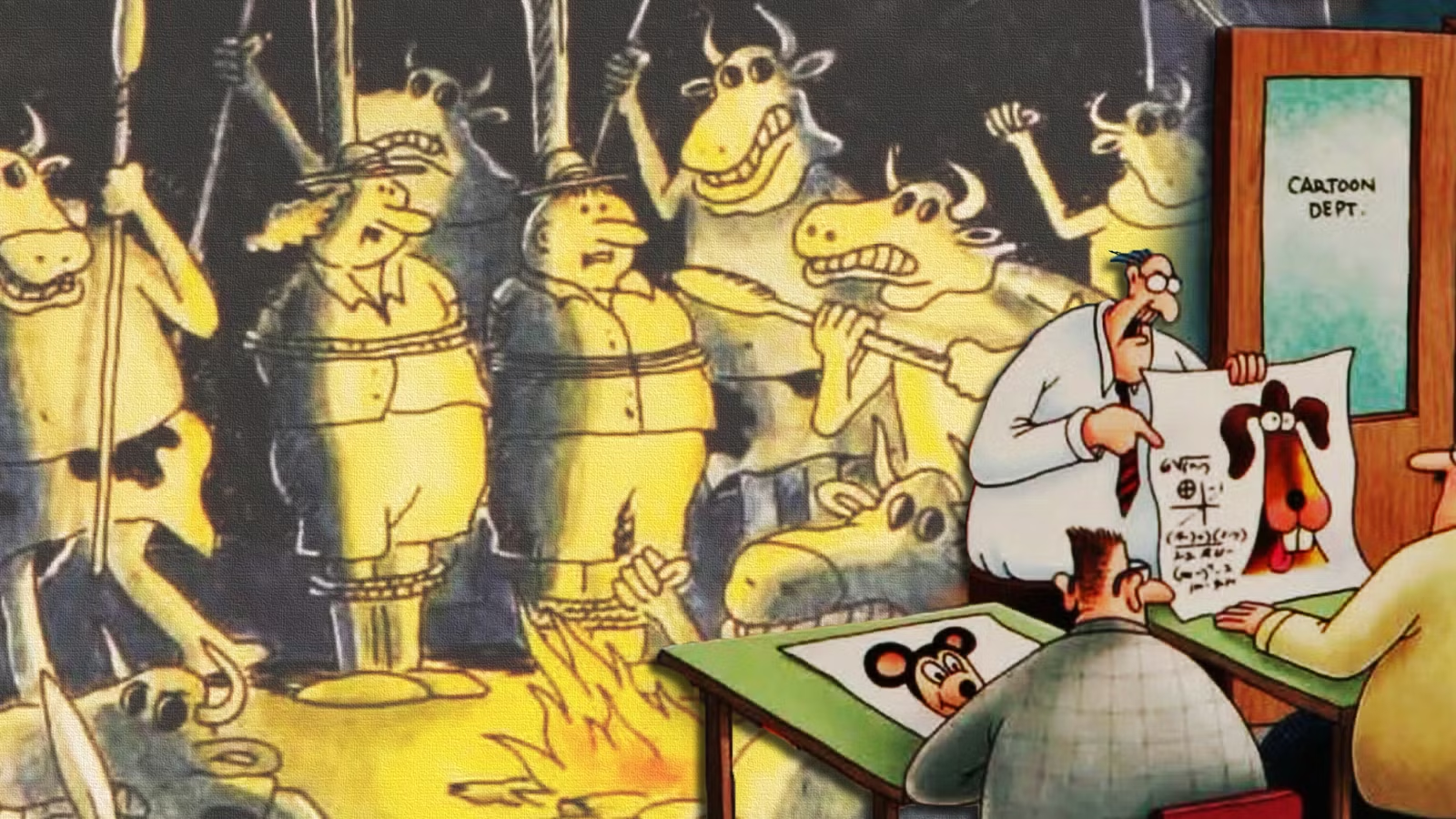
Explorers from another cartoon are captured and tortured by the savage Farsidians.
Of course, with an observation like that, Larson would’ve created this panel to respond to such people. If unhappy readers believed his comics were far too graphic, grotesque, or violent, it would stand to reason that this panel was in direct response to such beliefs. Here, Larson responds that his characters could be violent if he drew them that way. Still, overall, violence wasn’t what his comic strip was about — it was about the humor, and in this panel’s case, the humor is straightforward, slightly sarcastic, and mostly hilarious. This entry takes the middle spot on the list for the open demonstration of its wide range of genres and themes.
Larson Bamboozles His Characters With A Glass Wall
It’s The Classic Cartoonist Method Of Subjugation

Larson only (officially) interacted with his Far Side characters and introduced himself into the comic strip in his farewell panels in 1995. However, this panel from 1991 shows that while Larson did not place himself in his own cartoon universe, in a way, he did have two of his characters acknowledge his existence.
Of course, it is always up to readers how a panel is interpreted, but it would be fair to see how the “dirty bugger” these explorers refer to is Larson. As the sole creator, writer, and illustrator for the comic strip, it makes sense that the characters have been trying to sneak past Larson but have been caught every time. In this panel’s case, a random glass wall in the middle of a jungle blocks the characters from escaping, so they look up as if directly addressing their creator. This is definitely one of Larson’s more creative Far Side panels.
The Cartoon Department Has A Zero-Maths-In-The-Office Rule
Higgins Was Caught Doing Physics Equations Again

While cartoonists take their jobs very seriously, it can’t be expected that they’d take their jobs seriously enough to ban them from entertaining other past times. After all, one of the best aspects of cartoonists is their freedom and liberty to express themselves in any way they wield their medium. Censoring artists is how mediocre and soulless work spreads like a disease.
Larson never allowed outside forces to influence his work in The Far Side. It was why he never took panel suggestions or ideas from his avid readers but still enjoyed hearing their opinions on his work. In this panel, a Cartoon Department supervisor catches one of his cartoonists working on some physics equations instead of his dog cartoon. This panel switches places with scientists who perhaps doodle or cartoon in the margins of their work. It assigns cartoonists as overtly serious workers and physicists as doodlers and the distracted. Neither fact is absolutely true in the real world, but such a panel is still hilarious for its absurdity.
The Far Side Spy Center Does Some Fine Spy Work
They Are The Best At Covert Cartoon Surveillance

As many famed Far Side characters sit by panels of buttons with headphones on and multiple surveillance feeds over them, it is evident these characters are spying. A closer look at their live feeds shows the familiar outline of Charlie Brown on one screen, a funky-looking Garfield on another, and Cathy in the left corner.
Paired together, these screens show that, behind the scenes, The Far Side characters spend their time checking over their “competition” and making note of their every action. It is unclear what the reason for their surveilling is, but what is clear is that in many ways, Larson was being self-referential in demonstrating this tendency to keep up to date with other comics through his own characters. It was the closest Larson came to addressing his readers directly.
The Mathematics Of Cartoons Are Very Complicated
It Takes Many Years To Crack The Code

A woman watches as a man is eaten by a very large snake — yet, in this panel, more than that is happening. Across the entire page, Larson provides a look at the “mathematical computations every cartoonist must know.” One line measures the “offensive quotient” and finds that “42 hate letters” will be sent over this panel alone. Across the page, many measuring lines write off the approximate lengths of the characters and their parts. One line writes how many flowers are in the woman’s dress, while another advises how much further she should be moved. At the very top of the panel, the words “Ok, this should be hilarious” conclude the series of annotations and equations, tying up the panel into an estimated result.
Overall, this wasn’t how Larson worked, but many of the elements he included in this hilarious panel were aspects and parts he most definitely kept in mind as he drew. Larson demonstrates that cartooning was not just a doodle with some words but an artistic process that took time, care, and dedication. While he may not have gone over mathematical equations to measure the number of hate letters a panel would get, he worried about his work being taken out of context or misunderstood enough to spark outrage about the size of Cow Tools. However, his wit, charisma, attention to detail, knowledge, and sense of humor made The Far Side beloved and admired. This panel takes the top spot, showing how Larson, as an artist, found pleasure and joy in his job.

- Writer
-
Gary Larson
- Publisher
-
Universal Press Syndicate
- Artist
-
gary larson








Leave a Reply