
The latest series by Russell T. Davies takes its title from an unhappy comment made by a character in its premiere. “I used to walk into a room and just go, ‘Ta-da!’” recalls Melba (Paul Rhys), an out and proud 60something in dramatic eyeshadow and a bright red lip. But now, “I tiptoe. Just in case.”
In case of what need not be spelled out when the series opens with a shocking tableau of gay bar owner Leo Struthers (Alan Cumming), the recipient of Melba’s speech, hanging by his neck from a streetlight outside his Manchester home. But if the recent surge of queerphobia has had a chilling effect on many, Davies (It’s a Sin) has yet to succumb to it. Angry but empathetic, frank in its darkness but refusing to wallow in it, Tip Toe is a cry of frustration that cuts right to the heart.
Tip Toe
The Bottom Line
Breathlessly and tragically of the moment.
Airdate: 9 p.m. Friday, Oct. 2 (Starz)
Cast: Alan Cumming, David Morrissey, Jackson Connor, Joseph Evans, Iz Hesketh, Elizabeth Berrington, Pooky Quesnel, Paul Rhys, Luyanda Unati Lewis-Nyawo
Creator: Russell T Davies
Premiering on Starz after bowing across the pond on Channel 4 over the summer, Tip Toe may not be the very first work to grapple with what it means to be queer in this specific moment, deep into the backlash of the last few years following the legislative victories and cultural landmarks of the 2010s. But in typical Davies fashion, the five-hour miniseries distinguishes itself for tackling its subject so head on and with such varied and visceral feeling, as manifested especially by Cumming and David Morrissey as a pair of feuding neighbors.
If Leo’s death is the first jolt of the series, the second arrives moments after, when the episode (directed, like the rest of the series, by Peter Hoar) jumps back 10 days to fill in the blanks of precisely how and why he wound up there. Even with his doom foretold, the man we meet in life seems so vibrant — sheepishly knocking on his neighbor’s door after getting locked out of his own, regaling his pals with the story later, effusively greeting passersby on his way to work — that it becomes easy to forget he could be headed for such an ugly fate.
Or maybe, more accurately, it becomes easy to tell ourselves he couldn’t possibly be. The mood that hangs over Tip Toe is two parts anxious dread to one part disbelief that things could really get quite so bad — as represented, with tragic irony, by Leo. While Melba frets from a patio on Canal Street about how much scarier things have gotten, it’s Leo who tries to reassure her that the pendulum of public opinion will swing back. It always has, he reasons, and so it will again.
Whether it does or doesn’t, we know already it won’t in time to save him. Even as Leo expects to ride out the storm, violence is already hanging in the air like humidity.
At first, it’s only as a threat. Zee (Iz Hesketh), a bartender at Leo’s Spit & Polish, or Regime (Dominic Holmes), a drag queen, might be justifiably afraid of the transphobic acquaintances threatening to assault them. But for now they’re able to avert the danger, with help from the community around them. The neighbor who reluctantly lets a locked-out Leo inside, Morrissey’s Clive Goss, might be obviously displeased to have a gay man in boxer-briefs making small talk with his 16-year-old son, George (a sweet Jackson Connor). In the moment, though, he subjects Leo to nothing worse than some inhospitable rudeness.
That initial chance encounter between Leo and Clive leads to more interactions between the previously distant neighbors — with Leo hiring struggling electrician Clive and his handsome 25-year-old son, Saul (Joseph Evans), for some repairs around Spit & Polish, and becoming a reluctant confidant of sorts for George, who turns out to be a closeted gay kid. In another series, in another era, those developments might have led to teachable moments and inspiring speeches, and the most bittersweet beats of the series are the ones that suggest how a happier ending could have come to pass.
But Tip Toe is a drama for an age in which Leo at one point muses that queerphobia can no longer be chalked up to a lack of visibility. The pressing concern now, he suggests, is, “What if they see us and they still don’t like us?”
Crucial to answering that question is Davies’ treatment of his characters as idiosyncratic individuals, rather than symbols in some endless culture war. He’s not always successful, especially with the supporting characters — Leo’s bestie Steph (Elizabeth Berrington) seems constructed primarily to give Leo someone to talk to and secondarily to give voice to the simmering transphobia of cisgender straight women, which makes it all the weirder that her bigotry is never meaningfully addressed. But he fills his leads with enough shading to make them leap off the screen.
Cumming positively crackles with charm and wit as Leo the social butterfly, and it’s in no small part due to his affability that Tip Toe feels much less punishing to watch than its bleak subject matter would suggest. But he’s especially impressive in his moments of tenderness, as when he relays to George the words of wisdom he never got growing up in the relative dark ages of the ’80s, or of galvanizing fury, as when he finally snaps that queer people are done begging for the approval of men like Clive, “our eyes like fucking puppies.”
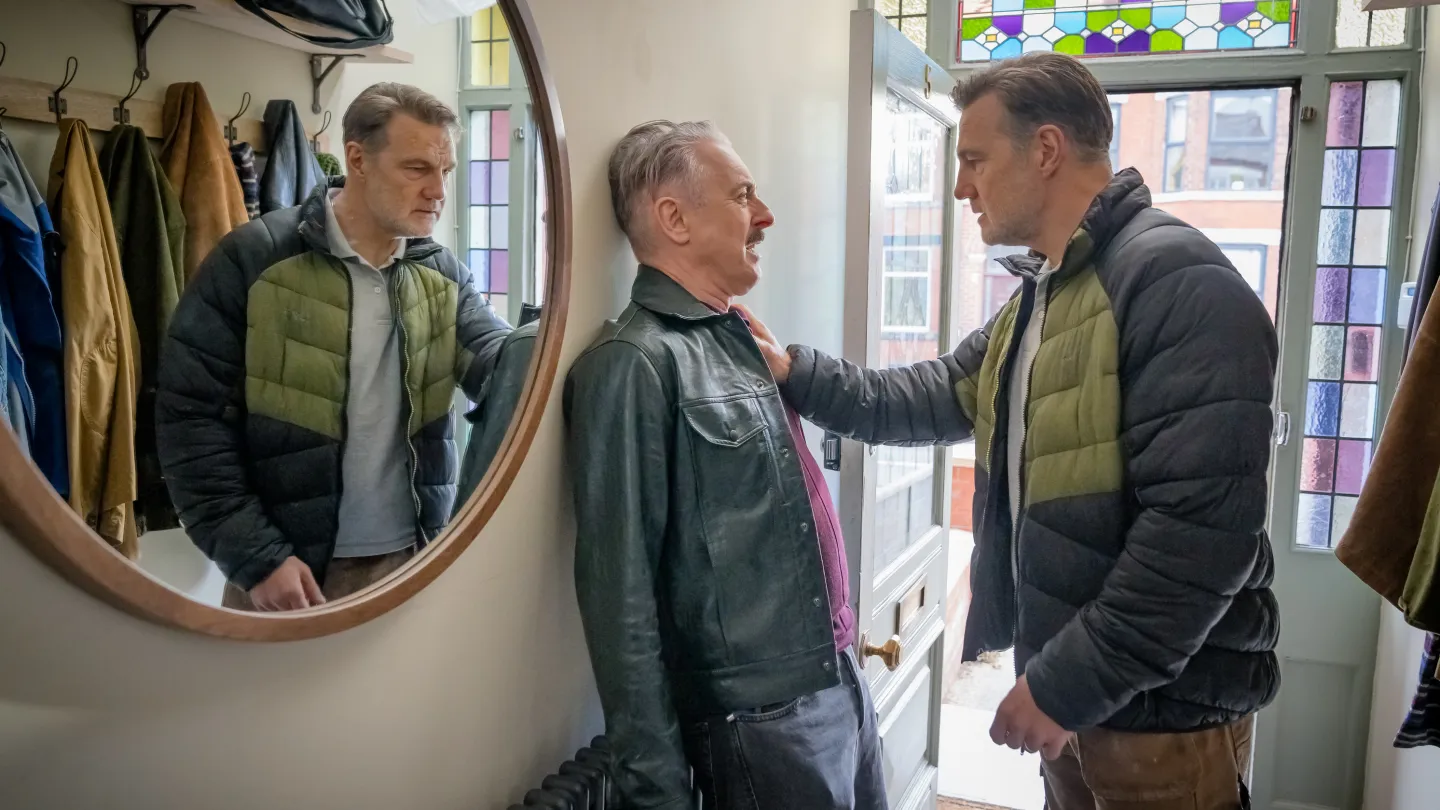
Morrisey’s performance initially seems the less dimensional of the two, operating as it does in a steady thrum of disgust and humiliated pride. He turns out, however, to excel at letting slip notes of vulnerability or curiosity or (most frustratingly) joy, only to forcefully retract them once more under his perma-scowl. It’s Clive who generally comes off as the imposing one in the men’s volatile interactions, more than once pressing Leo against the wall in a fit of wild rage. But it’s Leo who registers as self-assured, while Clive spins out over worst-case scenarios shaped by the ragebait he watches like porn every night.
Tip Toe’s acknowledgement of both Leo’s humanity and Clive’s works not to excuse the cruelty that will claim Leo in the end, but to reaffirm it as a choice. It’s not that Clive lacks for opportunities to see that Leo is a perfectly ordinary fellow who means him and his family no harm. It’s that he actively refuses to believe it — no matter how earnestly Leo explains his good intentions, no matter how little evidence Clive finds of Leo’s ill intent in all his creepy snooping around, no matter even what his own better angels might whisper to him in calmer moments.
As for what might be done about it, Tip Toe does not pretend to have answers. Nor does it pretend that treading softly through what Melba describes as the “merciless” march of history is going to save anyone, either. The series speaks its bitter truth with its whole chest, and makes that its own cathartic kind of power.




Leave a Reply